
Why AI gets the 2026 tax rules wrong
Short answer
AI models are least reliable on rules that changed most recently, and tax year 2026 changed several at once. The charitable deduction gained a 0.5% of AGI floor, a new limitation replaced the repealed Pease limitation, and the Schedule 1-A deductions entered their second year with their own caps and phase-outs. Check any AI answer on those five points before it reaches a return.
- 01Why it fails
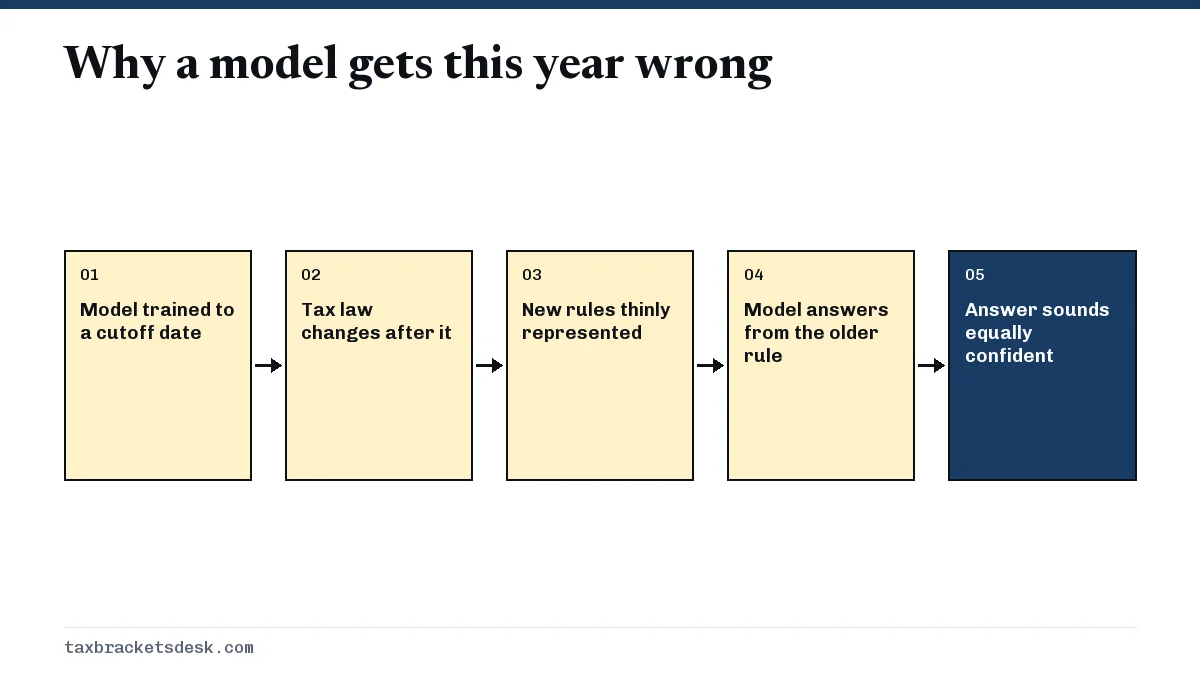
- Training data has a cutoff date; tax rules do not
- 02New for 2026
- 0.5% AGI floor on charitable deductions
- 03Also new for 2026
- Limitation replacing the repealed Pease limitation
- 04Standard deduction 2026
- $32,200 joint, $16,100 single, $24,150 head of household
Is AI tax advice accurate?
It depends entirely on how old the rule is. AI models handle settled tax concepts well, because those concepts appear in millions of pages of training text. They handle this year's rules badly, because those rules were written after the model was trained and are thinly represented if they appear at all.
Tax year 2026 is an unusually bad year for this. Several changes take effect at once, which means an answer that was correct for 2024 or 2025 can be wrong for the return you are about to file.
The five 2026 answers most likely to be wrong
If an AI answer touches any of these, verify it before acting.
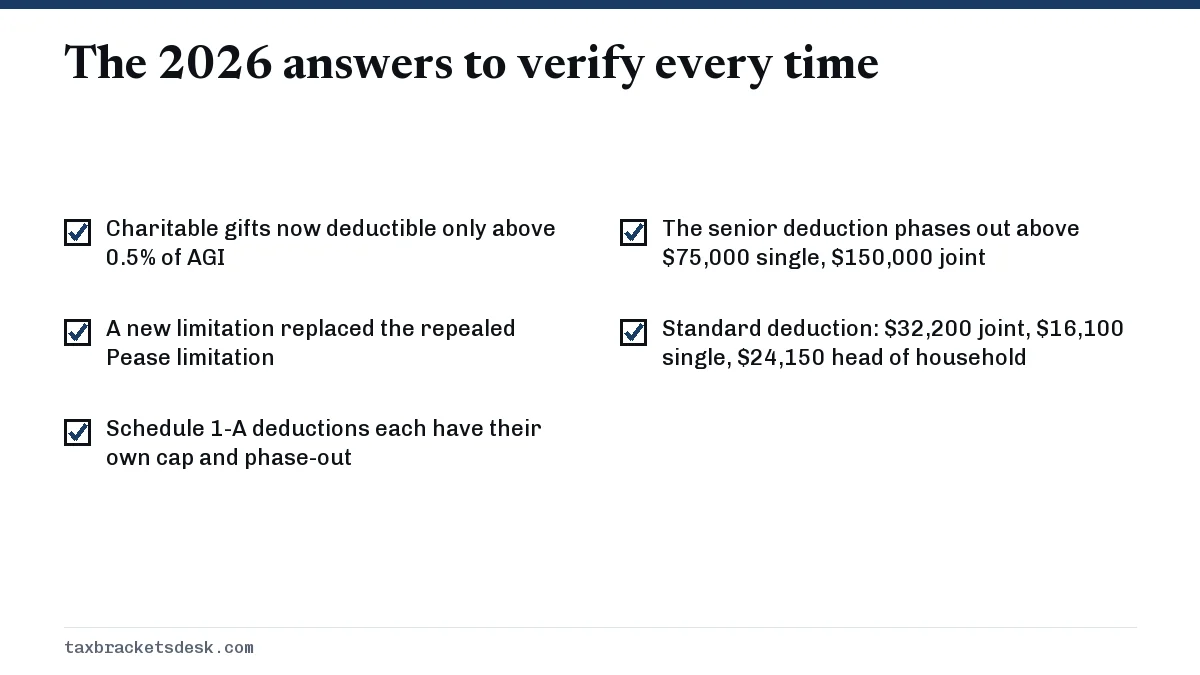
1. The charitable deduction floor
From tax year 2026, itemizers can deduct charitable gifts only to the extent they exceed 0.5% of adjusted gross income. A model trained before this will tell you the first dollar counts. It no longer does. The detail is in charitable deduction limits.
2. The limitation on itemized deductions
The 2025 law permanently repealed the Pease limitation and introduced a different limitation affecting filers in the top bracket from 2026. Models frequently describe the old rule, or describe the repeal without the replacement.
3. The Schedule 1-A deductions
The deductions for qualified tips, overtime, car-loan interest and taxpayers aged 65 and over each carry their own cap, income phase-out and eligibility test. Answers tend to repeat the headline, "no tax on tips", without the limits that decide what you actually get. See Schedule 1-A.
4. The senior deduction phase-out
The $6,000 bonus deduction for those 65 and over begins to phase out above $75,000 of modified AGI for single filers and $150,000 on a joint return. Models often give the headline amount with no phase-out at all.
5. Standard deduction figures
For tax year 2026 the standard deduction is $32,200 for married couples filing jointly, $16,100 for single filers and married filing separately, and $24,150 for heads of household. Anything else is a prior year's figure.
Why the tax year and the filing year get confused
Ask about "2027 taxes" and you may get 2027 figures, 2026 figures, or a mixture, because the question is genuinely ambiguous and models resolve ambiguity by guessing.
| What you mean | How to ask |
|---|---|
| The return you file in early 2027 | Tax year 2026 |
| Income you earn during 2027 | Tax year 2027, filed in 2028 |
| Brackets published in late 2026 | Tax year 2027 brackets |
| Brackets that apply to the return you are filing now | Tax year 2026 brackets |
Always name the tax year rather than the filing year, and the error rate on dated figures falls sharply. Tax changes for 2027 sets out what applies when.
How to test any AI tax answer in two minutes
- Ask which form, schedule or IRS publication the answer comes from.
- Ask what tax year the figure applies to, and make it say the year out loud.
- Open the IRS page for that form and year yourself.
- Find the specific number. If it is not there, discard the answer rather than arguing with the model.
- If the answer involves a phase-out, check the threshold separately, because that is the part most often dropped.
Where AI is still useful on brackets and deductions
The concepts, not the figures. Marginal against effective rates, how a phase-out works arithmetically, why a raise cannot cost you more than it pays, what adjusted gross income is and why so much depends on it: these are stable ideas that models explain well.
The rule that follows is simple enough to remember. Use AI for how the system works, and an official table for what the number is. The numbers live on federal tax brackets and the IRS inflation adjustment releases, and they do not change because a model states them confidently.
Common questions
Is AI tax advice accurate?
It is reasonably accurate on settled concepts and unreliable on recent rules. Tax year 2026 changed several rules at once, so answers about the charitable deduction floor, the new itemized limitation and the Schedule 1-A deductions need checking against IRS sources.
Does ChatGPT know the 2026 tax brackets?
It may state figures confidently and still give a prior year's. Confirm any bracket or standard deduction figure against the IRS inflation adjustment release for the tax year you are filing.
What is the standard deduction for 2026?
$32,200 for married couples filing jointly, $16,100 for single filers and married filing separately, and $24,150 for heads of household.
Why does AI miss the charitable deduction floor?
Because it is new for tax year 2026. Itemizers can now deduct charitable gifts only above 0.5% of adjusted gross income, and a model trained before that change will describe the old rule.
How do I stop AI mixing up tax years?
Name the tax year rather than the filing year. Say "tax year 2026" rather than "this year's taxes", and ask the model to repeat which year its figures apply to.
Sources
- IRS releases tax inflation adjustments for tax year 2026 irs.gov
- Preparing for 2026: how OBBBA reshapes itemized deductions (PKF O'Connor Davies) pkfod.com
- 2026 tax filing season: tax law and IRS changes (NTU Foundation) ntu.org
- What AI gets right, and very wrong, about taxes (NerdWallet) nerdwallet.com
We check figures against these official pages. Rules change; confirm anything that affects a deadline or payment with the agency before you act.
Tell us what happened
Describe your situation and our editors will use it to improve this guide. If you leave your email, we may reply with a pointer to the right page or official contact. We never share your details.