
Topic
State income tax rates by state: how the largest states compare
State income tax rates run from zero in nine states to a 12.3% top bracket in California, plus a 1% surcharge on taxable income over $1 million. Most large states use graduated brackets; Illinois (4.95%), Pennsylvania (3.07%) and North Carolina (3.99% for 2026) charge one flat rate. Your state of residence taxes all of your income, wherever you earned it.
12 guides in this topic Updated September 19, 2026
- California Tax Brackets 2026: Rates and ThresholdsCalifornia tax brackets run from 1% to 12.3% across nine brackets, and taxable income over $1 million pays an extra 1% Behavioral Health Services Tax…
- Georgia Income Tax Rate: The Flat Tax and Recent Rate CutsThe Georgia income tax rate is a flat 4.99% for tax year 2026, down from 5.19% for 2025, under House Bill 463 signed on May 11, 2026. The same law ra…
- Illinois Income Tax Rate: The Flat 4.95% Rate ExplainedThe Illinois income tax rate is a flat 4.95% of net income, the rate in effect since July 1, 2017, according to the Illinois Department of Revenue. E…
- Massachusetts Income Tax Rate and the 4% Millionaires SurtaxThe Massachusetts income tax rate is 5.0% on wages, long-term capital gains and most other income, and 8.5% on short-term capital gains, according to…
- Michigan Income Tax Rate: State Rate and City Income TaxesThe Michigan income tax rate is a flat 4.25% for tax year 2026, the Michigan Department of Treasury confirmed on April 15, 2026, because general fund…
- New Jersey Income Tax Rates and Brackets for 2026 ReturnsNew Jersey income tax rates run from 1.4% to 10.75%. Single filers have seven brackets and joint filers and heads of household have eight, with the t…
- New York Income Tax Rates 2026: State and NYC BracketsThe New York income tax rate for 2026 ranges from 3.9% to 10.9% across nine state brackets, after a 2025 law cut the five lowest rates by 0.1 point.…
- North Carolina Income Tax Rate 2026: 3.99% and 2027 OutlookThe North Carolina income tax rate is a flat 3.99% for tax years beginning after 2025, down from 4.25% in 2025 and 4.5% in 2024, according to the NC…
- Ohio Income Tax Rate 2026: Flat 2.75% Over $26,050Ohio income tax rates for 2026 are 0% on the first $26,050 of taxable nonbusiness income and a flat 2.75% above it, after House Bill 96 removed the 3…
- Pennsylvania Income Tax: Flat Rate and Local TaxesPennsylvania income tax is a flat 3.07% of taxable income, with no standard deduction and no personal exemption, according to the Pennsylvania Depart…
- States With No Income Tax: The Full List and What to KnowNine states have no income tax on wages for 2026: Alaska, Florida, Nevada, New Hampshire, South Dakota, Tennessee, Texas, Washington and Wyoming. New…
- Virginia Income Tax Rate: Brackets and Deductions ExplainedThe Virginia income tax rate runs from 2% to 5.75%, and the top 5.75% rate applies to all Virginia taxable income over $17,000, for every filing stat…
What are state income tax rates?
A state income tax is a tax your state charges on your income, separate from the federal income tax, and reported on a separate state return such as California Form 540, New York Form IT-201, Form NJ-1040, Form IL-1040 or the Pennsylvania PA-40. State income tax rates are the percentages applied to your state taxable income, and each state sets its own rates, brackets, deductions and credits.
The spread is wide. Nine states do not tax wages at all, three of the largest states tax every dollar at one flat rate, and the high-tax coastal states use graduated state tax brackets that climb above 10% for very high incomes. The rest of this page compares the largest states and links to a full page for each one.
Read the video transcript
State income tax rates by state: how the largest states compare
State income tax rates run from zero in nine states to a 12.3% top bracket in California, plus a 1% surcharge on taxable income over $1 million.
States with no wage income tax: 9 (AK, FL, NV, NH, SD, TN, TX, WA, WY).
Highest top rate among large states: California 12.3% + 1% over $1 million.
New York top rate (2026): 10.9% over $25 million, plus NYC tax for city residents.
The table below shows the latest schedules each state has published as of September 2026.
A flat-rate state applies one percentage to all taxable income. Illinois charges 4.95% of net income, a rate in effect since July 1, 2017, according to the Illinois Department of Revenue.
Nine states do not tax wages: Alaska, Florida, Nevada, New Hampshire, South Dakota, Tennessee, Texas, Washington and Wyoming.
State income tax by state: rates for the largest states
The table below shows the latest schedules each state has published as of September 2026. California has not yet posted its inflation-indexed 2026 schedules, so its figures are the 2025 schedules used on returns filed in 2026. New York's 2026 rates come from the 2026 Form IT-2105 instructions.
| State | Structure | Lowest rate | Top rate and where it starts (single) |
|---|---|---|---|
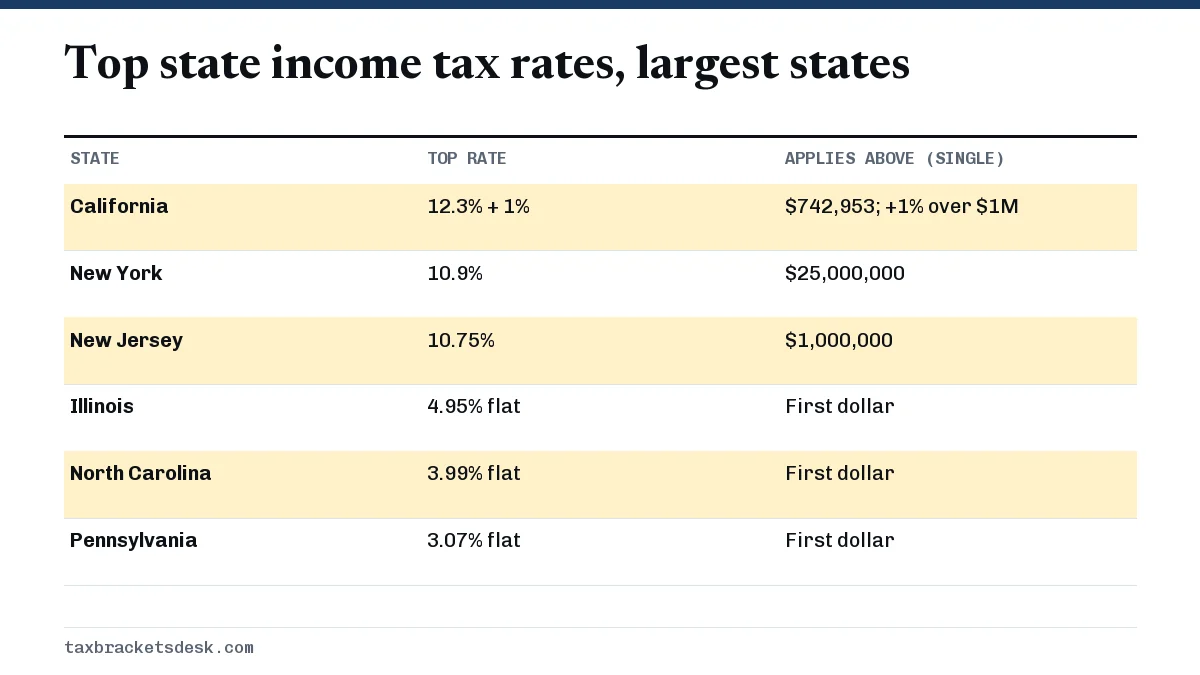
| California | 9 brackets | 1% | 12.3% over $742,953 (2025), plus 1% on taxable income over $1 million |
| New York | 9 brackets | 3.9% (2026) | 10.9% over $25,000,000; NYC residents add 3.078% to 3.876% |
| New Jersey | 7 brackets | 1.4% | 10.75% over $1,000,000 |
| Illinois | Flat | 4.95% | 4.95% on all net income |
| Pennsylvania | Flat | 3.07% | 3.07%, plus local earned income tax |
| North Carolina | Flat | 3.99% (2026) | 3.99% on all taxable income |
| Texas, Florida and 7 others | None on wages | 0% | 0% (Washington taxes large capital gains) |
Each state has its own page with the full bracket tables and a worked example: California tax brackets, New York income tax rates, New Jersey income tax rates, the flat Illinois income tax rate and Pennsylvania income tax with its local wage taxes.
Flat vs graduated state tax brackets
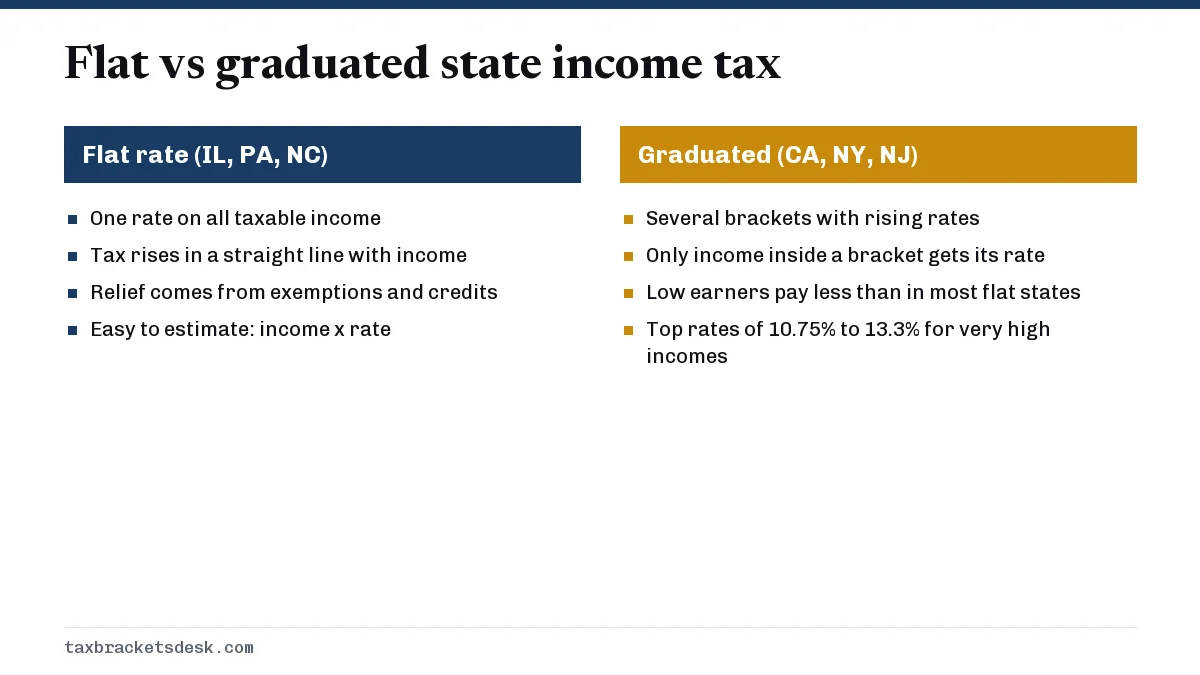
A flat-rate state applies one percentage to all taxable income. Illinois charges 4.95% of net income, a rate in effect since July 1, 2017, according to the Illinois Department of Revenue. Pennsylvania charges 3.07% and gives no standard deduction or personal exemption at all. North Carolina's rate fell to 3.99% for tax years beginning after 2025.
A graduated state works like the federal system: each slice of income is taxed at the rate for its bracket, so moving into a higher bracket raises the tax only on the dollars inside it. Our guide to how tax brackets work walks through that math with federal numbers, and the same logic applies to state tax brackets.
Two graduated states with unusual mechanics
- New York recaptures the low brackets. Once New York adjusted gross income passes $107,650, filers must use the tax computation worksheets in the IT-201 instructions, which gradually take back the benefit of the lower rates. High earners end up paying close to their top rate on every dollar.
- New Jersey uses a subtraction method. The NJ-1040 rate schedules multiply all taxable income by your bracket rate and then subtract a fixed amount. For a single filer with $60,000 of taxable income the tax is $60,000 x 5.525% minus $1,492.50, or $1,822.50.
Which states have the highest income tax?
By top rate, California is highest among the large states: 12.3% on the top bracket plus the 1% Behavioral Health Services Tax on taxable income over $1 million, for 13.3% at the very top. New York's top state rate is 10.9% on income over $25 million, and New York City residents add up to 3.876%. New Jersey's top rate is 10.75% on income over $1 million.
Top rates only reach very high earners, though. For a single person with $75,000 of wages, no dependents and the state's standard deduction or exemption, the ranking changes. The figures below use each state's latest published schedule; they ignore credits other than California's $153 personal exemption credit, and they leave out local taxes.
| State | Taxable income | State tax | Basis |
|---|---|---|---|
| Illinois | $72,150 ($2,850 exemption) | $3,571 | 4.95% flat, 2025 exemption |
| New York | $67,000 ($8,000 standard deduction) | $3,453 | 2026 schedule, plus NYC tax of $2,472 for city residents |
| California | $69,294 ($5,706 standard deduction) | about $2,775 | 2025 schedule less $153 credit |
| New Jersey | $74,000 ($1,000 exemption) | $2,596 | Schedule in use since 2020 |
| Pennsylvania | $75,000 (no deduction) | $2,303 | 3.07% flat, before local earned income tax |
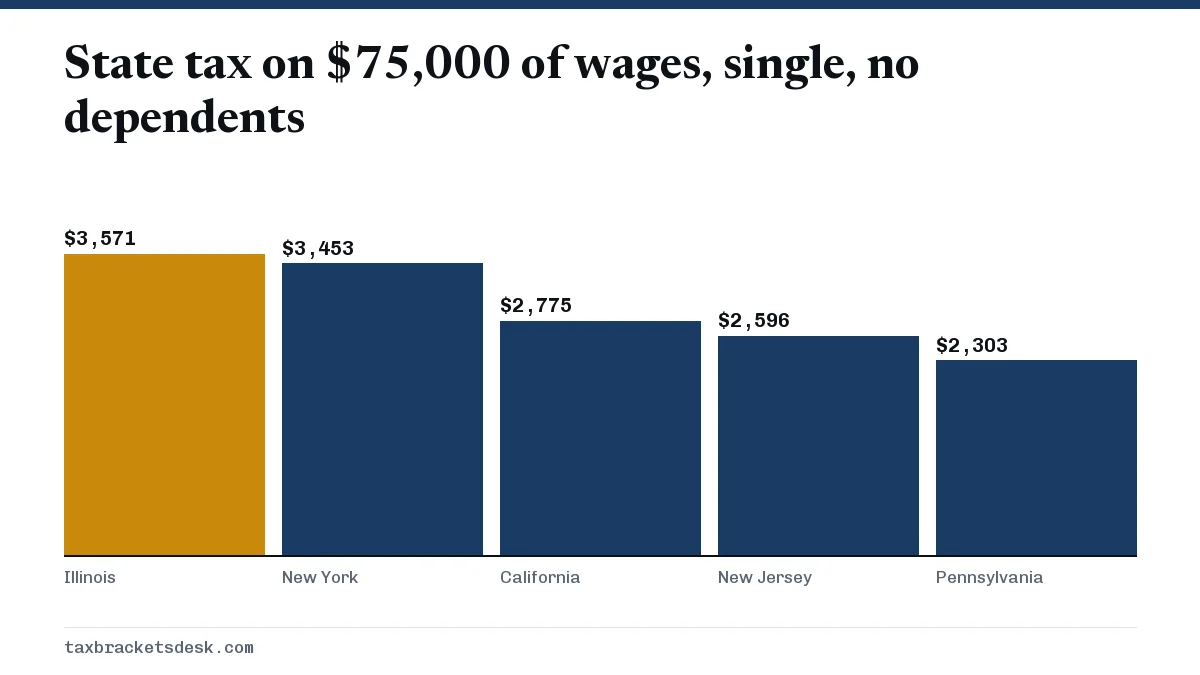
At this income a flat-rate state, Illinois, takes more than California, because California's 1% to 8% brackets cover most of the income while Illinois applies 4.95% from the first dollar. That is why the effective tax rate, tax divided by income, is a better comparison than the headline top rate.
Which states have no income tax?
Nine states do not tax wages: Alaska, Florida, Nevada, New Hampshire, South Dakota, Tennessee, Texas, Washington and Wyoming. New Hampshire's tax on interest and dividends was repealed for tax periods beginning on or after January 1, 2025, and Tennessee's Hall income tax ended for tax years beginning January 1, 2021. Washington still taxes long-term capital gains above a standard deduction ($278,000 for 2025) at 7%, and at 9.9% on the part above $1 million.
The full list, the taxes these states lean on instead, and the residency rules for people moving there are on our page about states with no income tax.
Do states use federal taxable income?
Most states start from a federal figure and then adjust it, but they rarely use federal taxable income as is. New York and Illinois start from federal adjusted gross income (AGI). California also starts from federal AGI and records its differences on Schedule CA (540). New Jersey and Pennsylvania do not start from federal AGI at all: each has its own list of income categories, and losses in one category cannot offset gains in another.
State deductions are usually far smaller than the federal standard deduction for 2026 of $16,100 for a single filer. California's 2025 standard deduction is $5,706 single and $11,412 joint, New York's is $8,000 single and $16,050 joint, and Illinois and New Jersey rely on per-person exemptions instead. As a result, your state taxable income is often higher than your federal taxable income.
Do I pay state tax where I work or where I live?
Often both, with a credit that prevents full double tax. Your state of residence taxes all of your income from everywhere. A state where you work but do not live can tax the wages you earned there as a nonresident. Your home state then gives a credit for tax paid to the other state, for example on Illinois Schedule CR or through New Jersey's credit for taxes paid to other jurisdictions.
Reciprocal agreements remove the double filing for some neighbors. Illinois has agreements with Iowa, Kentucky, Michigan and Wisconsin, so residents of those states who work in Illinois are taxed only at home on their wages. New Jersey and Pennsylvania have a Reciprocal Personal Income Tax Agreement covering compensation, although it does not cover the Philadelphia Wage Tax.
- Confirm your state of residence on December 31 and whether you moved during the year; a move usually means two part-year returns.
- Check whether your work state has a reciprocal agreement with your home state. If it does, give your employer the exemption certificate, such as Pennsylvania Form REV-419 or New Jersey Form NJ-165.
- If there is no agreement, file the nonresident return in the work state first, because the tax on it sets the credit you claim at home.
- Claim the other-state credit on your resident return and attach a copy of the nonresident return if the form asks for it.
- Adjust state withholding on your employer's state form so the right state gets the money during the year.
How state income tax affects your federal return
State income tax withheld or paid can be deducted on the federal Schedule A, but only if you itemize and only within the state and local tax (SALT) cap. For tax year 2026 the cap is $40,400 ($20,200 married filing separately), reduced once modified AGI passes $505,000 but never below $10,000. The SALT deduction cap page shows the phase-down math.
Residents of no-income-tax states can elect to deduct general sales tax instead of income tax. And if you itemized last year and received a state refund, part of that refund may be taxable on your federal return; your state reports it on Form 1099-G.
When are 2026 state tax brackets published?
States publish on different schedules. As of September 2026, New York has already printed its 2026 rates in the Form IT-2105 estimated tax instructions, reflecting the rate cut enacted in 2025. California indexes its brackets to inflation each year, but the Franchise Tax Board had not posted 2026 rate schedules on its site as of September 2026. New Jersey's rate schedule has been the same since 2020, and Illinois, Pennsylvania and North Carolina set a single rate in law.
Federal 2027 brackets are a separate question: the IRS has not announced them yet and normally releases them in October or November. Until then, 2026 federal brackets are the latest official figures.
Common questions
What state has the highest income tax rate?
California has the highest top rate: 12.3% on its top bracket plus a 1% Behavioral Health Services Tax on taxable income over $1 million, or 13.3% in total. New York's top state rate is 10.9%, and New York City residents pay city tax on top of that.
Which states have a flat income tax?
Among the largest states, Illinois (4.95%), Pennsylvania (3.07%) and North Carolina (3.99% for 2026) tax all income at one rate. A flat rate still has exemptions or credits in some states, so the effective rate can be lower than the headline rate.
Is state income tax based on gross or taxable income?
It is based on state taxable income, which each state defines. Most states begin with federal adjusted gross income and then subtract state deductions or exemptions, while New Jersey and Pennsylvania build income from their own categories.
Do I have to file a state return if I work remotely for a company in another state?
You always file in your home state. You generally owe the employer's state only if you physically work there, but some states have their own sourcing rules for remote work, so check the nonresident instructions for your employer's state.
Can I deduct state income tax on my federal return?
Yes, if you itemize on Schedule A. State and local income tax, plus property tax, share a $40,400 cap for tax year 2026, and the cap shrinks for modified AGI above $505,000.
Sources
- Illinois Department of Revenue, Income tax rates
- North Carolina Department of Revenue, Tax rate schedules
- California Franchise Tax Board, 2025 California tax rate schedules
- New York State, Instructions for Form IT-2105 (2026)
- New Jersey Division of Taxation, Tax rate schedules
- IRS Publication 505 (2026), state and local tax deduction