
Topic
How is taxable income calculated? From gross income to the taxed amount
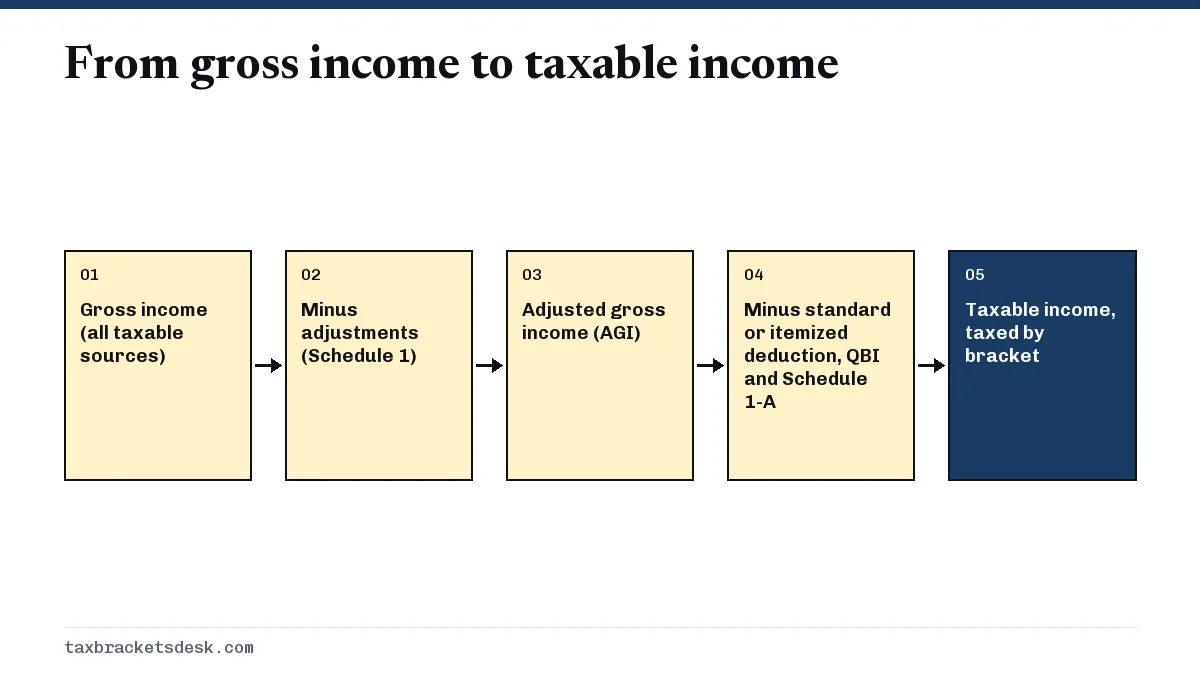
Taxable income is calculated in three steps: add up all gross income that is not excluded by law, subtract adjustments such as deductible IRA and HSA contributions to reach adjusted gross income (AGI), then subtract the standard or itemized deduction and other allowed deductions. For 2026 the standard deduction is $16,100 single and $32,200 married filing jointly. The brackets apply only to what is left.
4 guides in this topic Updated October 20, 2026
- Gambling Winnings Tax: Rates, Forms and 2026 ChangesGambling winnings tax is ordinary federal income tax at your bracket rate, from 10% to 37%, on every dollar you win, whether or not you get a Form W-…
- Kiddie Tax 2026: Thresholds, Rules and How It Is FiguredThe kiddie tax makes a child's unearned income above $2,700 taxable at the parent's marginal rate instead of the child's lower rate for tax year 2026…
- Tax on 401(k) Withdrawal: How Much You Will Owe and WhyThe tax on a 401(k) withdrawal is ordinary federal income tax at your normal bracket rates, because pre-tax money was never taxed going in. Most lump…
- Tax on Social Security Benefits: 50% and 85% RulesFederal tax on Social Security benefits applies only when your other income plus half of your benefits is more than $25,000 (single or head of househ…

How is taxable income calculated, in one formula?
Taxable income is calculated as gross income minus adjustments, which gives adjusted gross income (AGI), minus deductions. Taxable income is the dollar figure the federal brackets are applied to, and for most households it is far lower than salary because of the standard deduction and pre-tax payroll contributions.
The whole calculation happens on Form 1040, U.S. Individual Income Tax Return. Extra income and adjustments come from Schedule 1, the four new deductions for tips, overtime, car loan interest and seniors come from Schedule 1-A, and itemized deductions come from Schedule A. The sections below walk through each stage with 2026 figures from Revenue Procedure 2025-32, which apply to returns filed in 2027.
Step 1: What counts as gross income?
Gross income is all income you receive in money, goods, property or services that the tax code does not specifically exclude (IRS Publication 525). It is broader than a paycheck. The table shows the most common sources and where each one is reported.
| Income type | Information form you receive | Taxed as |
|---|---|---|
| Wages, salary, bonuses, taxable tips | Form W-2 | Ordinary income |
| Interest from banks and bonds | Form 1099-INT | Ordinary income |
| Dividends and fund distributions | Form 1099-DIV | Ordinary or qualified dividend rates |
| Sale of stock or property | Form 1099-B, Form 8949 | Short-term or long-term capital gain |
| 401(k), IRA and pension payouts | Form 1099-R | Ordinary income (Roth rules differ) |
| Social Security benefits | Form SSA-1099 | 0% to 85% of benefits included |
| Freelance and gig work | Form 1099-NEC or 1099-K | Ordinary income plus self-employment tax |
| Gambling and lottery winnings | Form W-2G (above thresholds) | Ordinary income |
Wages reported in box 1 of Form W-2 are already reduced by traditional 401(k) deferrals, pre-tax health premiums and health FSA contributions (the 2026 health FSA limit is $3,400). That is why box 1 is often several thousand dollars lower than your gross pay on the final pay stub.
Step 2: How do adjustments turn gross income into adjusted gross income?
Adjusted gross income is gross income minus a short list of adjustments reported on Schedule 1, Part II. You can claim these whether or not you itemize, and they matter twice: they cut taxable income and they lower AGI, which is the figure many credits and phaseouts are tested against.
- Deductible contributions to a traditional IRA.
- Health savings account (HSA) contributions made outside payroll.
- The deductible half of self-employment tax, plus self-employed health insurance and retirement plan contributions.
- Student loan interest, up to $2,500 for 2026, phasing out between $85,000 and $100,000 of modified AGI ($175,000 to $205,000 joint).
- Educator expenses, up to $350 for 2026.
- Alimony paid under a divorce or separation agreement signed before 2019.
AGI is also the starting point for the taxable part of Social Security, the 7.5% floor on medical expenses and the new 0.5% floor on itemized charitable gifts. For retirees this is where a single large IRA or 401(k) payout can pull more Social Security into income, as the special-income section below explains.
Step 3: Which deductions are subtracted from AGI to reach taxable income?
After AGI, you subtract either the standard deduction or your itemized deductions, whichever is larger, and then any deductions that are allowed on top of that choice. The result, if above zero, is taxable income.
| Filing status | Standard deduction | Extra if 65+ or blind, each |
|---|---|---|
| Single | $16,100 | $2,050 |
| Married filing jointly | $32,200 | $1,650 |
| Head of household | $24,150 | $2,050 |
| Married filing separately | $16,100 | $1,650 |
Itemizing on Schedule A only helps if state and local taxes, mortgage interest, charitable gifts and large medical bills add up to more than the standard amount; see whether to itemize or take the standard deduction. The full list of 2026 amounts, including the dependent rule, is on our 2026 standard deduction page.
Deductions allowed on top of the standard deduction
Three kinds of deductions reduce taxable income without requiring you to itemize. The qualified business income deduction for owners of pass-through businesses is one. The four temporary deductions from the 2025 law are the others, claimed on Schedule 1-A: up to $25,000 of qualified tips, up to $12,500 of qualified overtime premium ($25,000 joint), up to $10,000 of new-car loan interest, and $6,000 per person age 65 or older. Each phases out at higher income. From 2026, non-itemizers can also deduct cash gifts to charity up to $1,000 ($2,000 joint).
How is tax calculated on salary once you know taxable income?
Tax on salary is calculated by running taxable income, not salary, through the brackets for your filing status. Each rate applies only to the slice of income inside its band, so moving into a higher bracket never makes your whole income taxed at the higher rate. The 2026 IRS tax brackets list every band.
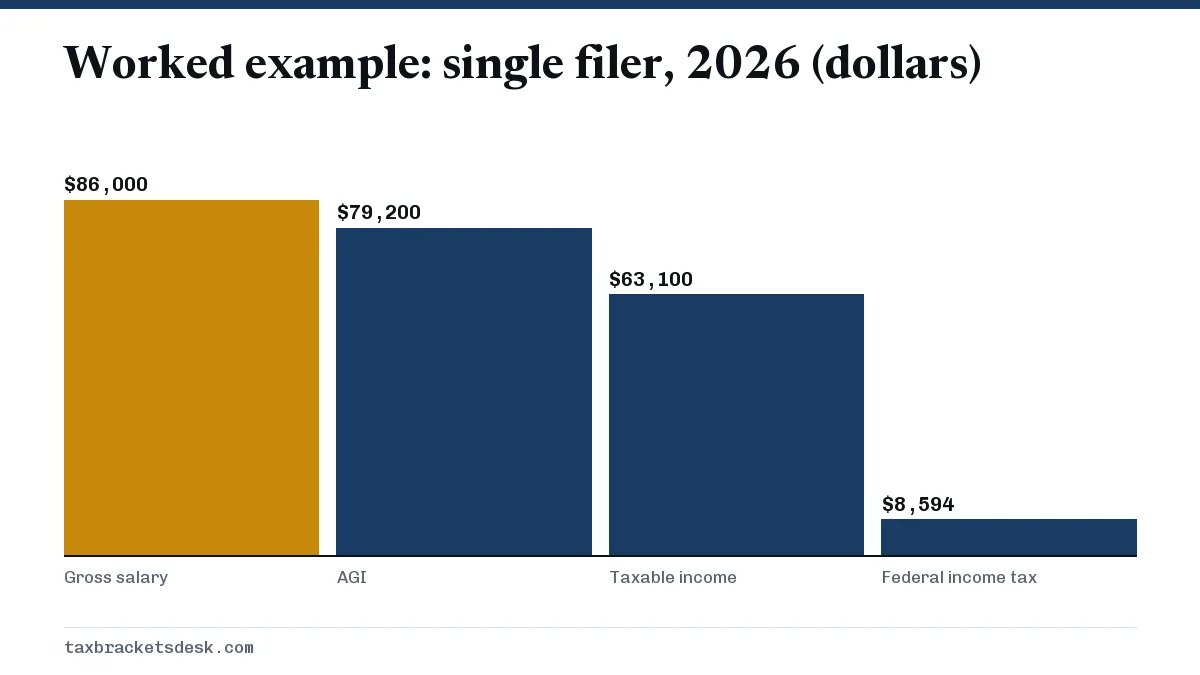
Worked example: single filer, 2026
| Line | Amount | How it is figured |
|---|---|---|
| Gross salary | $86,000 | Before any payroll deductions |
| Traditional 401(k) deferral | -$6,000 | Excluded from W-2 box 1 |
| W-2 box 1 wages | $80,000 | Reported as wages |
| Bank interest | +$1,200 | Form 1099-INT |
| Student loan interest adjustment | -$2,000 | Schedule 1, Part II |
| Adjusted gross income | $79,200 | Total income minus adjustments |
| Standard deduction | -$16,100 | Single, 2026 |
| Taxable income | $63,100 | Amount the brackets apply to |
| Federal income tax | $8,594 | $5,800 on the first $50,400 plus 22% of $12,700 |
The $8,594 is 10% of the first $12,400 ($1,240), 12% of the next $38,000 ($4,560) and 22% of the last $12,700 ($2,794). That is an effective rate of about 10% of the $86,000 salary, even though the top slice is taxed at 22%. Credits such as the Child Tax Credit would be subtracted from this tax, not from income.
What is the difference between AGI and taxable income?
AGI is income after adjustments but before the standard or itemized deduction; taxable income is what remains after those deductions. In the example above AGI is $79,200 and taxable income is $63,100, a $16,100 gap equal to the single standard deduction.
The two numbers do different jobs. AGI, or a modified version of it, decides eligibility for items like the student loan interest deduction, the senior deduction phaseout above $75,000 ($150,000 joint) and the taxable share of Social Security. Taxable income decides your bracket and the tax itself, including whether long-term capital gains fall in the 0% band, which for 2026 ends at $49,450 of taxable income for single filers.
What income is not taxable?
Some receipts are left out of gross income entirely, so they never reach AGI. IRS Publication 525 lists the main exclusions. The most common for households are below.
- Gifts and inheritances you receive (the giver or estate handles any gift or estate tax; income the property later earns is taxable).
- Life insurance death benefits paid because of the insured person's death.
- Child support payments.
- Interest on most state and local government bonds, for federal tax purposes.
- Qualified distributions from a Roth IRA or Roth 401(k).
- Gain on selling your main home up to $250,000 ($500,000 joint) if you owned and lived in it for 2 of the last 5 years.
- Scholarships used for tuition and required course fees by a degree candidate.
How are special types of income taxed?
A few kinds of income follow their own rules before they land in gross income. Each has a dedicated page in this section.
- Social Security: between 0% and 85% of benefits are included, based on your other income plus half your benefits. See how Social Security benefits are taxed.
- 401(k) withdrawals: fully taxable as ordinary income unless from Roth money, with 20% withheld on many payouts and a possible 10% additional tax before age 59 and a half. See tax on a 401(k) withdrawal.
- Gambling and lottery prizes: fully taxable, with losses deductible only by itemizers and, from 2026, capped at 90% of losses. See gambling winnings tax.
- A child's investment income: above $2,700 in 2026 it can be taxed at the parent's rate. See the kiddie tax rules.
How to calculate your own taxable income
You can estimate taxable income in about ten minutes with last year's return or this year's pay stubs. Follow the order below; skipping ahead to the brackets is the most common reason estimates come out too high.
- Add every income source: W-2 box 1 wages, 1099 interest and dividends, net business profit, the taxable part of retirement payouts and benefits, and any other income.
- Subtract Schedule 1 adjustments you qualify for to get AGI.
- Subtract the larger of your standard deduction or itemized total.
- Subtract any qualified business income deduction and Schedule 1-A deductions you qualify for.
- If the result is below zero, taxable income is zero. Otherwise, apply the brackets for your filing status.
- Subtract credits from the tax, then compare with withholding and estimated payments to see your refund or balance due.
Common questions
Is taxable income the same as gross income?
No. Gross income is everything you received that is not excluded by law. Taxable income is what is left after adjustments and deductions, and for a single filer taking the 2026 standard deduction it is at least $16,100 lower than AGI.
Does a 401(k) contribution reduce taxable income?
Yes, for traditional pre-tax deferrals. They are left out of W-2 box 1 wages, so they never enter gross income. Roth 401(k) contributions do not reduce taxable income now, but qualified withdrawals later are tax free.
Can taxable income be zero?
Yes. If deductions equal or exceed AGI, taxable income is zero and no regular income tax is owed. You may still owe self-employment tax or other taxes that are not based on taxable income.
Is taxable income calculated before or after the standard deduction?
After. The standard deduction is subtracted from AGI, and the result is taxable income. The brackets are then applied to that lower figure.
Where is taxable income on my tax return?
It is the line on Form 1040 that follows the deduction lines and is labeled taxable income, right before the tax computation. Your W-2 does not show it, because the W-2 reports wages, not deductions.