
Topic
FICA tax explained: 2026 rates, the wage cap and who pays what
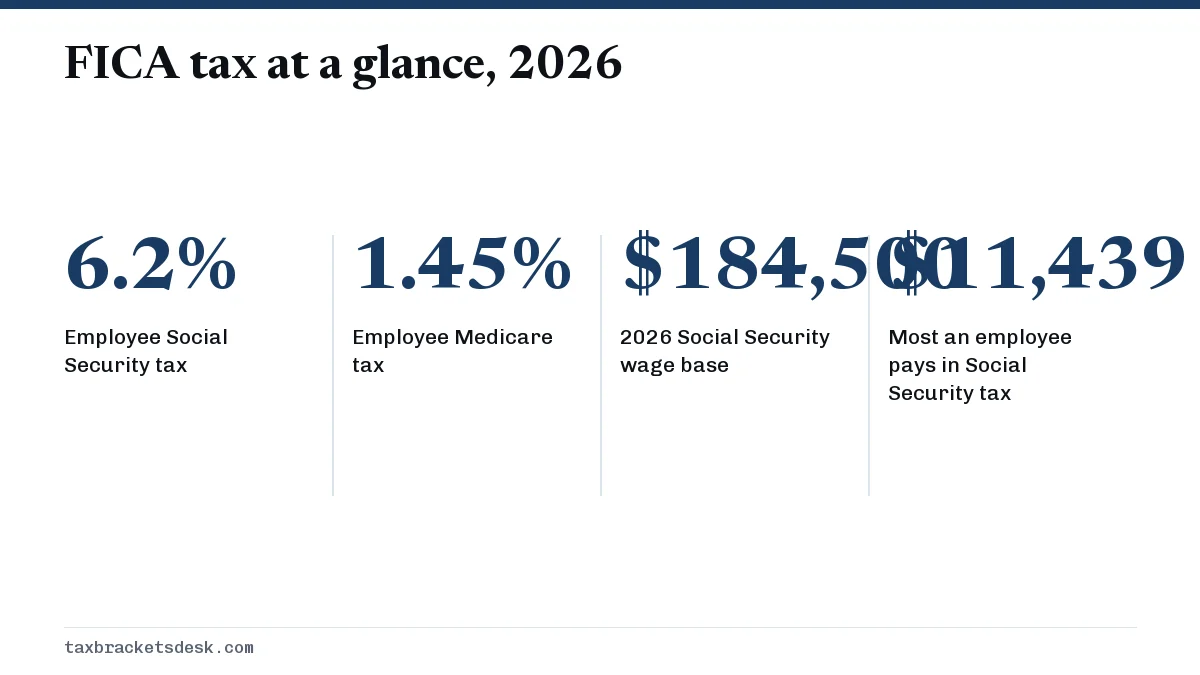
FICA tax is the 7.65% payroll tax taken from an employee's wages in 2026: 6.2% for Social Security on the first $184,500 of pay and 1.45% for Medicare on every dollar, with your employer paying a matching 7.65%. Earnings above $200,000 also carry a 0.9% Additional Medicare Tax that the employer does not match.
8 guides in this topic Updated October 20, 2026
- Additional Medicare Tax: 0.9% Over $200,000 ExplainedAdditional Medicare Tax is a 0.9% tax on Medicare wages and self-employment income above $200,000 for single and head of household filers, $250,000 f…
- Bonus Tax Rate 2026: 22% Federal Withholding ExplainedThe federal bonus tax rate for 2026 is a flat 22% income tax withholding rate that employers may use on bonuses paid separately from regular pay, ris…
- Medicare Tax Rate 2026: 1.45% Rate With No Wage Base CapThe Medicare tax rate for 2026 is 1.45% of all wages for the employee, matched by another 1.45% from the employer, for 2.9% in total. Self-employed p…
- Self-Employment Tax Calculator for 2026: Estimate SE TaxThis self-employment tax calculator estimates 2026 Schedule SE tax by taking 92.35% of your net profit and applying 12.4% up to the $184,500 Social S…
- Self-Employment Tax: 15.3% Rate and How to Figure ItSelf-employment tax is 15.3% (12.4% Social Security plus 2.9% Medicare) charged on 92.35% of your net earnings from self-employment, and you owe it o…
- Social Security Tax 2026: 6.2% Rate Up to the $184,500 CapSocial Security tax is 6.2% of an employee's wages up to the 2026 wage base of $184,500, which makes the maximum employee tax $11,439 for the year. E…
- Social Security Wage Base 2027: $192,300 Official LimitThe Social Security wage base for 2027 is $192,300, up from $184,500 in 2026. The Social Security Administration announced it on October 14, 2026, to…
- W-4 Withholding: How to Fill Out the Form W-4 for 2026W-4 withholding is the federal income tax your employer takes from each paycheck based on the Form W-4 you give it. The 2026 Form W-4 has five steps:…

What is FICA tax?
FICA tax is the federal payroll tax that funds Social Security and Medicare, withheld from almost every paycheck in the United States. The name comes from the Federal Insurance Contributions Act, the law that imposes it, which is the short answer to the common search for FICA meaning.
FICA has two parts. The Social Security part (sometimes labeled OASDI on pay stubs) pays retirement, disability and survivor benefits. The Medicare part (often shown as "Med" or "HI") pays for hospital insurance. Both are separate from federal income tax, and both are charged on your first dollar of wages with no standard deduction and no brackets.
Because FICA is flat, it hits lower earners at the same percentage as middle earners. That is the main reason people call it a payroll tax rather than an income tax: it is figured on gross wages each pay period, not on taxable income once a year.
What is the FICA tax rate for 2026?
The 2026 FICA tax rate for employees is 7.65% of wages: 6.2% for Social Security and 1.45% for Medicare, according to IRS Topic 751. Your employer pays another 7.65%, so the combined rate on a paycheck is 15.3%.
| Tax | Employee | Employer | Wage limit |
|---|---|---|---|
| Social Security | 6.2% | 6.2% | First $184,500 of wages |
| Medicare | 1.45% | 1.45% | No limit |
| Additional Medicare Tax | 0.9% | None | Withheld on wages over $200,000 |
| Total on typical wages | 7.65% | 7.65% | 15.3% combined |
These percentages are set in the tax code and have not changed for many years. What changes each year is the Social Security wage base, the dollar ceiling for the 6.2% part. For 2026 it is $184,500, up from $176,100 in 2025 (IRS Publication 15).
Is there a cap on FICA?
Only half of FICA has a cap. Social Security tax stops once your wages from one employer reach $184,500 in 2026, so the most an employee can pay is $11,439. Medicare tax has no ceiling and applies to every dollar you earn.
The cap works per employer for withholding purposes but per person for the final tax. If two jobs together push you past $184,500, each employer keeps withholding, and you claim the overpayment back on your return. Our page on Social Security tax and the wage base shows the math and the exact form to use.
The 2027 wage base is $192,300, announced by the Social Security Administration on October 14, 2026 with the cost-of-living adjustment. For wages paid in 2027 the maximum employee Social Security tax is therefore $11,922.60, and the employer pays the same; the 2027 Social Security wage base page shows how it was set.
How much FICA tax comes out of a paycheck?
Multiply gross wages by 7.65% until you pass the wage base, then by 1.45% alone. The table below shows full-year 2026 amounts for a single employee with one job and no pre-tax cafeteria plan deductions.
| Annual wages | Social Security (6.2%) | Medicare (1.45% + 0.9%) | Total employee FICA |
|---|---|---|---|
| $40,000 | $2,480 | $580 | $3,060 |
| $60,000 | $3,720 | $870 | $4,590 |
| $120,000 | $7,440 | $1,740 | $9,180 |
| $250,000 | $11,439 (capped) | $3,625 + $450 | $15,514 |
At $250,000, the employer withholds the 0.9% Additional Medicare Tax on the $50,000 above $200,000, which adds $450. Whether you actually owe it depends on your filing status, as explained in our guide to the Additional Medicare Tax. The full breakdown of the 1.45% part is on the Medicare tax rate page.
On your Form W-2, box 3 shows Social Security wages, box 4 the Social Security tax withheld, box 5 Medicare wages and box 6 the Medicare tax withheld. Box 4 should equal 6.2% of box 3, and box 6 should be at least 1.45% of box 5.
What does the employer pay in payroll tax?
Employers pay a matching 6.2% Social Security tax and 1.45% Medicare tax on each employee's wages, up to the same $184,500 Social Security cap. The employer never matches the 0.9% Additional Medicare Tax. Employers report both shares, plus income tax withheld, on Form 941 each quarter.
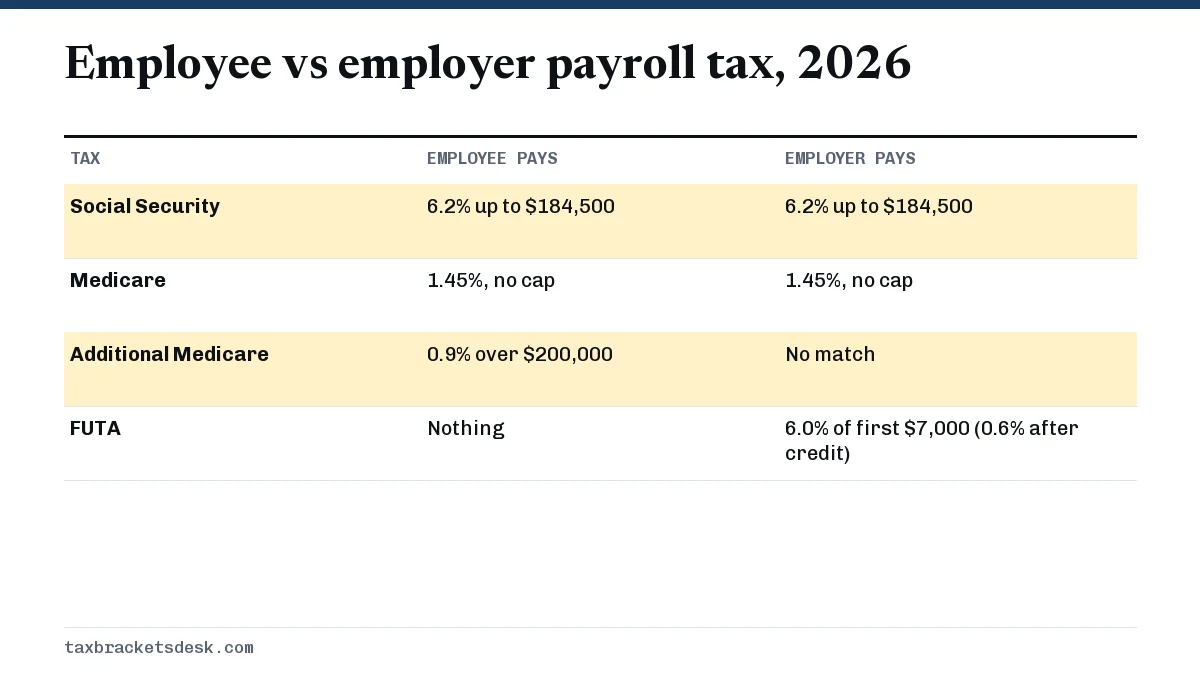
Most employers also owe the Federal Unemployment Tax (FUTA), reported on Form 940. IRS Topic 759 sets the FUTA rate at 6.0% on the first $7,000 of each employee's wages, reduced to 0.6% after a credit of up to 5.4% for state unemployment tax paid in full. FUTA is an employer-only payroll tax and never appears as a deduction on your pay stub.
Do self-employed people pay FICA?
Self-employed people do not pay FICA through payroll, but they pay the same money as self-employment tax: 15.3% (12.4% Social Security plus 2.9% Medicare) on 92.35% of net earnings, owed once net earnings reach $400 (IRS Topic 554). In effect, a freelancer pays both the employee and employer halves.
Half of that tax is deductible from income, and the Social Security part stops at the same $184,500 wage base. The self-employment tax rate page explains each step on Schedule SE, and the self-employment tax calculator turns a net profit figure into a dollar estimate.
How payroll tax differs from federal income tax
Payroll tax and income tax are figured on different bases, so a change that lowers one often leaves the other untouched. The comparison below covers the points people most often mix up.
- Brackets and deductions: income tax uses seven brackets from 10% to 37% after the standard deduction; FICA ignores both and taxes gross wages at a flat rate.
- Refunds: income tax withholding is reconciled on Form 1040 and can come back as a refund; FICA is generally final unless too much Social Security tax was withheld.
- 401(k) deferrals: traditional 401(k) contributions lower income tax withholding but are still subject to Social Security and Medicare tax (IRS Publication 15).
- Cafeteria plan benefits: health premiums paid through a section 125 plan are generally excluded from both income tax and FICA wages (IRS Publication 15-B).
- Bonuses: a bonus carries the full 7.65% FICA on top of whatever income tax is withheld; see our page on the bonus tax rate.
Who does not pay FICA tax?
Almost all employees pay FICA, but the law carves out a few groups. The most common exceptions are listed here; each has specific conditions, so check the IRS source for your situation before assuming you are exempt.
- Students employed by the school, college or university where they are enrolled and regularly attending classes.
- Many nonresident aliens in F-1, J-1, M-1 or Q status, for work allowed by their visa (IRS Publication 519).
- Members of certain religious groups who hold an approved exemption, filed on Form 4029.
- Some state and local government employees covered by a public retirement system instead of Social Security (they usually still pay Medicare).
What to do if the FICA on your pay stub looks wrong
- Check the year-to-date Social Security line. If it exceeds $11,439 for 2026 from one employer, that employer over-withheld.
- Ask payroll to correct it. IRS Topic 608 says the employer should adjust excess withholding it caused.
- If the employer will not fix it, file Form 843, Claim for Refund and Request for Abatement, with copies of your Forms W-2.
- If the excess came from two or more employers, claim it as a credit on Schedule 3 (Form 1040) when you file.
- If Medicare is less than 1.45% of box 5 wages, ask payroll for a corrected Form W-2c.
Common questions
What does FICA stand for on my paycheck?
FICA stands for the Federal Insurance Contributions Act. The line on your pay stub is the Social Security and Medicare tax withheld under that law, 7.65% of wages for most employees in 2026.
Is FICA tax refundable?
Usually not. FICA is a fixed payroll tax, not a prepayment like income tax withholding. The main exception is excess Social Security tax when your total wages from two or more employers passed $184,500 in 2026, which you can claim back on your return.
Why did FICA stop coming out of my paycheck?
If only the Social Security line stopped, your wages from that employer have reached the $184,500 wage base for 2026. Medicare tax should continue on every paycheck. Social Security withholding restarts on January 1.
Do retirees pay FICA tax on Social Security benefits?
No. FICA applies to wages and self-employment earnings, not to benefits. Retirees who keep working pay FICA on those new wages, and part of their benefits may be subject to income tax instead.
Is FICA the same as payroll tax?
FICA is the largest payroll tax paid by employees, but payroll tax is a broader term. It also includes federal income tax withholding and the employer-only FUTA tax, plus state payroll taxes where they apply.
Sources
- Topic 751, Social Security and Medicare withholding rates
- Topic 554, Self-employment tax
- Topic 759, Form 940, Employer's Annual Federal Unemployment (FUTA) Tax Return
- Topic 608, Excess Social Security and RRTA tax withheld
- Publication 15 (2026), Employer's Tax Guide
- Publication 15-B, Employer's Tax Guide to Fringe Benefits