
Schedule 1-A (Form 1040): how to fill out the tips, overtime, car loan interest and senior deduction parts
Short answer
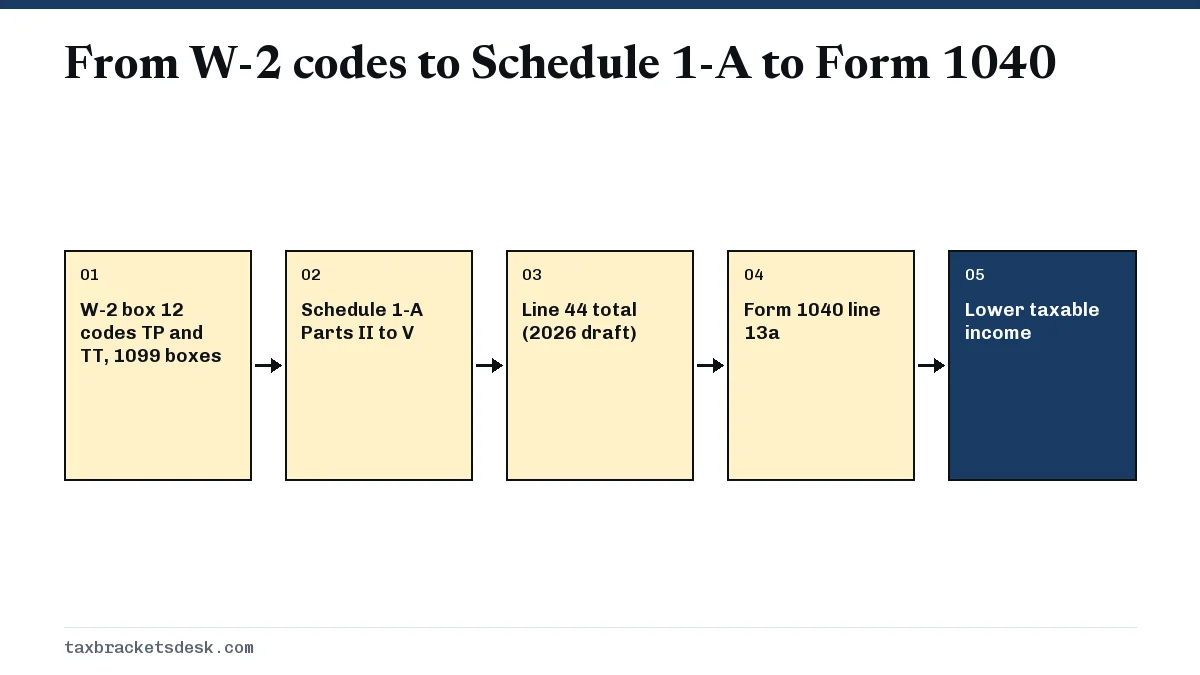
Schedule 1-A (Form 1040), Additional Deductions, is the form you attach to Form 1040 to claim the four temporary deductions created by the 2025 tax law: qualified tips, the overtime premium, car loan interest on a new US-assembled vehicle, and the $6,000 senior deduction. Each has its own part and income phaseout. The total goes to Form 1040 line 13a on the draft 2026 form (line 13b on 2025 returns), and you can use it whether or not you itemize.
- 01Attach to
- Form 1040, 1040-SR or 1040-NR
- 02Number of parts
- Six (MAGI, four deductions, total)
- 03Total carried to (2026 draft)
- Schedule 1-A line 44 to Form 1040 line 13a
- 04Total carried to (2025)
- Schedule 1-A line 38 to Form 1040 line 13b
- 05Tax years
- 2025 through 2028
- 06Itemizing required
- No; works with either deduction method
What Schedule 1-A is for
The IRS created Schedule 1-A, titled Additional Deductions, for 2025 returns to hold the four deductions added by Public Law 119-21. They sit on their own schedule, apart from Schedule A, so filers can take them whether they itemize or not.
You file the Schedule 1-A form only if at least one part applies to you. A salaried office worker under 65 with no car loan on a new vehicle has nothing to enter and can skip it. For a summary of every change in the law, start with our One Big Beautiful Bill tax changes hub.
| Part | Covers | Lines | Maximum |
|---|---|---|---|
| I | Modified AGI | 1 to 3 | Not a deduction |
| II | No tax on tips | 4 to 15 | $25,000 |
| III | No tax on overtime | 16 to 27 | $12,500 ($25,000 joint) |
| IV | Car loan interest | 28 to 36 | $10,000 |
| V | Enhanced deduction for seniors | 37 to 43 | $6,000 per person |
| VI | Total additional deductions | 44 | Sum of II to V |
Who needs to file Schedule 1-A?
You need the form if any of these applied to you during the tax year. The tips, overtime and senior parts each require a valid Social Security number and, for married people, a joint return.
- You received qualified tips in an occupation on the Treasury list of tipped occupations.
- You were paid overtime that the Fair Labor Standards Act required, and you were not an exempt employee.
- You paid interest on a loan taken out after December 31, 2024, to buy a new personal-use vehicle with final assembly in the United States.
- You, or your spouse on a joint return, were 65 or older by the end of the year. For 2026 that means born before January 2, 1962.
Do I need Schedule 1-A if I itemize?
Yes, if you want these deductions. Itemizing on Schedule A does not replace Schedule 1-A; you file both. The only difference for older itemizers is that they lose the age 65 add-on to the standard deduction but keep the $6,000 senior amount.
Part by part walkthrough of the Schedule 1-A additional deductions
Part I: modified AGI (lines 1 to 3)
Line 1 is your AGI from Form 1040 line 11b. Lines 2a to 2d add back income you excluded from Puerto Rico, the foreign earned income and housing exclusions from Form 2555 lines 45 and 50, and American Samoa income from Form 4563 line 15. For most people, line 3 simply equals AGI. Every later part uses line 3 for its phaseout.
Part II: no tax on tips (lines 4 to 15)
Employees list each employer on line 4 with the tips in W-2 box 12 code TP or on Form 4137, taking the larger figure per employer. Self-employed tipped workers use line 6, where the tips from Forms 1099-NEC box 1b, 1099-MISC box 13a or 1099-K box 1c are limited to that business's net profit. Line 9 caps the total at $25,000, and lines 10 to 15 cut it by $100 for each full $1,000 of MAGI over $150,000 ($300,000 joint).
Part III: no tax on overtime (lines 16 to 27)
Line 16 lists each employer with the amount in W-2 box 12 code TT, and line 18 takes qualified overtime reported in Form 1099-NEC box 1d or Form 1099-MISC box 14. Line 21 applies the $12,500 or $25,000 joint cap. Lines 22 to 27 run the same $100 per full $1,000 phaseout as the tips part. Only the premium part of time-and-a-half counts; our overtime deduction calculator shows the math.
Part IV: car loan interest (lines 28 to 36)
Line 28 has room for two vehicles. For each, you enter the VIN, answer whether the original use began with you and whether final assembly was in the United States, and split interest between column (ii), already deducted on Schedule C, E or F, and column (iii), the rest. Lenders report certain 2026 interest on the new Form 1098-VLI, box 1. The cap is $10,000, and the phaseout is steeper: $200 per $1,000 of MAGI over $100,000 ($200,000 joint), with a partial thousand rounded up. Eligible vehicles are covered in our car loan interest deduction guide.
Part V: enhanced deduction for seniors (lines 37 to 43)
Lines 37 to 41 start from $6,000 and subtract 6% of MAGI above $75,000 ($150,000 joint). Line 42a is for you and line 42b for your spouse, each entered only if that person has a valid SSN and was born before January 2, 1962. Line 43 adds them. How this interacts with the regular deduction is explained in is the senior deduction on top of the standard deduction.
Part VI: total (line 44)
Line 44 adds lines 15, 27, 36 and 43. That single figure is what moves to your Form 1040.
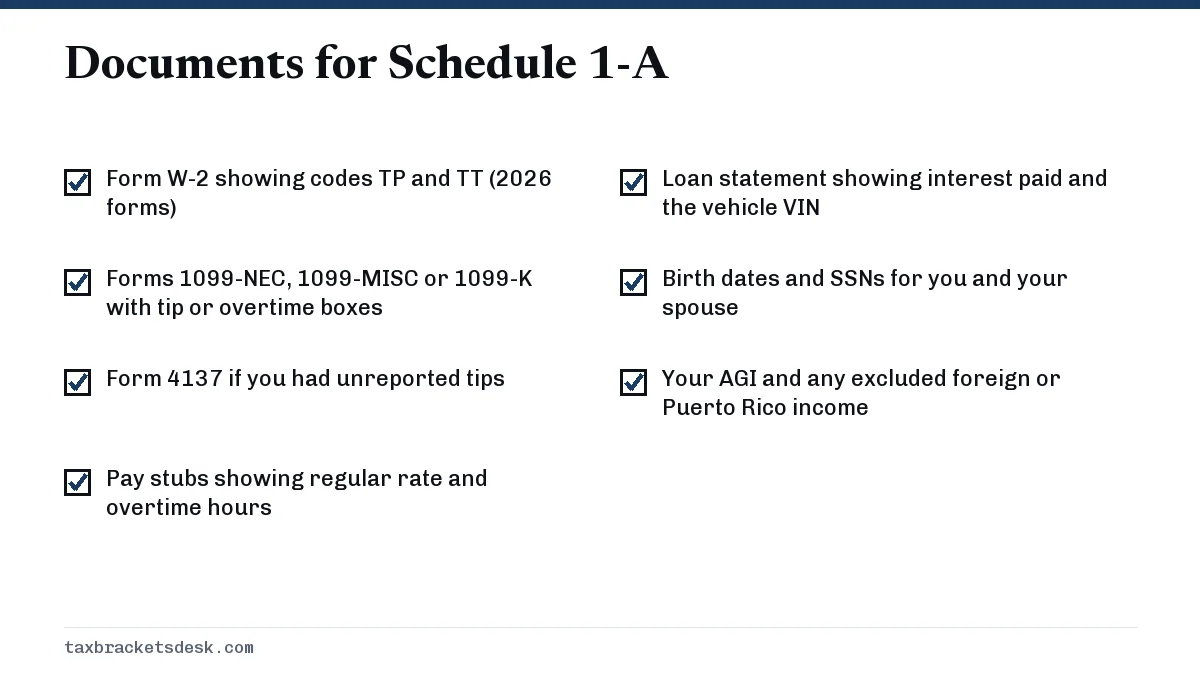
Documents you will need for the Schedule 1-A form
Pull these together before you start. For 2026 returns, employers and payers report tips and overtime in new boxes, which our page on W-2 codes TT and TP explains.
Where the total goes on Form 1040
On the draft 2026 forms, the line 44 total goes on Form 1040, 1040-SR or 1040-NR line 13a. On 2025 returns it was line 38, carried to Form 1040 line 13b (1040-NR line 13c). It is subtracted after adjusted gross income, alongside the standard or itemized deduction, to reach taxable income. Because it is below the AGI line, it does not change AGI-based figures such as the income test for taxing Social Security benefits.
Full example: a two-income couple for 2026
A married couple filing jointly has MAGI of $168,000. She is a 41-year-old server with $9,200 of qualified tips. He is a 66-year-old machinist with $4,100 of overtime premium, and they paid $2,300 of interest on a new US-assembled pickup bought in 2025.
| Part | Calculation | Deduction |
|---|---|---|
| II Tips | $9,200; MAGI under $300,000 | $9,200 |
| III Overtime | $4,100; MAGI under $300,000 | $4,100 |
| IV Car loan | $2,300; MAGI under $200,000 | $2,300 |
| V Senior (husband only) | $6,000 - 6% x $18,000 | $4,920 |
| VI Line 44 total | Sum of parts | $20,520 |
Their taxable income is MAGI of $168,000 minus the $33,850 standard deduction (including his $1,650 age add-on) minus $20,520, or $113,630. Without Schedule 1-A it would have been $134,150, all of the difference falling in the 22% bracket, a federal saving of $4,514.40.
Common Form 1040 Schedule 1-A mistakes
- Entering total overtime pay instead of the premium part.
- Filing married filing separately, which blocks the tips, overtime and senior deductions.
- Claiming the senior deduction for a spouse who turns 65 after the year ends.
- Deducting interest on a used car, a lease, or a vehicle assembled outside the US.
- Using AGI after the deduction for the phaseouts instead of line 3.
- Counting tips earned in a job that is not on the Treasury tipped occupation list.
If you left a Schedule 1-A deduction off a return that has already been filed, you can amend it with Form 1040-X within the normal amendment window. Changes coming for the 2027 filing year are tracked on tax changes 2027.
Step by step
Figure modified AGI
Complete Part I using Form 1040 line 11b plus any excluded Puerto Rico, foreign or American Samoa income.
Complete the tips part
Enter tips from W-2 code TP, Form 4137 or the 1099 tip boxes in Part II, cap at $25,000 and apply the phaseout.
Complete the overtime part
Enter the FLSA overtime premium from W-2 code TT or the 1099 overtime boxes in Part III, cap at $12,500 or $25,000 joint and apply the phaseout.
Complete the car loan part
List the VIN, answer the new-vehicle and US assembly questions and enter qualified interest in Part IV, cap at $10,000 and apply the $200 per $1,000 phaseout.
Complete the senior part
In Part V, reduce $6,000 by 6% of MAGI over the threshold and enter it for each person who qualifies.
Total and transfer
Add the four results on line 44 of the draft 2026 form and enter the total on Form 1040 line 13a.
Common questions
What is Schedule 1-A on my tax return?
It is a two-page IRS schedule titled Additional Deductions that you attach to Form 1040 to claim the tips, overtime, car loan interest and senior deductions for 2025 through 2028.
Which line of Schedule 1-A is for overtime?
Part III. On the draft 2026 form, W-2 code TT amounts go on line 16, 1099 overtime on line 18, the capped amount on line 21 and the final overtime deduction on line 27. The 2025 form used lines 14a to 21.
Where does the Schedule 1-A total go on Form 1040?
On the draft 2026 forms, Schedule 1-A line 44 goes on Form 1040, 1040-SR or 1040-NR line 13a. For 2025, line 38 went on Form 1040 line 13b or Form 1040-NR line 13c.
Can I file Schedule 1-A with the standard deduction?
Yes. It works with both the standard deduction and itemized deductions, and you do not give up the standard deduction to use it.
Does Schedule 1-A lower my AGI?
No. The total is subtracted after AGI, so AGI and anything calculated from it stay the same.
Is Schedule 1-A the same as Schedule 1?
No. Schedule 1 reports additional income and adjustments that reduce AGI. Schedule 1-A holds only the four new deductions, which are taken after AGI.
Sources
- Schedule 1-A: what to know about the new form irs.gov
- Schedule 1-A (Form 1040) 2025, Additional Deductions irs.gov
- Draft 2026 Schedule 1-A (Form 1040) irs.gov
- Publication 505 (2026), Tax Withholding and Estimated Tax irs.gov
- One Big Beautiful Bill Act: tax deductions for working Americans and seniors irs.gov
- Rev. Proc. 2025-32, 2026 inflation adjustments irs.gov
We check figures against these official pages. Rules change; confirm anything that affects a deadline or payment with the agency before you act.
Tell us what happened
Describe your situation and our editors will use it to improve this guide. If you leave your email, we may reply with a pointer to the right page or official contact. We never share your details.