
Estimated tax due dates 2026: the four quarterly deadlines
Short answer
The estimated tax due dates for 2026 are April 15, 2026, June 15, 2026, September 15, 2026 and January 15, 2027, per the IRS 2026 Form 1040-ES. None falls on a weekend or holiday. You can skip the January 15 payment if you file your 2026 return and pay everything owed by February 1, 2027.
- 011st payment
- Wednesday, April 15, 2026
- 022nd payment
- Monday, June 15, 2026
- 033rd payment
- Tuesday, September 15, 2026
- 044th payment
- Friday, January 15, 2027
- 05File-early alternative to the 4th payment
- File and pay in full by February 1, 2027
When are 2026 estimated taxes due?
Estimated taxes for tax year 2026 are due on four dates: April 15, 2026, June 15, 2026, September 15, 2026 and January 15, 2027 (IRS, 2026 Form 1040-ES). Each is a weekday that is not a federal holiday, so no date shifts this year.
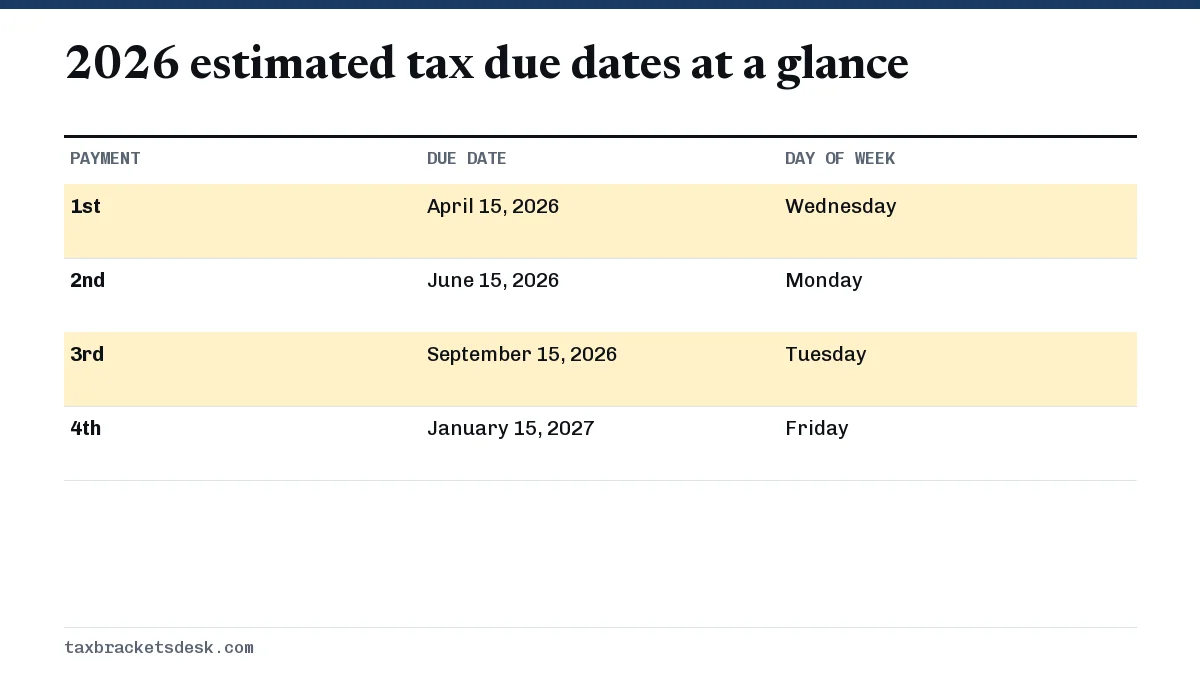
As of October 20, 2026, three of the four dates have passed. The one still ahead is Friday, January 15, 2027. If you missed September 15, the section on late payments below explains what that costs and what to do now.
What period does each quarterly tax payment cover?
The four quarterly taxes due dates do not match calendar quarters. Publication 505 splits the year into periods of three, two, three and four months, which is why the June payment arrives only two months after April.
| Income received | Months | Due date |
|---|---|---|
| January 1 to March 31, 2026 | 3 | April 15, 2026 |
| April 1 to May 31, 2026 | 2 | June 15, 2026 |
| June 1 to August 31, 2026 | 3 | September 15, 2026 |
| September 1 to December 31, 2026 | 4 | January 15, 2027 |
The periods matter most if your income is lumpy. You do not have to start paying until you have income that needs estimated tax. If your first such income arrives in July, for example, your first payment is due September 15, 2026, and you can pay the year's estimate then or split it between September and January.
What if an estimated tax due date falls on a weekend?
If a due date lands on a Saturday, Sunday or legal holiday, a payment made on the next business day counts as on time (Pub. 505). That rule changes nothing in 2026, but it does move the last 2027 payment to January 18, 2028; see our estimated tax due dates 2027 page.
For mailed payments, the U.S. postmark date is the payment date. The 2026 form adds a caution: under clarified U.S. Postal Service rules, the postmark reflects when a processing facility handles the envelope, which may be later than the day you dropped it in a mailbox. Mailing a few days early, or paying online, avoids that risk.
Can I skip the January 15, 2027 payment?
Yes. You do not have to make the January 15, 2027 payment if you file your 2026 return early and pay the entire balance with it. Publication 505 states the deadline as January 31, 2027; because that day is a Sunday, the 2026 Form 1040-ES and its payment record print February 1, 2027.
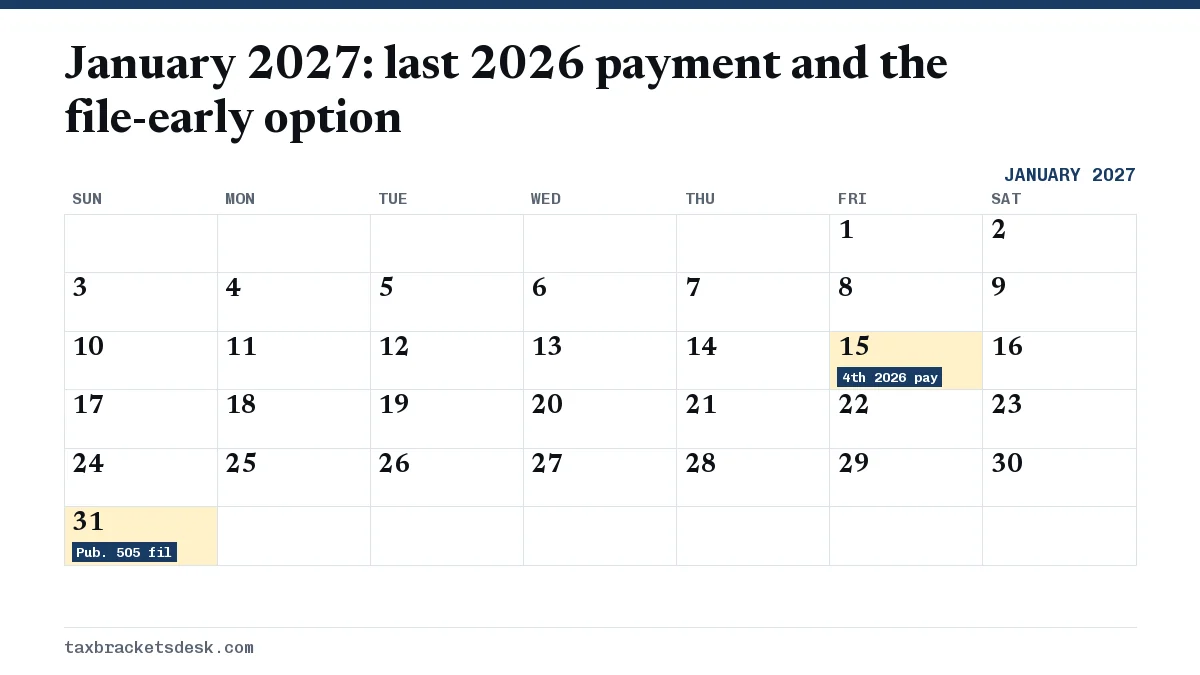
This option only protects the fourth payment. If you were short for April, June or September, a penalty for those periods can still apply, figured up to the date you file and pay. It suits people who have all their year-end forms early and would rather settle up once.
Special dates for farmers, fishers and fiscal-year filers
- Farmers and fishers: if at least two-thirds of your gross income for 2025 or 2026 comes from farming or fishing, you have one due date, January 15, 2027. You can skip even that by filing your 2026 return and paying all tax due by March 1, 2027.
- Fiscal-year taxpayers: payments are due on the 15th day of the 4th, 6th and 9th months of your fiscal year and the 15th day of the 1st month after it ends, moved to the next business day when needed.
- Disaster areas: the IRS can postpone estimated tax deadlines for people who live or have a business in a federally declared disaster area, and generally applies that relief automatically.
What happens if you miss a quarterly due date?
Missing a due date does not create a flat fee. The underpayment penalty accrues daily on the late amount at the IRS underpayment rate, which is 7% a year for July through December 2026 (IRS quarterly interest rates). The sooner you pay, the smaller it is. Our estimated tax penalty page walks through the full calculation, Form 2210 and the waivers.
For example, if you owed $2,000 on September 15, 2026 and pay it on October 15, 2026, the charge is about $2,000 x 7% x 30/365 = $11.51. Pay the missed amount now rather than waiting to fold it into January, and do not let the missed period make you skip the next one.
If you pay online on the due date, the payment counts for that date even if your bank processes it a day or two later. If the payment does not appear in your IRS account afterward, follow our steps for an estimated tax payment not showing up.
How to put the dates to work
- Figure your required annual payment once, using the safe harbor estimated tax test that gives the lowest number.
- Schedule all remaining payments at once: IRS Online Account and Direct Pay both accept dates up to 365 days ahead.
- Set a reminder a week before each date to check whether your income has changed enough to adjust the next payment.
- Record each payment's date, amount and confirmation number; you will enter the total on your 2026 Form 1040.
For who must pay, how much, and the ways to pay, start with our estimated taxes guide.
Common questions
Are estimated taxes due on the 15th of every quarter?
No. The 2026 dates are April 15, June 15 and September 15, 2026, and January 15, 2027. There is no payment in March, July or December, and the gap between April and June is only two months.
Is the September 15 estimated payment the third quarter?
Yes. The September 15, 2026 payment is the third installment and covers income received from June 1 through August 31, 2026.
What time of day is the estimated tax deadline?
An online payment dated for the due date counts as on time. Direct Pay notes that payments submitted after 8 p.m. Eastern time typically appear as next-business-day payments in your online account, so paying earlier in the day is safer.
Do I need to pay estimated tax if I only started freelancing in October?
Your first payment would be due January 15, 2027, because income received after August 31 falls in the fourth period. You can also file and pay in full by February 1, 2027 instead.
Is the January 15 payment for this year or next year?
The January 15, 2027 payment is the last installment for tax year 2026. Mark the voucher or online payment for 2026, not 2027.
Sources
- Form 1040-ES (2026), Estimated Tax for Individuals irs.gov
- Publication 505 (2026), Tax Withholding and Estimated Tax irs.gov
- Quarterly interest rates irs.gov
- Direct Pay help irs.gov
We check figures against these official pages. Rules change; confirm anything that affects a deadline or payment with the agency before you act.
Tell us what happened
Describe your situation and our editors will use it to improve this guide. If you leave your email, we may reply with a pointer to the right page or official contact. We never share your details.
Related guides
 Estimated Taxes: Who Must Pay, Due Dates and How Much
You generally must pay estimated taxes for 2026 if you expect to owe at least $1,000 after withholding and refundable credits, an…
Estimated Tax Due Dates 2027: Apr 15, Jun 15, Sep 15, Jan 18
The estimated tax due dates for 2027 are expected to be April 15, June 15 and September 15, 2027, and January 18, 2028, applying…
Estimated Tax Payment Not Showing Up? What to Check
An estimated tax payment not showing up usually has not posted yet: the IRS says to check your online account two business days a…
Safe Harbor Estimated Tax 2026: 90%, 100% and 110% Rules
To meet the 2026 safe harbor for estimated tax and avoid the IRS underpayment penalty, your withholding plus on-time estimated pa…
Estimated Tax Penalty 2026: Rates, Form 2210 and Waivers
The estimated tax penalty is the IRS charge for paying quarterly tax too late or too little. It works like interest: each short i…