
Earned income credit 2026: maximum $664 to $8,231 by number of children, and what changed from 2025
Short answer
The earned income credit 2026 maximum is $664 with no qualifying children, $4,427 with one, $7,316 with two and $8,231 with three or more. These amounts apply to tax year 2026 returns filed in 2027. Each is a little higher than 2025, and the investment income limit rose to $12,200.
- 01No qualifying children
- $664
- 02One child
- $4,427
- 03Two children
- $7,316
- 04Three or more children
- $8,231
- 05Investment income limit
- $12,200
- 06Source
- Rev. Proc. 2025-32, released October 9, 2025
EITC 2026 maximum by number of children
The earned income credit 2026 amounts were fixed by the IRS in Rev. Proc. 2025-32 on October 9, 2025. They cover income earned from January 1 to December 31, 2026, and you claim them on the return you file in the 2027 season.
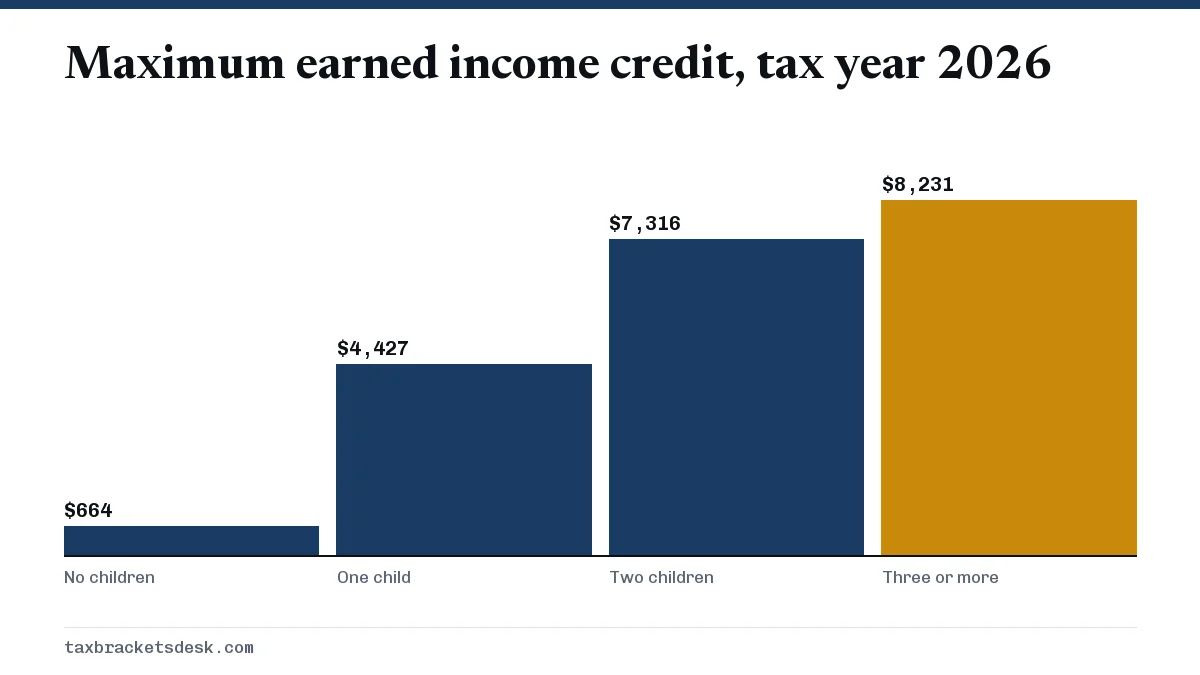
The jump from no children to one child is the largest step, about $3,760. Going from two to three children adds only $915, because the third child raises the credit rate from 40% to 45% but uses the same $18,290 earned income amount. A fourth or fifth child adds nothing further.
Each maximum is simply the credit rate times the earned income amount, rounded. For one child that is 34% of $13,020; for no children it is 7.65% of $8,680. The same rates appear in section 32 of the tax code every year; only the dollar amounts are indexed.
Did the EITC go up for 2026?
Yes, but only by the inflation adjustment. No law passed in 2025 changed the credit rates, the age limits or the qualifying child rules. The dollar figures rose by roughly 2.3% across the board.
| Qualifying children | 2025 maximum | 2026 maximum | Increase |
|---|---|---|---|
| None | $649 | $664 | $15 |
| One | $4,328 | $4,427 | $99 |
| Two | $7,152 | $7,316 | $164 |
| Three or more | $8,046 | $8,231 | $185 |
The income limits moved by similar small steps. A married couple with three children could have income just under $68,675 and still get something in 2025; for 2026 the ceiling is $70,244. The complete grid for both years is in our EITC income limits table.
Because the increase is small, a family whose income rose with a 3% or 4% raise may still see a lower credit in 2026 if they are in the phaseout range. The raise pushes them further along the declining part of the curve faster than the thresholds moved.
EITC 2026 investment income limit
For 2026, your investment income must be $12,200 or less. In 2025 the limit was $11,950. This test is a cliff, not a phaseout: $12,201 of investment income removes the entire credit.
Investment income for this test includes taxable and tax-exempt interest, dividends, net capital gains, net rental and royalty income, and net passive activity income. Money in a savings account rarely reaches the limit. It is more often triggered by selling a stock or a rental property at a gain.
If a sale in late 2026 would push you over, the timing of that sale can decide whether you keep a credit worth thousands of dollars. Check the total before you sell, not after.
Earned income credit 2026 chart: three example incomes
These examples use the 2026 formula for a head of household with one qualifying child whose AGI equals earned income. Results are rounded to the dollar; the IRS table in the Form 1040 instructions works in $50 bands and may differ by a few dollars.
| Earned income | Stage of the credit | How it is figured | Estimated credit |
|---|---|---|---|
| $9,000 | Phase-in | 34% x $9,000 | $3,060 |
| $20,000 | Plateau | Full amount; income is between $13,020 and $23,890 | $4,427 |
| $40,000 | Phaseout | $4,427 minus 15.98% x ($40,000 - $23,890) | $1,853 |
The same $40,000 of pay with two children produces a larger credit: $7,316 minus 21.06% of $16,110, or about $3,923. For a joint return the phaseout would start at $31,160 instead of $23,890, which adds roughly $1,160 to the one-child figure at $40,000.
To test your own numbers, use our earned income credit calculator, which walks through the same three stages.
Claiming the 2026 credit in 2027
- Collect your 2026 Forms W-2, any 1099-NEC or 1099-K for side work, and records of self-employment expenses.
- Confirm each child's Social Security number and the months they lived with you in 2026.
- File Form 1040 or 1040-SR and complete Schedule EIC for each qualifying child.
- Expect the refund no earlier than mid-February, because the law bars the IRS from releasing EITC refunds before then.
The EITC stacks with the child tax credit, which is $2,200 per child for 2026 with up to $1,700 refundable. Our page on the child tax credit 2026 amount shows how that credit is figured on the same return. For the full list of EITC eligibility rules, start from the earned income credit guide.
Common questions
How much is the earned income credit for 2026?
Between $664 and $8,231 at the maximum, depending on how many qualifying children you claim. Your actual credit depends on your earned income and AGI, so many filers receive less than the maximum.
What is the max EITC with three kids in 2026?
$8,231. You reach it with earned income of $18,290 or more, as long as income stays at or below $23,890 ($31,160 on a joint return). Above that, the credit falls by 21.06 cents per dollar.
What is the EITC investment income limit for 2026?
$12,200. If your interest, dividends, capital gains and other investment income add up to more than that, you cannot claim any EITC for 2026.
Is there an EITC 2026 chart from the IRS?
Yes. The IRS prints the full EIC table in the Form 1040 instructions for each tax year, listing the credit for every $50 band of income by filing status and number of children. The 2026 instructions come out ahead of the 2027 filing season.
When will I get my 2026 EITC refund?
Not before mid-February 2027 if you file early, because the law requires the IRS to hold refunds that include the EITC until then. Later filers receive it on the normal refund schedule.
Sources
- Rev. Proc. 2025-32, section 4.06, Earned Income Credit irs.gov
- IRS: Tax inflation adjustments for tax year 2026 (IR-2025-103) irs.gov
- IRS: Earned income and EITC tables (tax year 2025 figures) irs.gov
- 26 U.S. Code section 32 uscode.house.gov
We check figures against these official pages. Rules change; confirm anything that affects a deadline or payment with the agency before you act.
Tell us what happened
Describe your situation and our editors will use it to improve this guide. If you leave your email, we may reply with a pointer to the right page or official contact. We never share your details.