
Why is my EITC so low? Seven reasons the credit shrank
Short answer
If you are asking why is my EITC so low, the usual answer is that your income moved into the phaseout range, where the credit drops by up to 21 cents per extra dollar. Other common causes are a child who turned 19 and left school, a marriage that combined two incomes, unemployment or interest raising AGI, low earnings in the phase-in, and investment income over $12,200.
- 01Credit lost per $1,000 of extra income (one child)
- $159.80
- 02Credit lost per $1,000 (two or more children)
- $210.60
- 03Phaseout starts with children, 2026
- $23,890 ($31,160 joint)
- 04Investment income cliff, 2026
- Over $12,200 means no credit
- 05Qualifying child age limit
- Under 19, or under 24 if a full-time student
Why is my EITC so low: the quick diagnosis
Compare this year's return with last year's on four lines: earned income, AGI, filing status and the number of children on Schedule EIC. Almost every drop in the credit traces back to a change in one of those four. The checklist below lists the causes in a sensible order to check them.
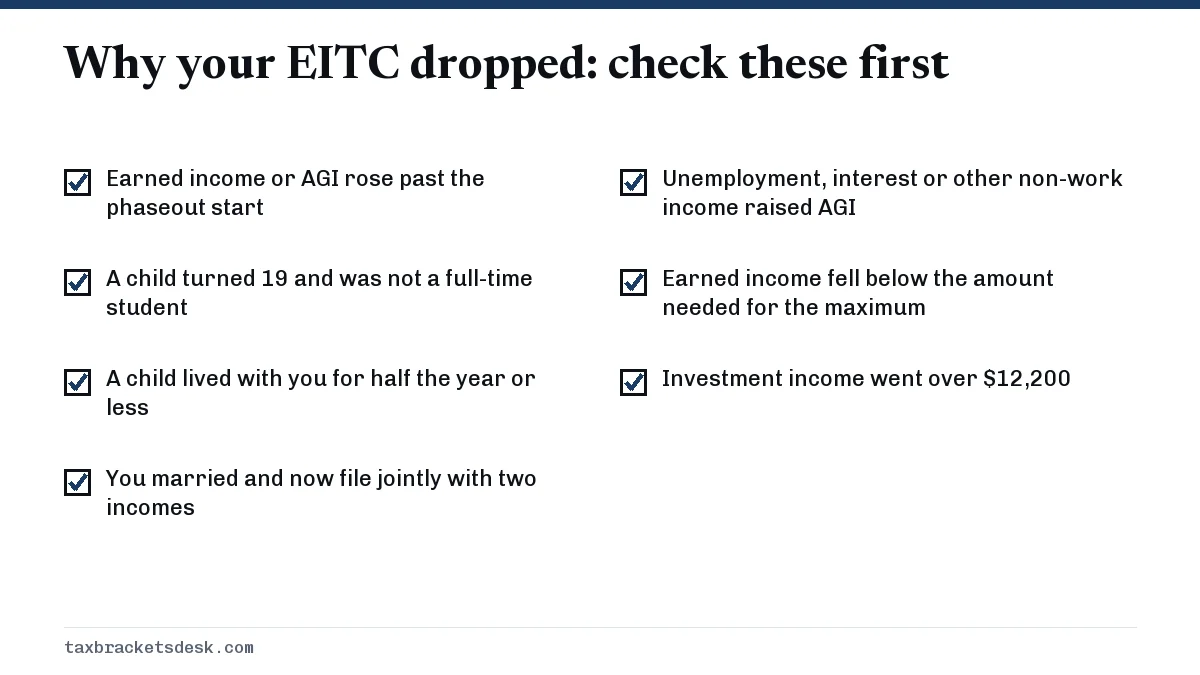
Before assuming an error, check whether the credit was reduced by your own numbers or by the IRS. If the IRS changed it, you will get a notice that explains the adjustment; your software's figure and the refund you receive will then differ.
Your income moved into the phaseout
This is the most common reason the earned income credit is reduced. Once your income passes the phaseout start, $23,890 for 2026 with children ($31,160 joint), every extra dollar cuts the credit at a fixed rate. It feels like a penalty on a raise, and in effect it is one.
| Qualifying children | Phaseout rate | Credit lost per extra $1,000 |
|---|---|---|
| None | 7.65% | $76.50 |
| One | 15.98% | $159.80 |
| Two | 21.06% | $210.60 |
| Three or more | 21.06% | $210.60 |
Example for 2026: a single parent of one child earning $24,000 gets about $4,409. The same parent earning $34,000 after a raise and some overtime gets about $2,811, a drop of roughly $1,600. The raise still leaves the household ahead, because $10,000 more pay costs about $1,600 of credit.
Overtime counts in full. Even if you deduct part of it under the no tax on overtime deduction, the IRS tells you to include all of it as earned income for the EITC.
Why did my EITC drop when a child turned 19?
A child stops being an EITC qualifying child at 19 unless they are a full-time student for at least five months of the year, in which case the limit is 24. A permanently and totally disabled child has no age limit. Losing one child can move you down a whole column in the table.
Example for 2026: a head of household earning $30,000 with two qualifying children gets about $6,029. If the older child turned 19 and did not attend school, the same return with one child gives about $3,451, roughly $2,580 less. If that was the last qualifying child, the parent would get nothing, because $30,000 is above the $19,540 no-child limit.
A child who moved out for more than half the year, or who now lives mostly with the other parent, drops off Schedule EIC in the same way. Check the residency and age tests in our EITC qualifications checklist.
EIC lower this year after marriage or a filing status change
Married couples must generally file jointly to claim the credit, and a joint return counts both spouses' income. The joint phaseout starts $7,270 higher, but a second paycheck often uses that up quickly.
Example for 2026: a single parent earning $25,000 with one child gets about $4,250. After marrying a partner who earns $20,000, the joint return shows $45,000 and the credit falls to about $2,215. Our marriage penalty page covers how marriage affects the rest of the return.
Switching to married filing separately does not fix this for most couples. It is allowed for the EITC only with a qualifying child and only if you lived apart from your spouse for the last six months of the year or are legally separated.
Non-work income raised your AGI
In the phaseout the IRS uses whichever is larger, AGI or earned income. Unemployment benefits, interest, a taxable retirement withdrawal, gambling winnings or taxable alimony received under an older divorce agreement all raise AGI without adding earned income.
Example for 2026: a single parent of one child with $20,000 of wages would normally get the full $4,427. With $8,000 of unemployment benefits added, AGI is $28,000 and the credit falls to about $3,770.
You earned less, or investment income crossed the limit
Low earnings in the phase-in
At the other end of the scale, a credit can be low because earned income is too small to reach the maximum. With one child you need $13,020 of 2026 earnings for the full $4,427; at $8,000 you get 34% of that, or $2,720. Fewer hours, time off work or a big business expense on Schedule C all lower earned income.
Investment income over $12,200
If your investment income is over $12,200 for 2026, the credit is not just reduced; it is gone. A one-time stock or property sale is the usual trigger. The 2025 limit was $11,950.
The IRS adjusted your claim
If the IRS reduced the credit because a child's SSN did not match its records or a child was claimed on another return, read the notice and respond by the date shown, with school, medical or lease records that show where the child lived. If the reduction was for anything other than a math or clerical error, you will need Form 8862 the next time you claim the credit.
What to do next
- Put last year's and this year's Form 1040 side by side and compare earned income, AGI, filing status and the children listed on Schedule EIC.
- Recalculate the credit with our earned income credit calculator using this year's figures.
- If a child should still qualify, confirm the age, student status and months lived with you.
- If the software is right, plan ahead: for 2027, check the new limits once announced, usually in October or November.
The child tax credit can shrink for different reasons; see why the child tax credit is reduced. For the credit's full rules, go back to the earned income credit guide.
Common questions
Why is my EITC lower this year?
Most often your income rose into or further along the phaseout, where the credit falls by 15.98 or 21.06 cents per dollar with children. A child aging out, marriage, or extra non-work income that raised AGI are the next most likely causes.
Does more income lower my EITC?
Only past a certain point. Below the phaseout start the credit grows or stays flat as you earn more. Above it, for 2026 $23,890 with children or $31,160 on a joint return, each dollar of income lowers the credit.
Can investment income reduce my EITC?
It can raise your AGI and push you into the phaseout, and if the total is over $12,200 for 2026 it removes the credit entirely. Interest, dividends, capital gains and net rental income all count.
Why did my EITC go down when I got a raise?
Because the raise put you further into the phaseout. With one child, each extra $1,000 cuts the credit by $159.80, so the raise still leaves you better off overall.
Why did my EITC go down with the same income as last year?
Check the children on Schedule EIC and your filing status first. If both are unchanged, compare AGI, since unemployment or interest can lower the credit, and check whether the IRS adjusted the return in a notice.
Sources
- Rev. Proc. 2025-32, section 4.06 irs.gov
- IRS: Qualifying child rules irs.gov
- IRS: Earned income irs.gov
- IRS: What to do if we deny your claim for a credit irs.gov
- 26 U.S. Code section 32 uscode.house.gov
We check figures against these official pages. Rules change; confirm anything that affects a deadline or payment with the agency before you act.
Tell us what happened
Describe your situation and our editors will use it to improve this guide. If you leave your email, we may reply with a pointer to the right page or official contact. We never share your details.