
Earned income credit calculator for tax year 2026
Short answer
This earned income credit calculator estimates your 2026 EITC from five inputs: earned income, AGI, filing status, number of qualifying children and investment income. It multiplies earned income by the credit rate up to the maximum, then subtracts the phaseout rate times income above the threshold. The result matches the IRS table within a few dollars.
- 01Credit rates (phase-in)
- 7.65%, 34%, 40%, 45% for 0, 1, 2, 3+ children
- 02Phaseout rates
- 7.65%, 15.98%, 21.06%, 21.06%
- 03Maximum credit, 2026
- $664 to $8,231
- 04Investment income limit
- $12,200
- 05Tax year covered
- 2026 (returns filed in 2027)
Calculator
- Estimated 2026 EITC
- —
- Stage of the credit (phase-in, plateau or phaseout)
- —
- Income at which your credit reaches zero
- —
- Credit lost per extra $1,000 of income
- —
Estimates for tax year 2026. The credit on a filed return comes from the IRS EIC table, which works in $50 bands, so it can differ by a few dollars. The calculator does not test residency, a child's SSN or the tie-breaker rules.
What the earned income credit calculator needs
The earned income credit calculator uses the tax year 2026 figures from Rev. Proc. 2025-32, which apply to returns filed in 2027. Have your W-2s, any 1099s for self-employment and a rough AGI in hand before you start.
- Earned income. Wages from Form W-2 box 1, tips, and net self-employment earnings after the deduction for half of self-employment tax. Include all tips and overtime, even if you deduct part of them on Schedule 1-A.
- AGI. Your adjusted gross income, which adds items like unemployment benefits, interest and taxable retirement withdrawals. If you have only wages, AGI usually equals earned income.
- Filing status. Joint returns get a higher phaseout threshold. Married filing separately qualifies only in narrow separated-spouse cases.
- Qualifying children. Count only children who pass the EITC relationship, age, residency and joint return tests and have a valid SSN, up to three.
- Investment income. Anything over $12,200 for 2026 means no credit.
Not sure whether a child counts? Our EITC qualifications checklist walks through each test before you enter a number.
How to calculate the earned income credit: the phase-in and phaseout formula
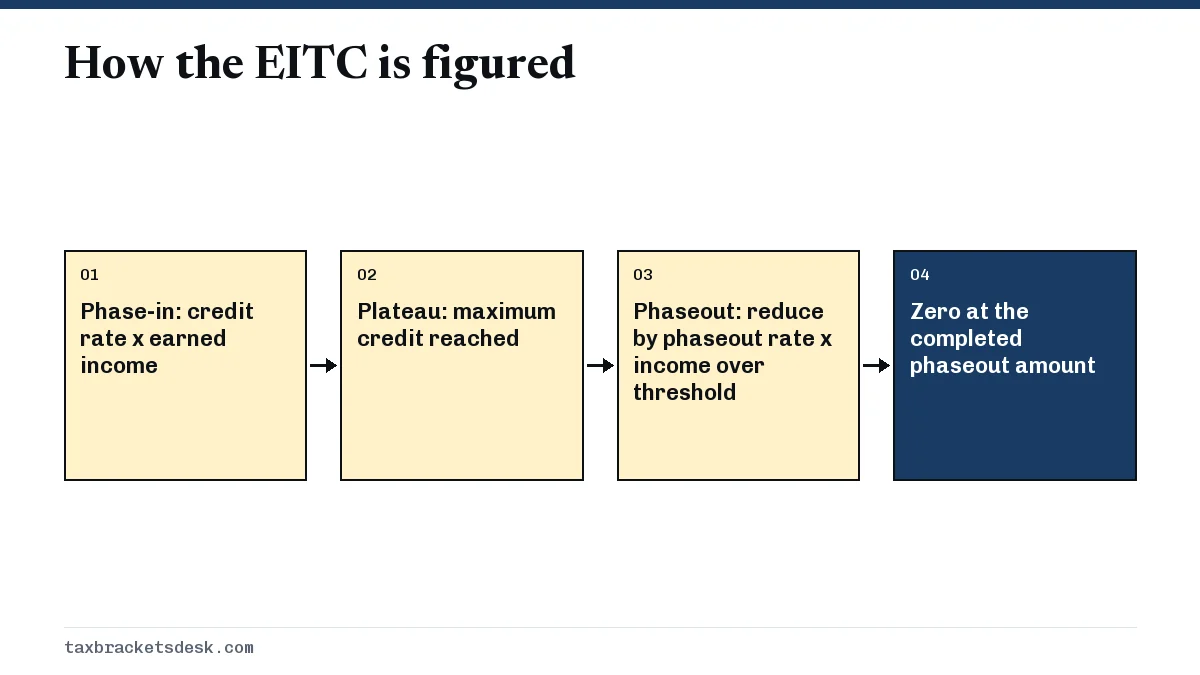
The credit follows three stages. The calculator applies them in order, the same logic that sits behind the IRS worksheet and EIC table.
| Children | Credit rate | Earned income for max | Maximum | Phaseout rate |
|---|---|---|---|---|
| 0 | 7.65% | $8,680 | $664 | 7.65% |
| 1 | 34% | $13,020 | $4,427 | 15.98% |
| 2 | 40% | $18,290 | $7,316 | 21.06% |
| 3 or more | 45% | $18,290 | $8,231 | 21.06% |
- Multiply earned income by the credit rate. If the result is above the maximum, use the maximum.
- Take the larger of AGI or earned income. Subtract the phaseout threshold: $23,890 with children or $10,860 without, or $31,160 and $18,140 on a joint return.
- Multiply any amount left by the phaseout rate. That is the reduction.
- Subtract the reduction from step 1. If the answer is below zero, the credit is zero.
The percentages come from section 32(b) of the tax code and have not changed in years. Only the dollar amounts are indexed. The full grid of thresholds and end points is on our EITC income limits table.
EITC calculator 2026: worked example
A married couple filing jointly with two qualifying children has $41,000 of wages, $600 of bank interest and nothing else. Their AGI is $41,600.
- Phase-in: 40% x $41,000 = $16,400, which is above the $7,316 maximum, so the base is $7,316.
- Phaseout income: the larger of $41,600 AGI and $41,000 earned income is $41,600.
- Excess over the joint threshold: $41,600 - $31,160 = $10,440.
- Reduction: 21.06% x $10,440 = $2,198.66.
- Credit: $7,316 - $2,198.66 = about $5,117.
Each extra $1,000 of income would cost them another $210.60 of credit, and the credit reaches zero at $65,899. If the same family had filed with only one qualifying child, the result would be $4,427 minus 15.98% of $10,440, or about $2,759.
| Situation | Earned income and AGI | Estimated EITC |
|---|---|---|
| Single, no children, age 30 | $12,000 | $577 |
| Head of household, one child | $9,000 | $3,060 |
| Head of household, two children | $20,000 | $7,316 |
| Head of household, three children | $15,000 | $6,750 |
| Married filing jointly, one child | $45,000 | $2,215 |
Is the IRS EITC Assistant the same?
No, it does a different job. The IRS EITC Qualification Assistant on IRS.gov asks eligibility questions about you and your children and tells you whether you qualify, along with an estimate. This page focuses on the arithmetic once you know who counts.
Tax software and the Form 1040 instructions use the IRS EIC table, which lists the credit for each $50 band of income. Because the table uses the middle of each band, it can differ from this formula by a few dollars either way. The amount on your filed return is the one that counts.
Limits of an estimate
- It does not test residency, the child's SSN or the tie-breaker rules. A wrong child count gives a wrong answer.
- It does not model the separated-spouse exception for married filing separately.
- It covers tax year 2026 only. The 2027 figures are not yet announced; the IRS usually releases them in October or November.
- Self-employed users must enter net earnings after the half-of-SE-tax deduction, not gross receipts.
If the number is lower than you expected, our guide on why your EITC is low lists the usual causes. For the maximum amounts and 2025 comparison, see the earned income credit 2026 page, and for the rules as a whole, the earned income credit guide. To estimate the full refund including other credits, try the tax refund calculator.
Step by step
Check the investment income limit
If your 2026 investment income is over $12,200, stop: the credit is zero.
Figure the phase-in amount
Multiply earned income by 7.65%, 34%, 40% or 45% for 0, 1, 2 or 3+ children, capped at $664, $4,427, $7,316 or $8,231.
Pick the phaseout income
Use the larger of AGI and earned income.
Figure the reduction
Subtract the threshold ($23,890 with children, $10,860 without; $31,160 and $18,140 joint) and multiply what is left by 7.65%, 15.98% or 21.06%.
Subtract
Take the reduction from the phase-in amount. A result below zero means no credit.
Common questions
How do I calculate my earned income credit?
Multiply earned income by the credit rate for your number of children, capped at the maximum. Then subtract the phaseout rate times the amount by which the larger of AGI or earned income exceeds the phaseout threshold. The result, if above zero, is your credit.
How much EITC will I get with two kids and $30,000 income?
For 2026, a single or head of household filer gets about $6,029 and a joint filer gets the full $7,316, since $30,000 is below the $31,160 joint threshold. This assumes AGI equals earned income and investment income is under $12,200.
Which income do I enter in an EITC calculator?
Enter earned income (wages, tips and net self-employment earnings) and AGI separately. The phase-in uses earned income only; the phaseout uses whichever of the two is higher.
Is the IRS EITC Assistant the same as an EITC calculator?
Not quite. The IRS tool mainly checks eligibility by asking about you and your children, then gives an estimate. A formula calculator like this one shows how the dollar amount is built from your income.
Does the EITC calculator work for 2027?
Not yet. The 2027 amounts are not yet announced and are usually released in October or November. This calculator uses tax year 2026 figures for returns filed in 2027.
Sources
- Rev. Proc. 2025-32, section 4.06 irs.gov
- IRS: Earned income and EITC tables irs.gov
- IRS: Earned income irs.gov
- 26 U.S. Code section 32 uscode.house.gov
We check figures against these official pages. Rules change; confirm anything that affects a deadline or payment with the agency before you act.
Tell us what happened
Describe your situation and our editors will use it to improve this guide. If you leave your email, we may reply with a pointer to the right page or official contact. We never share your details.