
Earned income credit with no children: who qualifies and how much
Short answer
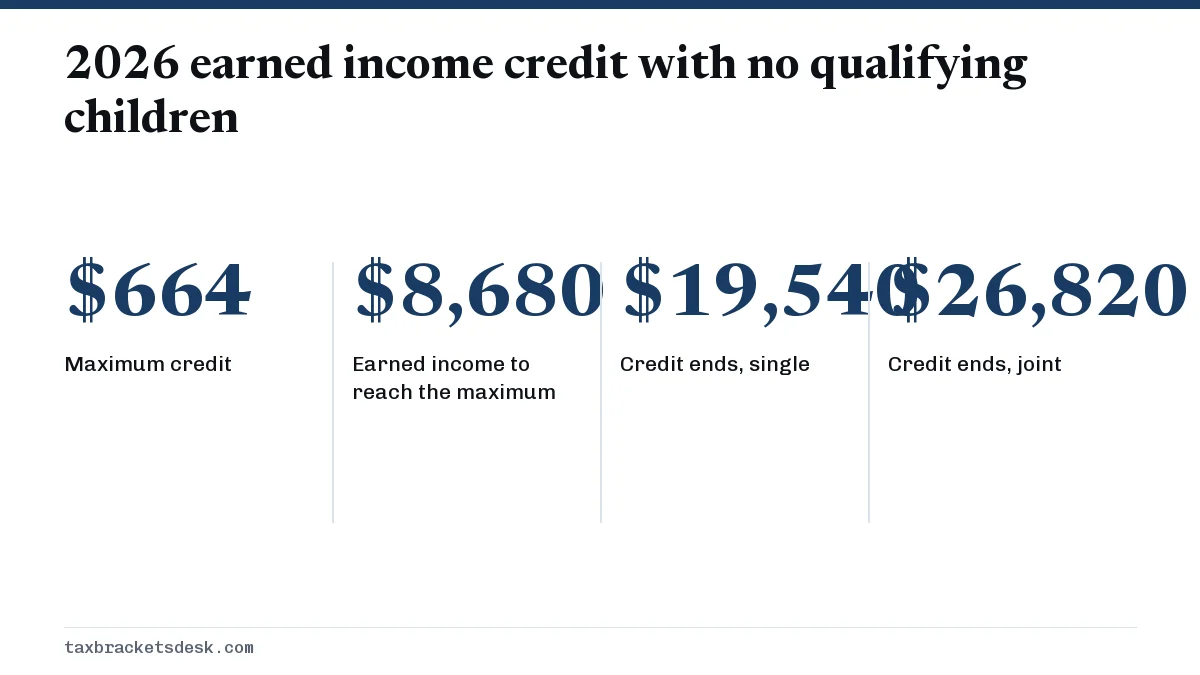
You can get the earned income credit with no children if you are at least 25 and under 65 at the end of 2026, lived in the United States for more than half the year, and are not someone else's dependent. The maximum is $664, reached at $8,680 of earned income, and the credit ends at $19,540 of income, or $26,820 on a joint return.
- 01Maximum credit, 2026
- $664
- 02Age at end of year
- At least 25 and under 65
- 03Earned income for the maximum
- $8,680
- 04Credit ends
- $19,540 single; $26,820 married filing jointly
- 05Schedule EIC needed
- No
Can you get the earned income credit with no children?
Yes. The earned income credit is not only for parents. A worker with no qualifying child can claim a smaller version of it, sometimes called the childless EITC, if they pass an age test, a residence test and a dependency test on top of the rules every EITC filer must meet.
The amounts are modest. For 2026 the most you can receive is $664, compared with $4,427 for a filer with one child. But the credit is refundable, so a low earner who owes no income tax still gets the full amount as cash in the refund.
The age 25 to 64 rule
You must be at least 25 but under 65 at the end of the tax year. For the 2026 return, that means your age on December 31, 2026. A 24-year-old who turns 25 in December 2026 meets the test for 2026; someone who turns 65 during 2026 does not.
On a joint return, only one spouse needs to be in the 25 to 64 range. A 23-year-old married to a 27-year-old can qualify, and so can a 66-year-old married to a 60-year-old.
There is no upper age limit when you claim a qualifying child, and no lower one either. The age window applies only to the no-children version of the credit.
EITC with no dependents: 2026 amount and income limits
The credit builds at 7.65% of each dollar you earn until earned income reaches $8,680. It then holds at $664 until income passes the phaseout start, and falls by 7.65% of every dollar above that point.
| Figure | Single, HoH or QSS | Married filing jointly |
|---|---|---|
| Earned income for maximum | $8,680 | $8,680 |
| Maximum credit | $664 | $664 |
| Phaseout starts | $10,860 | $18,140 |
| Credit ends | $19,540 | $26,820 |
Both your earned income and your AGI must be under the end point. Your investment income must also be $12,200 or less. In 2025 the maximum was $649 and the single limit was $19,104, so the 2026 figures are slightly higher. Amounts for 2027 are not yet announced; the IRS usually releases them in October or November.
Compare the other columns in our EITC income limits table. Full-time work of 2,080 hours at $9.40 an hour already comes to about $19,550, just past the single limit, which is why the no-child credit mostly reaches part-time, seasonal and very low-wage workers.
Other tests for the childless EITC
- Main home in the United States for more than half the year. The 50 states and the District of Columbia count; US territories do not.
- Not a dependent. No one else can claim you as a dependent on their return, even if they choose not to.
- Not a qualifying child. You cannot be someone else's qualifying child for the EITC. This mostly affects adults who are permanently and totally disabled and live with a parent or other relative, since they can be a qualifying child at any age.
- Valid SSN, citizenship and filing status. The same rules as for every EITC claimant: a work-valid SSN by the due date, US citizen or resident alien all year, and not married filing separately.
The dependency test trips up young adults who still live with parents. If your parent claims you as a dependent, you cannot claim the credit, even if you are 25 and earned your own wages. Settle between you who files what before either return goes in.
A parent whose child lacks a valid SSN can still claim the credit under the no-child rules if they meet the age and residence tests. You then get up to $664 rather than the child-based amount. The full set of tests is on our EITC qualifications checklist.
Earned income credit without children: worked examples
These use the 2026 formula with AGI equal to earned income and no investment income over the limit. The IRS table may differ by a few dollars.
| Situation | Earned income | Calculation | Credit |
|---|---|---|---|
| Single, age 30, part-time job | $6,000 | 7.65% x $6,000 | $459 |
| Single, age 42 | $9,500 | On the plateau | $664 |
| Single, age 28 | $12,000 | $664 - 7.65% x ($12,000 - $10,860) | $577 |
| Married, both 35, joint | $22,000 | $664 - 7.65% x ($22,000 - $18,140) | $369 |
Married people cannot file as single. The separated-spouse exception for married filing separately also requires a qualifying child, so filing jointly is the only way a married couple without children can claim this credit.
How to claim it
- File Form 1040 or 1040-SR even if your income is below the filing threshold.
- Skip Schedule EIC; it is required only when you list a qualifying child.
- Enter the credit on the earned income credit line, from the EIC table or your software.
- If an earlier EITC claim was denied only because of a child, you generally do not need Form 8862 to claim the no-child credit.
For how this smaller credit fits among the other versions, see the earned income credit guide. If you worked for yourself, your net self-employment earnings count as earned income after you figure self-employment tax on Schedule SE.
Common questions
Can I get the earned income credit with no children?
Yes, if you are 25 to 64 at year end, lived in the US more than half the year, are not claimed as a dependent, and meet the income limits. The 2026 maximum is $664.
What is the age requirement for EITC without kids?
At least 25 and under 65 on December 31 of the tax year. On a joint return, one spouse meeting the range is enough.
How much is the EITC with no children for 2026?
Up to $664. You reach the full amount with $8,680 of earned income, and it starts to shrink once income passes $10,860 ($18,140 joint).
What is the income limit for earned income credit with no kids?
For 2026 it is $19,540 for single and head of household filers and $26,820 for married couples filing jointly. Your AGI and earned income both have to be below it.
Can a 24-year-old college student get the EITC without children?
Not under the no-child rules, because the minimum age is 25 at year end. A 24-year-old could qualify only by claiming their own qualifying child.
Do I need Schedule EIC if I have no children?
No. Schedule EIC is only for listing qualifying children. You claim the no-child credit directly on Form 1040.
Sources
- Rev. Proc. 2025-32, section 4.06 irs.gov
- IRS: Who qualifies for the EITC irs.gov
- IRS: How to claim the EITC irs.gov
- IRS: What to do if we deny your claim for a credit irs.gov
We check figures against these official pages. Rules change; confirm anything that affects a deadline or payment with the agency before you act.
Tell us what happened
Describe your situation and our editors will use it to improve this guide. If you leave your email, we may reply with a pointer to the right page or official contact. We never share your details.