
Child and dependent care credit 2026: how much you can get, rates and Form 2441
Short answer
The child and dependent care credit for 2026 is 20% to 50% of up to $3,000 of work-related care costs for one qualifying person or $6,000 for two or more, so the maximum is $1,500 or $3,000; most working families get 35%, which is $1,050 or $2,100. The top rate rose from 35% to 50%. It is not refundable, is claimed on Form 2441 and is separate from the child tax credit.
- 01Expense limit
- $3,000 (one person), $6,000 (two or more)
- 02Credit rate for 2026
- 50% down to 20%, based on AGI
- 0320% floor applies above
- $206,000 AGI joint; $103,000 other filers
- 04Dependent care FSA limit 2026
- $7,500 ($3,750 married filing separately)
- 05Refundable
- No
- 06Form
- Form 2441, credit to Schedule 3, line 2
How much is the child and dependent care credit in 2026?
The child and dependent care credit is a percentage of the work-related care costs you pay for a child under 13 or a dependent or spouse who cannot care for themselves. For 2026 the percentage runs from 50% down to 20% depending on AGI, applied to at most $3,000 of expenses for one qualifying person or $6,000 for two or more.
That makes the largest possible credit $1,500 for one person and $3,000 for two or more, both at the 50% rate. Most working families land at 35%, which gives $1,050 or $2,100. This is not the child tax credit, which is $2,200 per child for 2026; the 2027 amount of that credit has not been announced yet and is tracked on our child tax credit 2027 page.
2026 changes: the 50% top rate and higher income bands
The 2025 law raised the top rate from 35% to 50% starting in 2026 and added a second, slower phase-down at higher incomes. The expense limits did not change. For 2025 returns the rate reached the 20% floor once AGI passed $43,000; for 2026 the floor does not apply until $206,000 on a joint return or $103,000 for other filers.
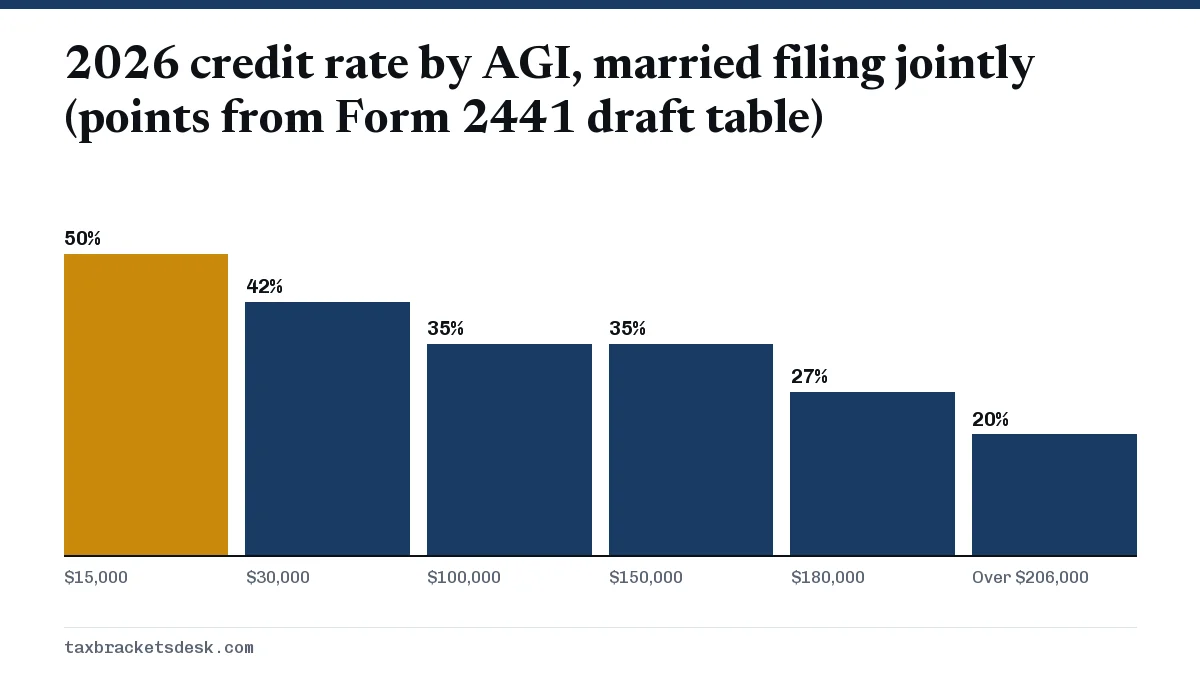
| AGI, married filing jointly | AGI, other filing statuses | Credit rate |
|---|---|---|
| Up to $15,000 | Up to $15,000 | 50% |
| $29,001 to $31,000 | $29,001 to $31,000 | 42% |
| $43,001 to $150,000 | $43,001 to $75,000 | 35% |
| $166,001 to $170,000 | $83,001 to $85,000 | 30% |
| $186,001 to $190,000 | $93,001 to $95,000 | 25% |
| Over $206,000 | Over $103,000 | 20% |
Between the rows shown, the rate falls one point per $2,000 of AGI on the lower band for everyone. On the upper band it falls one point per $4,000 for joint filers and per $2,000 for others. Line 8 of Form 2441 uses the full table.
Dependent care credit income limit: why low incomes may not benefit
There is no income ceiling that removes the credit; the rate just stops at 20%. The real limit is at the bottom. The credit can only reduce your income tax, and any part above your tax is lost. The 50% rate applies at AGI of $15,000 or less, where the 2026 standard deduction usually leaves no tax at all.
Example: head of household, one child, AGI $28,000
Care costs are $5,000, so $3,000 counts. The rate at $28,000 is 43%, giving $1,290 on paper. But taxable income is only $3,850 after the $24,150 head of household standard deduction, and tax is $385. The dependent care credit is capped at $385.
It also competes with the child tax credit for that same $385. The dependent care credit is applied first, which pushes the full $2,200 child tax credit into the refundable part, capped at $1,700. Without the care credit, $385 of the child credit would have covered the tax and $1,700 would still have been refunded. Either way the family receives $2,085 in total, so in this case the care credit adds nothing. See child tax credit for how the refundable part works.
Example: married, two children, AGI $180,000
With $6,000 or more of care costs, the 2026 rate at $180,000 of AGI is 27%, a credit of $1,620. On a 2025 return the same family would have been at 20%, or $1,200. This is where the 2026 change helps most in dollars.
What expenses qualify
Expenses qualify only if their main purpose is the person's care and protection, and you paid them so you (and your spouse, if married) could work or look for work.
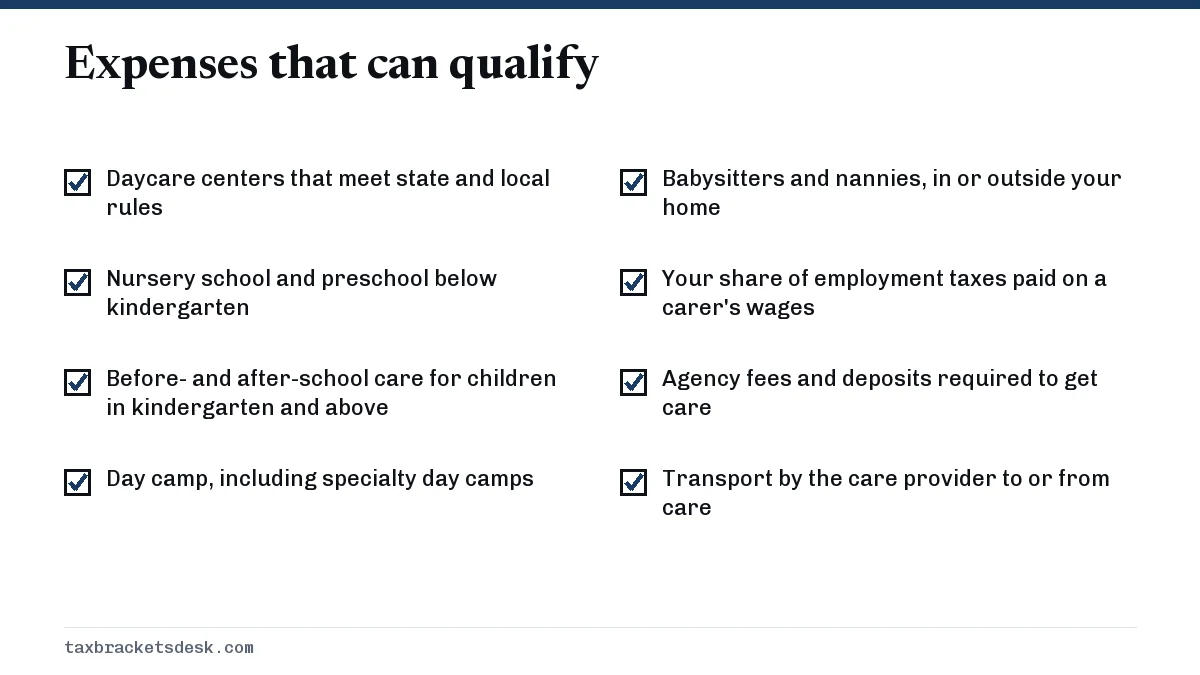
These do not qualify: school tuition for kindergarten and above, overnight camp, summer school, tutoring, food, clothing and entertainment that can be separated from the care, child support payments, transport not provided by the carer, and a deposit you forfeit when no care is provided.
The earned income cap
Your expenses cannot exceed your earned income, or the lower-earning spouse's income if married. A spouse who is a full-time student for at least five months, or who cannot care for themselves, is treated as earning $250 a month with one qualifying person or $500 with two or more.
Qualifying persons and providers
- A qualifying child under 13 whom you claim as a dependent. A child who turns 13 counts for the part of the year before the birthday.
- A spouse who could not physically or mentally care for themselves and lived with you more than half the year.
- A dependent of any age who could not care for themselves and lived with you more than half the year.
The provider cannot be your spouse, the child's other parent, someone you claim as a dependent, or your own child under 19 at year end. You must report the provider's name, address and SSN or EIN. Form W-10 is the standard way to request it. A nanny who works in your home is usually a household employee, which can mean filing Schedule H for employment taxes.
Married couples generally must file jointly to claim the credit. A spouse who lived apart for the last six months of the year and kept up the child's home may qualify as unmarried for this purpose.
Can I use both a dependent care FSA and the credit
Yes, but not on the same dollars. Money you exclude through an employer dependent care FSA or other assistance program reduces the $3,000 or $6,000 expense limit dollar for dollar. For 2026 the exclusion limit is $7,500 ($3,750 married filing separately), up from $5,000, if your employer raises its plan limit.
That creates a new trade-off. A family that puts the full $7,500 in an FSA has nothing left for the credit, since $7,500 is more than the $6,000 cap. Which is better depends on your bracket:
| AGI | Tax bracket | Savings from $7,500 FSA | Credit on $6,000, no FSA |
|---|---|---|---|
| $60,000 | 12% | About $1,474 | $2,100 (35%) |
| $160,000 | 22% | About $2,224 | $1,920 (32%) |
FSA savings are the income tax bracket plus 7.65% Social Security and Medicare tax, since the benefit is excluded from both. At lower brackets the credit usually wins; in the 22% bracket and up, the FSA usually wins. Check your own figures, and see the 2026 tax brackets for your rate.
Form 2441 basics
- Part I: list each care provider with name, address, SSN or EIN and the amount paid.
- Part II: list each qualifying person, total the qualified expenses, apply the $3,000 or $6,000 cap and the earned income cap, then find your rate on line 8.
- Part III: if you received dependent care benefits (Form W-2, box 10), figure the excluded amount first. This part reduces the expense limit used in Part II.
- Carry the credit to Schedule 3, line 2, and then to Form 1040. The credit limit worksheet caps it at your tax.
Care costs from 2025 that you paid in 2026 use 2025 rules and a separate worksheet in the Form 2441 instructions. For other family credits, see the adoption credit for 2026 and the child tax credit SSN rules.
Common questions
Is the child and dependent care credit the same as the child tax credit?
No. The child tax credit is a set amount per qualifying child, $2,200 for 2026 with up to $1,700 of it refundable. The care credit is a percentage of what you pay for care so you can work, and it is not refundable. You can claim both on the same return.
Is the child and dependent care credit refundable in 2026?
No. It can reduce your income tax to zero, but any excess is lost and is not paid as a refund. Publication 503 states this limit directly.
What is the maximum dependent care credit for 2026?
$1,500 for one qualifying person and $3,000 for two or more, which requires AGI of $15,000 or less for the 50% rate and enough income tax to use it. At the common 35% rate the maximum is $1,050 or $2,100.
Does summer camp count for the dependent care credit?
Day camp counts, even a specialty camp such as soccer or computers. Overnight camp and summer school do not.
Can I claim the credit if I pay a grandparent to babysit?
Yes, if the grandparent is not your dependent. You must report their name, address and SSN on Form 2441, and they report the payments as income.
Can I claim the credit if my spouse does not work?
Generally no, because both spouses need earned income. The exceptions are a spouse who is a full-time student or unable to care for themselves, who is treated as earning $250 or $500 a month.
Sources
- Instructions for Form 2441 (2026), draft irs.gov
- Publication 503, Child and Dependent Care Expenses irs.gov
- IRS: Child and dependent care credit information irs.gov
- Publication 505 (2026) irs.gov
- Publication 15-B (2026), Employer's Tax Guide to Fringe Benefits irs.gov
We check figures against these official pages. Rules change; confirm anything that affects a deadline or payment with the agency before you act.
Tell us what happened
Describe your situation and our editors will use it to improve this guide. If you leave your email, we may reply with a pointer to the right page or official contact. We never share your details.