
Child tax credit age limit: who counts as under 17, and what you get once a child turns 17
Short answer
The child tax credit age limit is under 17 at the end of the tax year. For 2026 returns, filed in 2027, a child born in 2010 or later qualifies and a child born in 2009 does not. A child who turns 17 on any day of the year, even December 31, is out for that year, but can still bring the $500 credit for other dependents. There is no exception for disability or for students.
- 01Age test
- Under 17 on December 31 of the tax year
- 022026 returns (filed in 2027)
- Child born in 2010 or later
- 032027 returns (filed in 2028)
- Child born in 2011 or later
- 04Credit once the child is 17
- $500 credit for other dependents
- 05Disability exception
- None for the child tax credit
- 06Newborns
- Full credit for the birth year, with an SSN by the due date
What is the age limit for the child tax credit?
To count for the child tax credit, a child must be under 17 at the end of the tax year, according to the IRS child tax credit page. The test is applied once, on December 31. It does not matter how many months of the year the child was 16: a child who is 17 on December 31 does not qualify for that year.
Because the test looks only at the last day of the year, the easiest way to check is by birth year. The table shows which children qualify on the returns being filed now and on the next two.
| Tax year | Return filed in | Qualifies if born | Too old if born |
|---|---|---|---|
| 2025 | 2026 | 2009 or later | 2008 or earlier |
| 2026 | 2027 | 2010 or later | 2009 or earlier |
| 2027 | 2028 | 2011 or later | 2010 or earlier |
The age test sits alongside the other qualifying child rules: relationship, living with you more than half the year, not paying more than half of their own support, being claimed as your dependent, US citizenship, national or resident status, and an SSN valid for employment. A child who passes the age test but fails one of these still does not bring the $2,200 credit. The full list is in our child tax credit guide.
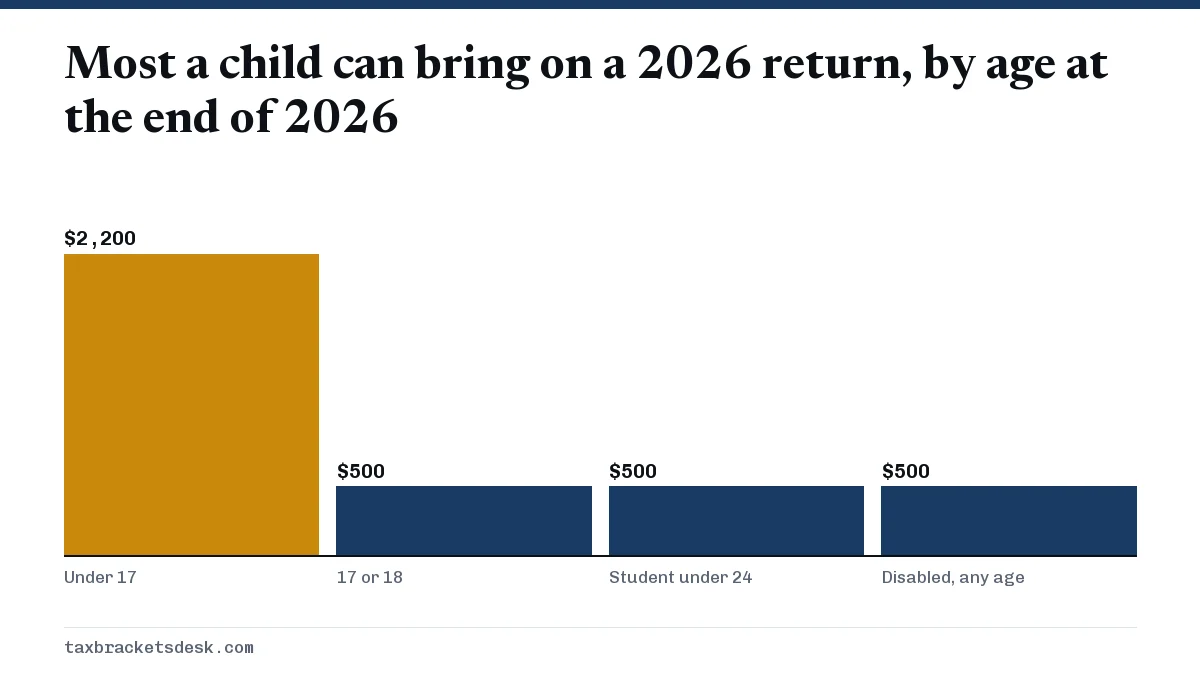
Does the child tax credit stop at 17 or 18?
It stops at 17. The first year you lose the credit is the year of the 17th birthday, not the year after it. A child born in 2009 turns 17 in 2026, so that child does not count on the 2026 return you file in 2027, even though the credit was claimed for them on the 2025 return.
The confusion about 18 comes from 2021. For that year only, the American Rescue Plan let 17-year-olds qualify: the IRS describes a 2021 qualifying child as one who had not turned 18 before January 1, 2022, with $3,000 for children aged 6 through 17. That rule was not extended. From 2022 the age test went back to under 17, and the 2025 law that set the credit at $2,200 left the age test unchanged.
When does a child turn 17 for tax purposes?
On the birthday itself. Rev. Rul. 2003-72 holds that a child attains a given age on the anniversary of the date the child was born. The ruling's own example is a child born on January 1, 1987, who attains age 17 on January 1, 2004.
This settles the edge cases parents worry about:
- Born January 1, 2010. The child turns 17 on January 1, 2027, so they are still 16 on December 31, 2026 and qualify for the 2026 credit.
- Born December 31, 2009. The child turns 17 on December 31, 2026, so they are not under 17 at the end of 2026 and do not qualify.
- Turned 17 on December 30. The Schedule 8812 instructions use a child who turned 17 on December 30, 2025 as an example of a child who cannot be used for the 2025 credit.
What credit can you get for a child who is 17 or older?
A child who is too old for the child tax credit can still bring the $500 credit for other dependents, as long as you claim them as a dependent. The Schedule 8812 instructions send every child who is 17 or older at the end of the year to that credit. You check one box or the other for each person on Form 1040, never both.
To stay your dependent as a qualifying child, the child must be younger than you (or your spouse on a joint return) and, at the end of the year, under 19, under 24 and a full-time student during some part of 5 calendar months, or permanently and totally disabled at any age, per Publication 501. Older children can still count as a qualifying relative if you provide more than half of their support and their 2026 gross income is under $5,300.
| Age on December 31, 2026 | Child tax credit | Credit for other dependents | What decides it |
|---|---|---|---|
| Under 17 | Up to $2,200 | No | Qualifying child tests and SSN |
| 17 or 18 | No | Up to $500 | Qualifying child: under 19 |
| 19 to 23, full-time student | No | Up to $500 | Student during some part of 5 months |
| 19 or older, not a student | No | Up to $500 | Qualifying relative: gross income under $5,300 |
| Any age, permanently and totally disabled | No | Up to $500 | Qualifying child at any age |
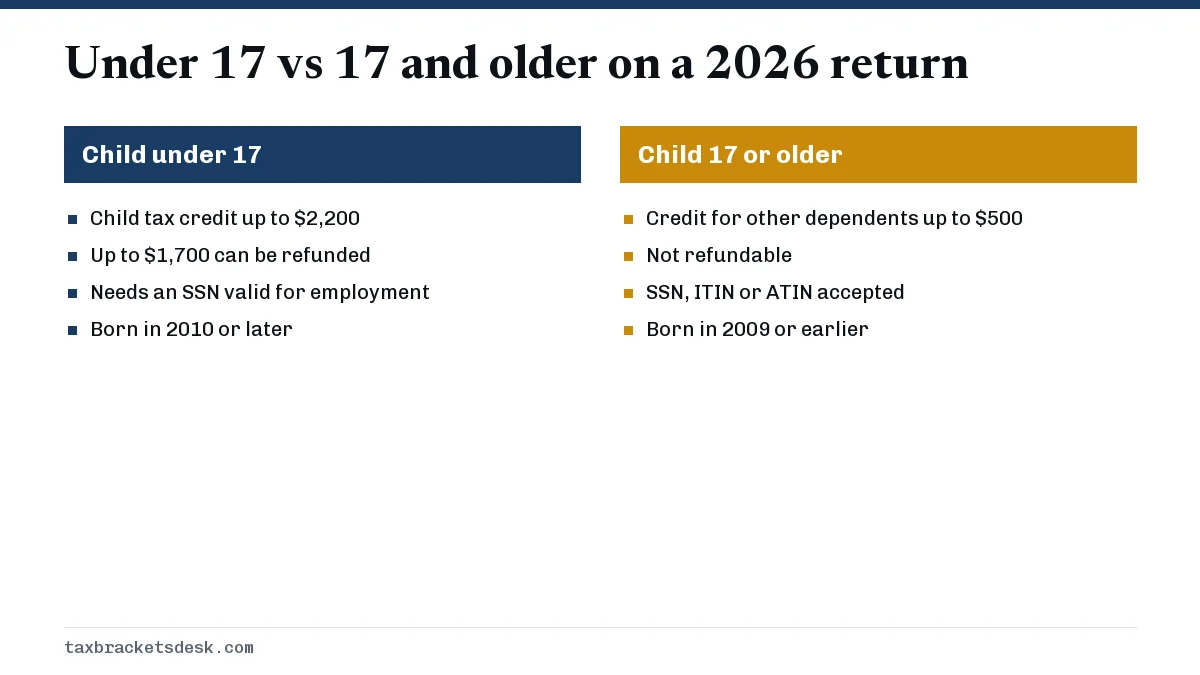
Both credits share the same income phaseout, which starts at $200,000 of modified AGI, or $400,000 on a joint return. The credit for other dependents page covers the $500 credit in full, including parents and other relatives you support.
Do newborns and children who died during the year qualify?
Yes. A baby born at any point in the year is under 17 on December 31, so the age test is met. Publication 501 treats a child who was born or died during the year as having lived with you for more than half the year if your home was the child's home for more than half the time the child was alive. A baby born on December 31, 2026 can therefore bring the full $2,200 for 2026.
The SSN is the usual obstacle. The child needs an SSN valid for employment, issued before the due date of the return including extensions. Apply when you register the birth, so the number arrives well before April. If a child was born and died in the same year and never received an SSN, the Schedule 8812 instructions tell you to attach proof of the birth and death, and the document must show the child was born alive. The SSN rules page covers the other cases.
How do age limits compare across family tax breaks?
Each family tax break sets its own age test, so a child can drop out of one while still counting for another. A 17-year-old with a part-time job, for example, no longer brings the child tax credit but can still be a qualifying child for the earned income credit.
| Tax break | Age limit | Exception for disability |
|---|---|---|
| Child tax credit | Under 17 at the end of the year | None |
| Credit for other dependents | No upper age for a dependent | Not needed |
| Earned income credit | Under 19, or under 24 if a full-time student | Any age if permanently and totally disabled |
| Child and dependent care credit | Under 13 when the care is provided | A dependent or spouse unable to care for themselves |
| Adoption credit | Under 18 | Any age if unable to care for themselves |
The earned income credit rules are in our EITC qualifications checklist. Care costs for children under 13 are on the child and dependent care credit page, and adoption costs on the adoption credit page.
How to plan for the year a child turns 17
- List each child's birth year. For 2026, anyone born in 2009 or earlier has left the child tax credit; for 2027, anyone born in 2010 or earlier.
- Budget for the smaller credit. Expect up to $500 instead of $2,200 for that child, and nothing refundable from it.
- Update Form W-4 in January. Step 3 counts $2,200 for each child under 17 and $500 for each other dependent. Moving a child from one line to the other lowers the credit your employer builds into withholding. Our W-4 withholding guide shows where it goes.
- Keep the dependent claim if you can. A full-time student under 24 still brings the $500 credit and can still count for the earned income credit.
- Check state credits separately. Some states run their own child credits with their own age rules, which do not follow the federal test.
If the credit on your return is lower than you expected and age is not the reason, our page on why your child tax credit is low walks through the other causes, from the income phaseout to the earned income rule.
Common questions
Can I claim the child tax credit for a 17-year-old?
No. The child must be under 17 at the end of the tax year. If you claim the 17-year-old as a dependent, you can take the $500 credit for other dependents instead.
My child turns 17 on December 31. Do I still get the credit for that year?
No. A child who turns 17 on December 31 is 17 at the end of the year and does not meet the age test. The credit for the last qualifying year is the one on the return for the year of the 16th birthday.
My child was born on January 1, 2010. Do I get the 2026 credit?
Yes. Under Rev. Rul. 2003-72 a child attains an age on the birthday itself, so this child turns 17 on January 1, 2027 and is still under 17 at the end of 2026.
Is there a higher age limit for a disabled child?
Not for the child tax credit, which is under 17 for every child. A permanently and totally disabled child of any age can still be your qualifying child and bring the $500 credit for other dependents and, if other tests are met, the earned income credit.
What is the child tax credit age limit for 2027?
It is still under 17 at the end of the year. For the 2027 return, filed in 2028, a child born in 2011 or later qualifies and a child born in 2010 or earlier does not.
Sources
- IRS: Child Tax Credit irs.gov
- Instructions for Schedule 8812 (Form 1040) irs.gov
- Publication 501, Dependents, Standard Deduction, and Filing Information irs.gov
- Internal Revenue Bulletin 2003-33 (Rev. Rul. 2003-72) irs.gov
- IRS: 2021 Child Tax Credit basics (Topic A) irs.gov
We check figures against these official pages. Rules change; confirm anything that affects a deadline or payment with the agency before you act.
Tell us what happened
Describe your situation and our editors will use it to improve this guide. If you leave your email, we may reply with a pointer to the right page or official contact. We never share your details.