
Payroll and Self-Employment Tax
W-4 withholding guide: filling out the 2026 Form W-4 step by step
Short answer
W-4 withholding is the federal income tax your employer takes from each paycheck based on the Form W-4 you give it. The 2026 Form W-4 has five steps: only Step 1 (personal information) and Step 5 (signature) are required. Steps 2 to 4 adjust for a second job, children, other income and deductions, including the new 2026 worksheet lines for tips, overtime, car loan interest and seniors.
- 01Required steps
- Step 1 and Step 5 only
- 02Step 3 child amount
- $2,200 per child under 17 (income $200,000 or less, $400,000 joint)
- 03Exempt status for 2026 expires
- New Form W-4 due by February 16, 2027
- 04When a new W-4 takes effect
- No later than the first payroll period ending on or after the 30th day
- 05IRS Tax Withholding Estimator
- About 25 minutes; produces a prefilled W-4
What is W-4 withholding?
W-4 withholding is the federal income tax an employer holds back from your wages and sends to the IRS on your behalf, calculated from the entries on your Form W-4, Employee's Withholding Certificate. The form tells payroll your filing status, whether you have other jobs, what credits and deductions to expect, and whether you want extra tax taken out.
The W-4 affects federal income tax only. Social Security and Medicare tax are fixed percentages that no W-4 entry can change (see FICA tax explained). Most states use their own withholding form, so a federal W-4 change does not automatically change state withholding.
The goal is to have withholding land close to your actual tax for the year. Too little means a balance due in April and possibly an underpayment penalty; too much means you wait for the money as a refund. According to the Form W-4 instructions, an employee who hands in no valid W-4 is treated as a single filer with no other entries.
How to fill out a W-4: the five steps
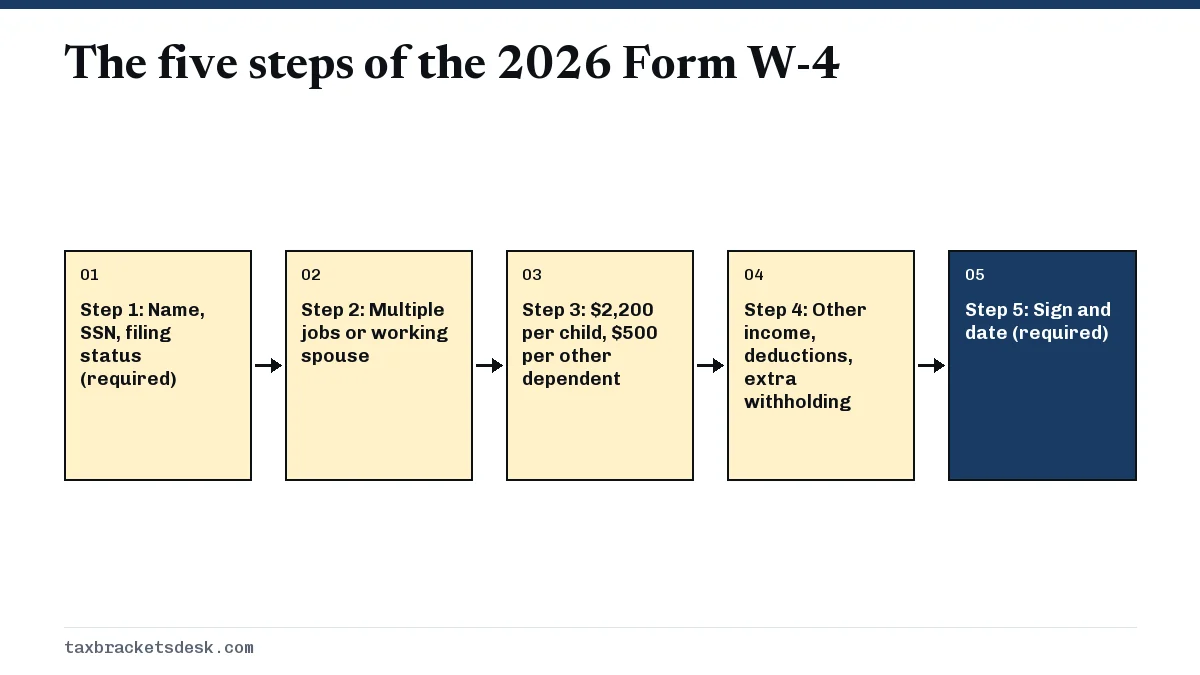
The 2026 Form W-4 fits on one page, with worksheets on pages 3 and 4. Work through it in order and skip Steps 2, 3 and 4 if none of them apply to you.
Step 1: Personal information and filing status
Enter your name, address and Social Security number, then check one box in Step 1(c): single or married filing separately; married filing jointly or qualifying surviving spouse; or head of household. The box sets the standard deduction and brackets payroll uses. Check head of household only if you are unmarried and pay more than half the cost of keeping up a home for yourself and a qualifying person.
Step 2: Multiple jobs or spouse works
Complete Step 2 if you hold more than one job at the same time, or if you are married filing jointly and your spouse also works. Choose one of three options: (a) use the IRS Tax Withholding Estimator, which the form calls the most accurate choice and the one to use if either of you has self-employment income; (b) use the Multiple Jobs Worksheet and put the result in Step 4(c); or (c) check the box on the W-4 for both jobs when there are exactly two jobs in total.
The Step 2(c) checkbox cuts the standard deduction and brackets in half for each job. The form says this works best when the two jobs pay about the same; when the pay gap is wide, it withholds more than needed.
Step 3: Claim dependents and other credits
If your total income will be $200,000 or less ($400,000 or less married filing jointly), multiply the number of qualifying children under 17 by $2,200 and the number of other dependents by $500, then add any other credits you expect, such as education credits. The $2,200 figure matches the 2026 Child Tax Credit amount.
Step 4: Other adjustments
- 4(a) Other income: interest, dividends or retirement income that has no withholding of its own. Entering it here can replace estimated tax payments for that income.
- 4(b) Deductions: the result of the Deductions Worksheet (line 15) if you expect deductions beyond the basic standard deduction. This line lowers withholding.
- 4(c) Extra withholding: a flat dollar amount added to every paycheck, including the result of the Multiple Jobs Worksheet.
Step 5: Sign and date
The form is not valid unless you sign it. With more than one job, complete Steps 3 through 4(b) on the W-4 for only one job, ideally the highest paying one, and leave them blank on the others.
Should I update my W-4 for the new deductions?
Yes, if you expect to claim any of the new Schedule 1-A deductions and want the tax savings in your paychecks instead of in a refund. The 2026 Step 4(b) Deductions Worksheet has new lines for them, and the amounts you enter reduce the income tax withheld each pay period.
| Worksheet line | Deduction | Maximum you can enter | Income limit on the worksheet |
|---|---|---|---|
| 1a | Qualified tips | $25,000 | Total income under $150,000 ($300,000 joint) |
| 1b | Qualified overtime (the "half" of time-and-a-half) | $12,500 ($25,000 joint) | Total income under $150,000 ($300,000 joint) |
| 1c | Passenger vehicle loan interest | $10,000 | Total income under $100,000 ($200,000 joint) |
| 3a and 3b | Seniors 65 or older | $6,000 per person | Total income under $75,000 ($150,000 joint) |
The worksheet uses simple cutoffs, while the actual deductions phase out gradually above those incomes. If your income is near a limit, enter a conservative estimate. Eligibility details are on our pages for no tax on overtime and the Schedule 1-A deductions.
Worked example: overtime on the Deductions Worksheet
A single hourly worker expects $6,000 of qualified overtime premium pay in 2026 and takes the standard deduction. On the worksheet, line 1b is $6,000 and line 2 is $6,000. Lines 4, 5 and 7 are zero because there is no senior amount, no adjustments and no itemized deductions, so line 10 is also zero. Line 11 is the $16,100 standard deduction, line 13 is $16,100, and line 14 is $0 because line 13 is larger than line 10. Line 15 is $6,000, which goes in Step 4(b).
If that $6,000 would otherwise be taxed in the 22% bracket, withholding for the year drops by roughly $1,320, or about $50.77 per biweekly check across 26 pay periods. This is an estimate: actual withholding follows the IRS percentage method tables in Publication 15-T.
Worked example: the Multiple Jobs Worksheet
A married couple files jointly. One spouse earns $92,000 and is paid every two weeks; the other earns $55,000. On the married filing jointly table on page 5 of the 2026 Form W-4, the higher paying job row for $80,000 to $99,999 meets the lower paying job column for $50,000 to $59,999 at $6,610. That is the extra tax for the year that neither paycheck would otherwise cover.
Divide $6,610 by 26 pay periods to get $254.23. The higher earner enters $254.23 in Step 4(c) of the W-4 for the $92,000 job and fills in Steps 3 and 4(b) on that same form. The lower earner's W-4 has only Steps 1 and 5 completed. The form notes that if more than one job pays over $120,000 or there are more than three jobs, you need the extra tables in Publication 505 or the online estimator.
How to use the IRS withholding calculator
The IRS Tax Withholding Estimator at irs.gov/W4App is the official withholding calculator. The IRS says it takes about 25 minutes, does not save or share your answers, and ends by producing a prefilled Form W-4 (or W-4P for pensions) that you can hand to your employer.
- Gather your most recent pay stubs for every job, your spouse's stubs if filing jointly, and last year's return if you have other income or itemize.
- Enter year-to-date wages and year-to-date federal withholding from each stub, so the tool counts tax already paid this year.
- Add expected tips, overtime, bonuses, self-employment income and credits.
- Review the projected refund or balance due, and choose a target (for example, close to zero).
- Download the prefilled W-4, check it, sign it and give it to payroll. Run the estimator again early next year.
The form itself recommends the estimator if you start a job mid-year, work only part of the year, receive bonuses, dividends, capital gains or Social Security, or expect to owe the Additional Medicare Tax or net investment income tax. For a quick look at take-home pay before you change anything, try our paycheck tax calculator.
How do I change my withholding, and when does it take effect?
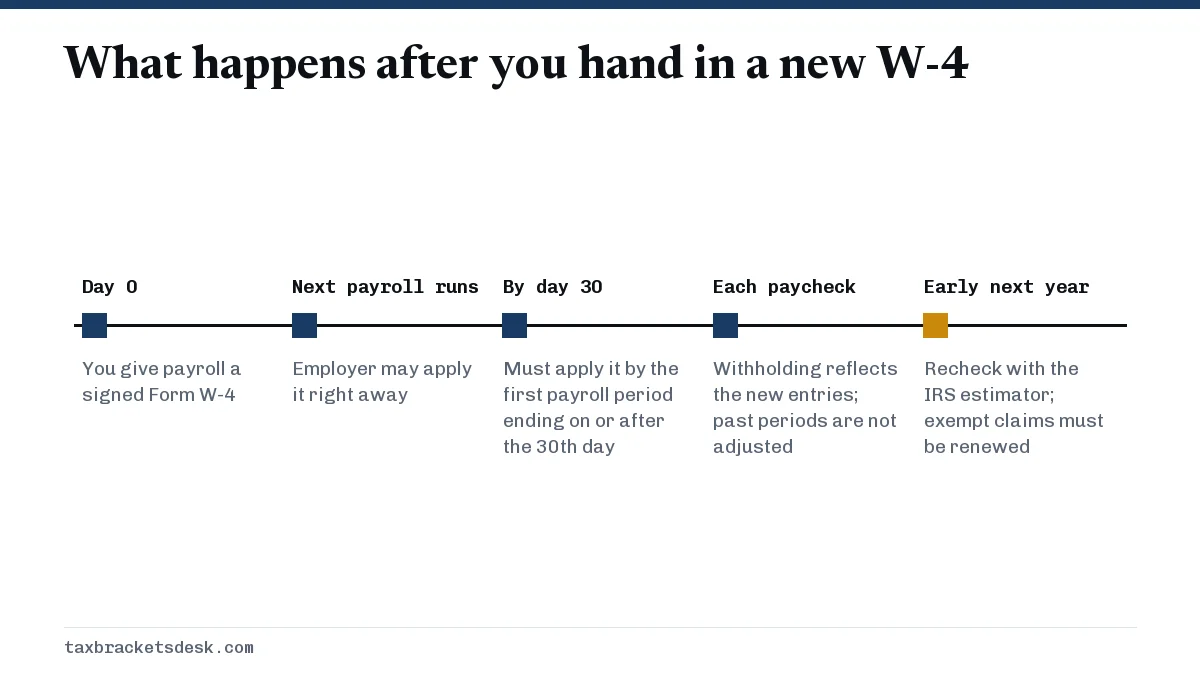
To change your withholding, give your employer a new Form W-4 (many employers accept it through the payroll portal). You can do this whenever you like. Your old W-4, even one from 2019 or earlier, stays in effect until you replace it, according to IRS Publication 15.
The employer must start using the new form no later than the first payroll period ending on or after the 30th day after it receives it. Withholding for pay periods already processed is not adjusted, and a W-4 marked for next year does not affect the current year.
How do I avoid owing at tax time?
Match your withholding to your full-year tax, including income that has no withholding. The most common causes of a surprise balance due, and the W-4 fix for each, are below.
- Two jobs or two earners with Step 2 skipped: each employer applies the full standard deduction and low brackets. Use Step 2(a), 2(b) or 2(c).
- Side income or investment income: enter it in Step 4(a), or pay quarterly using the estimated tax safe harbor rules.
- Bonuses: employers may withhold a flat 22% on bonus pay, which can be less than your top rate. See bonus tax rate.
- New deductions overestimated: if your tips or overtime come in lower than you entered in Step 4(b), withholding will be too low. Update the form mid-year.
- Pay above $200,000 in a two-earner household: add a Step 4(c) amount for the 0.9% Additional Medicare Tax that employers may not withhold.
Claiming exempt from W-4 withholding
You can claim exemption from federal income tax withholding for 2026 only if you had no federal income tax liability in 2025 and expect none in 2026. To claim it, check the Exempt box and complete only Steps 1(a), 1(b) and 5. Social Security and Medicare tax are still withheld.
Exempt status lasts one calendar year. The 2026 Form W-4 says you must submit a new form by February 16, 2027 to stay exempt. If you do not, Publication 15 tells the employer to withhold as if you had checked single or married filing separately with no other entries, and it will not refund tax withheld before a late exemption form arrives.
If the IRS finds serious underwithholding, it can send your employer a lock-in letter setting your maximum filing status and withholding. The employer must follow it and give you a copy within 10 business days; a new W-4 that would withhold less than the letter requires is ignored unless you contact the IRS and it agrees.
Step by step
Enter your personal information
Fill in Step 1 with your name, address, Social Security number and filing status box.
Account for multiple jobs
If you or your spouse have more than one job, use the IRS estimator, the Multiple Jobs Worksheet or the Step 2(c) checkbox.
Claim dependents
If income is $200,000 or less ($400,000 joint), enter $2,200 per child under 17 and $500 per other dependent in Step 3.
Make other adjustments
Enter other income in Step 4(a), the Deductions Worksheet result in Step 4(b) and any extra per-paycheck withholding in Step 4(c).
Sign and submit
Sign Step 5 and give the form to your employer, which must apply it by the first payroll period ending on or after the 30th day.
Common questions
Should I claim 0 or 1 on my W-4?
The current Form W-4 no longer uses allowances, so there is no 0 or 1 to claim. Since 2020 the form asks for dollar amounts for credits, other income, deductions and extra withholding instead. To have more tax withheld, enter a per-paycheck amount in Step 4(c).
Do I need to fill out a new W-4 every year?
No. Your existing W-4 stays in effect until you replace it, unless you claimed exempt, which expires each year. The IRS still suggests reviewing it each year and after any change in marriage, jobs, children or income.
How do I put tips and overtime on my W-4?
Use the Step 4(b) Deductions Worksheet on page 4 of the 2026 form. Enter expected qualified tips on line 1a and the overtime premium on line 1b, then carry line 15 to Step 4(b). Those entries reduce the tax withheld from each check.
Why is so little federal tax withheld from my paycheck?
Common reasons are a second job or working spouse without Step 2 completed, large Step 3 credits, a big Step 4(b) deduction, or an exempt claim. Compare your W-4 entries with your current situation and run the IRS estimator.
Can my employer refuse my new W-4?
Publication 15 says a W-4 is invalid if it has unauthorized changes or the employee clearly indicates it is false, and a false W-4 can bring a $500 penalty. An employer must also follow an IRS lock-in letter over your form. Otherwise it has to apply a valid new W-4 within the 30-day window.
Does the W-4 change state tax withholding?
Usually not. Many states have their own withholding certificate, while some rely on the federal form. Check with your employer's payroll team or your state revenue department.
Sources
- Form W-4 (2026), Employee's Withholding Certificate irs.gov
- About Form W-4 irs.gov
- Tax Withholding Estimator irs.gov
- Publication 505 (2026), Tax Withholding and Estimated Tax irs.gov
- Publication 15 (2026), Employer's Tax Guide irs.gov
We check figures against these official pages. Rules change; confirm anything that affects a deadline or payment with the agency before you act.
Tell us what happened
Describe your situation and our editors will use it to improve this guide. If you leave your email, we may reply with a pointer to the right page or official contact. We never share your details.
Related guides
 FICA Tax: Social Security and Medicare Rates for 2026
FICA tax is the 7.65% payroll tax taken from an employee's wages in 2026: 6.2% for Social Security on the first $184,500 of pay a…
Bonus Tax Rate 2026: 22% Federal Withholding Explained
The federal bonus tax rate for 2026 is a flat 22% income tax withholding rate that employers may use on bonuses paid separately f…
Additional Medicare Tax: 0.9% Over $200,000 Explained
Additional Medicare Tax is a 0.9% tax on Medicare wages and self-employment income above $200,000 for single and head of househol…
Paycheck Tax Calculator: Take-Home Pay After Taxes
A paycheck tax calculator subtracts three federal taxes from each check: income tax withholding from the 2026 IRS Publication 15-…
Safe Harbor Estimated Tax 2026: 90%, 100% and 110% Rules
To meet the 2026 safe harbor for estimated tax and avoid the IRS underpayment penalty, your withholding plus on-time estimated pa…
Social Security Tax 2026: 6.2% Rate Up to the $184,500 Cap
Social Security tax is 6.2% of an employee's wages up to the 2026 wage base of $184,500, which makes the maximum employee tax $11…