
Standard and Itemized Deductions
HSA contribution limits 2027 and 2026: self-only, family, the age 55 catch-up and the HDHP rules
Short answer
The HSA contribution limits for 2027 are $4,500 for self-only coverage and $9,000 for family coverage, up from $4,400 and $8,750 for 2026, under IRS Rev. Proc. 2026-24. People 55 or older can add $1,000. Employer contributions count toward the limit. Contributions for 2026 can still be made until April 15, 2027, and the deduction lowers AGI whether or not you itemize.
- 012027 limit, self-only coverage
- $4,500
- 022027 limit, family coverage
- $9,000
- 032026 limits
- $4,400 self-only; $8,750 family
- 04Catch-up at 55 or older
- $1,000 extra
- 052027 HDHP minimum deductible
- $1,750 self-only; $3,500 family
- 06Last day for 2026 contributions
- April 15, 2027
What are the HSA contribution limits for 2027?
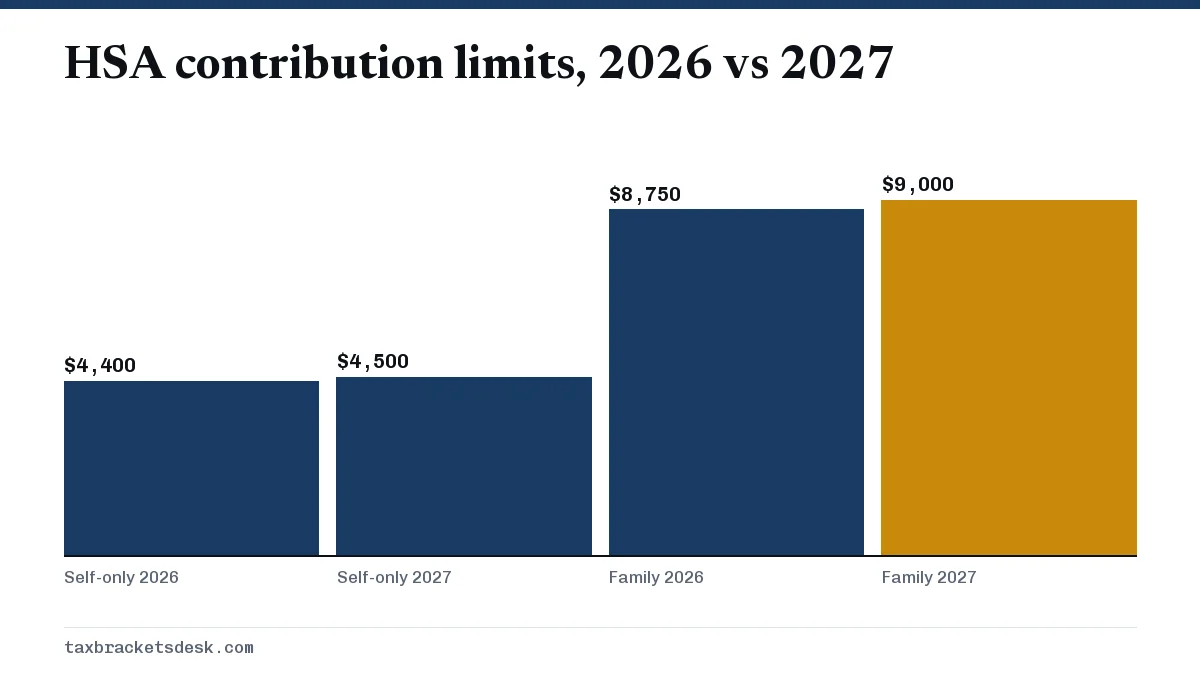
For 2027 you can put up to $4,500 into a health savings account if your high deductible health plan (HDHP) covers only you, or up to $9,000 if it covers you and at least one other person. The IRS set these amounts in Rev. Proc. 2026-24, released in 2026, using the yearly inflation adjustment. The 2026 limits, from Rev. Proc. 2025-19, are $4,400 and $8,750.
| Item | 2026 | 2027 |
|---|---|---|
| Contribution limit, self-only coverage | $4,400 | $4,500 |
| Contribution limit, family coverage | $8,750 | $9,000 |
| Catch-up contribution, age 55 or older | $1,000 | $1,000 |
| HDHP minimum deductible, self-only | $1,700 | $1,750 |
| HDHP minimum deductible, family | $3,400 | $3,500 |
| HDHP out-of-pocket maximum, self-only | $8,500 | $8,700 |
| HDHP out-of-pocket maximum, family | $17,000 | $17,400 |
Most employers ask for a 2027 payroll election during fall 2026 open enrollment. Spread over 26 biweekly paychecks, the self-only maximum of $4,500 is about $173 per paycheck, and the family maximum of $9,000 is about $346.
How much can you contribute to an HSA for 2026?
For 2026 the limits are $4,400 for self-only coverage and $8,750 for family coverage, plus $1,000 if you are 55 or older at the end of the year. You do not have to finish by December 31. Publication 969 allows contributions for a year until the due date of that year's return, so contributions made through April 15, 2027 can still count for 2026.
If you were HSA-eligible for only part of 2026, the limit is figured on the Form 8889 line 3 limitation chart and worksheet, which counts the months you were eligible. The exception is the last-month rule: if you are eligible on December 1, you are treated as eligible for the whole year and can contribute the full amount. You then have to stay eligible through a testing period that ends on the last day of the 12th month after that December. If you do not, the extra contributions are added to your income and charged a 10% additional tax.
What is the HSA catch-up contribution for people 55 and older?
If you are 55 or older at the end of the year, your limit rises by $1,000. The catch-up amount is the same for 2026 and 2027. On family coverage, each spouse who is 55 or older must put the extra $1,000 into their own HSA; it cannot go into the other spouse's account.
| Coverage and age | 2026 | 2027 |
|---|---|---|
| Self-only, under 55 | $4,400 | $4,500 |
| Self-only, 55 or older | $5,400 | $5,500 |
| Family, one spouse 55 or older | $9,750 | $10,000 |
| Family, both spouses 55 or older, each with an HSA | $10,750 | $11,000 |
Do employer HSA contributions count toward the limit?
Yes. Publication 969 says you must reduce your limit by contributions your employer makes that are excludable from your income. Money you put in through a cafeteria plan by salary reduction is treated as an employer contribution, so it counts too. Form W-2 box 12 with code W shows the total.
Worked example: you have family coverage in 2027 and your employer adds $1,500 to your HSA. You can contribute $7,500 more ($9,000 minus $1,500). At 55 or older, you could add another $1,000, for $8,500.
Going over the limit costs a 6% excise tax on the excess for each year it stays in the account. You avoid it by withdrawing the excess and the earnings on it by the due date of the return, including extensions, and reporting those earnings as other income.
Which health plans qualify for an HSA in 2026 and 2027?
You can contribute for a month only if you are covered by an HDHP on the first day of that month, have no other disqualifying health coverage, are not enrolled in Medicare and cannot be claimed as someone else's dependent. The HDHP must meet the minimum deductible and out-of-pocket maximum in the table above. The 2025 tax law widened the list of plans that work with an HSA:
- Bronze and catastrophic plans. From January 1, 2026, bronze and catastrophic plans available through an Exchange are treated as HSA-compatible. Notice 2026-5 adds that the same plan bought outside the Exchange also qualifies.
- Direct primary care. From January 1, 2026, enrolling in a qualifying direct primary care arrangement does not stop you contributing, and you can pay its fees from the HSA tax-free. For 2027 the fees must not exceed $150 a month, or $300 for an arrangement covering more than one person.
- Telehealth. Receiving telehealth and other remote care before you meet the deductible no longer disqualifies you. The 2025 law made this permanent for plan years beginning on or after January 1, 2025.
How does an HSA contribution lower your tax?
Contributions you make yourself are deducted on Form 8889, and Publication 969 says you can claim the deduction even if you do not itemize. It lowers adjusted gross income, so a single filer in the 22% bracket who contributes $4,400 for 2026 cuts federal income tax by $968. Contributions through payroll are excluded from wages instead, and employer contributions are generally not subject to employment taxes, so they also avoid the 7.65% of Social Security and Medicare tax.
A lower AGI can help elsewhere on the return. It lowers the 7.5% floor for the medical expense deduction, the household income used for the premium tax credit, and the modified AGI used in the child tax credit phaseout. The HSA deduction is one of the adjustments listed in our guide to how taxable income is calculated.
- Qualified medical expenses paid from the HSA are tax-free, but you cannot also deduct them on Schedule A.
- Other withdrawals are taxed as income and carry an additional 20% tax.
- No 20% tax applies to withdrawals after you reach 65, become disabled or die; ordinary income tax still applies to non-medical withdrawals.
Common questions
What is the HSA contribution limit for 2027?
$4,500 for self-only HDHP coverage and $9,000 for family coverage, under Rev. Proc. 2026-24. People 55 or older can contribute $1,000 more.
What is the 2026 HSA limit if I am over 55?
$5,400 with self-only coverage ($4,400 plus the $1,000 catch-up) and $9,750 with family coverage. If both spouses are 55 or older, each can add $1,000 to their own HSA, for $10,750 in total.
Can I still contribute to my HSA for 2026 in 2027?
Yes. Contributions for 2026 can be made until the due date of the 2026 return, April 15, 2027.
Does my employer's HSA contribution count toward the limit?
Yes. Employer contributions, including your own pre-tax payroll contributions through a cafeteria plan, reduce the amount you can add yourself.
Can I contribute to an HSA with a bronze plan in 2026?
Yes. From January 1, 2026, bronze and catastrophic plans available through an Exchange are treated as HSA-compatible, as long as you meet the other eligibility rules.
Sources
- Rev. Proc. 2026-24 (2027 HSA and HDHP amounts) irs.gov
- Rev. Proc. 2025-19 (2026 HSA and HDHP amounts) irs.gov
- IRS Publication 969, Health Savings Accounts and Other Tax-Favored Health Plans irs.gov
- IRS: Guidance on new tax benefits for health savings account participants (IR-2025-119) irs.gov
- Notice 2026-5 irs.gov
We check figures against these official pages. Rules change; confirm anything that affects a deadline or payment with the agency before you act.
Tell us what happened
Describe your situation and our editors will use it to improve this guide. If you leave your email, we may reply with a pointer to the right page or official contact. We never share your details.
Related guides
 How Taxable Income Is Calculated: Gross to Taxable
Taxable income is calculated in three steps: add up all gross income that is not excluded by law, subtract adjustments such as de…
Premium Tax Credit 2026: 400% Income Cap and Full Repayment
The premium tax credit for 2026 is back to its original limits: a household with income above 400% of the federal poverty line, $…
 Standard Deduction: Amounts by Filing Status and Age
For tax year 2026, the returns you file in 2027, the standard deduction is $16,100 for single or married filing separately, $32,2…
Tax Changes 2027: What Is New for Your Next Return
The main tax changes in 2027 land on the tax year 2026 return you file that season: a $1,000 ($2,000 joint) charity deduction wit…