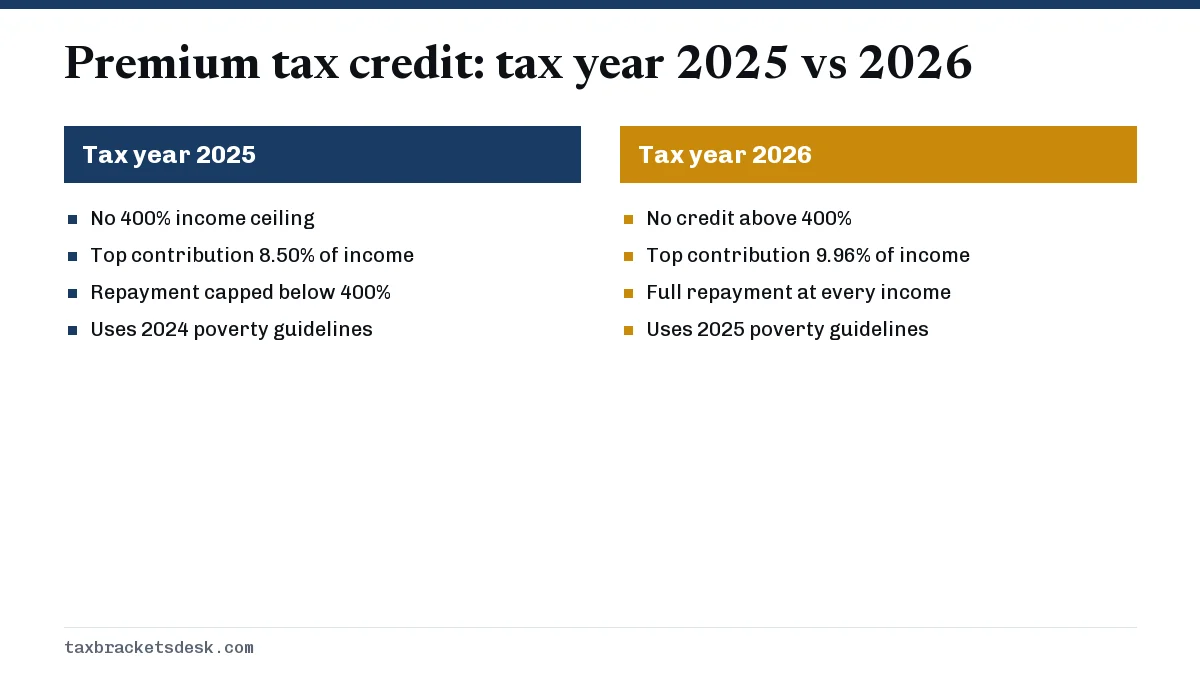
The premium tax credit for 2026 is back to its original limits: a household with income above 400% of the federal poverty line, $62,600 for one person, gets no credit, and the expected contribution tops out at 9.96% of income. For the first time, any excess advance credit must be repaid in full on Form 8962 when you file in 2027, with no repayment cap at any income.
01Income range
100% to 400% of the federal poverty line
02400% line, one person (48 states and DC)
$62,600
03400% line, family of four
$128,600
04Top expected contribution
9.96% of household income
05Repayment cap on excess advance credit
None from tax year 2026
06Form
Form 8962, filed with the 2026 return
07Top expected contribution for 2027
10.22% (Rev. Proc. 2026-26)
What changed for the premium tax credit in 2026?
The premium tax credit (PTC) helps pay for health insurance bought through the Health Insurance Marketplace. For 2021 through 2025, Congress temporarily removed the 400% income ceiling and lowered the share of income people were expected to pay. That expansion ended with 2025. Publication 505 for 2026 lists two changes that apply from 2026: households above 400% of the federal poverty line are no longer eligible, and there is no longer a limit on how much excess advance credit you pay back, even if your income is below 400%.
The repayment change comes from the 2025 tax law, Public Law 119-21, which IRS pages now call the Working Families Tax Cuts Act. As of October 20, 2026, IRS guidance still applies both rules to 2026 coverage, and the enhanced 2021 to 2025 credit has not been restored.
Premium tax credit rules: tax year 2025 vs tax year 2026
Rule
Tax year 2025
Tax year 2026
Income above 400% of the poverty line
Could still qualify
No credit
Expected contribution at the low end
0.00% below 150%
2.10% below 133%
Top expected contribution
8.50% of income
9.96% of income
Repaying excess advance credit
Capped at $375 to $3,250 below 400%
Full amount, no cap
Poverty guidelines used
2024 figures
2025 figures
Premium tax credit: tax year 2025 vs 2026
What is the income limit for the premium tax credit in 2026?
Household income generally has to be at least 100% and no more than 400% of the federal poverty line for your family size. For 2026 coverage the Marketplace and Form 8962 use the poverty guidelines published in 2025, because HealthCare.gov uses income from the previous year's table to calculate savings for the next year. The table shows the lines for the 48 contiguous states and the District of Columbia; Alaska and Hawaii have higher figures.
Premium tax credit income range for 2026 coverage (48 states and DC)
Household size
100% of poverty line
400% of poverty line
1
$15,650
$62,600
2
$21,150
$84,600
3
$26,650
$106,600
4
$32,150
$128,600
5
$37,650
$150,600
Household income is your modified AGI plus that of every family member who must file a return. Modified AGI adds back tax-exempt interest, Social Security benefits that are not taxed and excluded foreign income, according to the IRS questions and answers on the credit. Pre-tax 401(k) and HSA contributions lower AGI, so they also lower household income.
Income is not the only test. The IRS eligibility rules also require that:
You or a family member enrolled in a plan through the Marketplace for at least one month.
The person enrolled was not eligible for Medicare, Medicaid, TRICARE or affordable employer coverage that provides minimum value. For 2026, employer coverage counts as affordable when the required contribution is no more than 9.96% of household income.
You do not file as married filing separately, except for certain victims of domestic abuse or spousal abandonment.
Nobody else can claim you as a dependent.
How much is the premium tax credit in 2026?
The credit is the premium for the second lowest cost silver plan available to you through the Marketplace (the benchmark plan), minus an expected contribution that is a percentage of your household income. It can never be more than the premium of the plan you actually enroll in. The percentage rises with income, under the 2026 table in Rev. Proc. 2025-25:
2026 applicable percentage table (Rev. Proc. 2025-25)
Household income, % of poverty line
Expected contribution, % of income
Less than 133%
2.10%
133% to less than 150%
3.14% to 4.19%
150% to less than 200%
4.19% to 6.60%
200% to less than 250%
6.60% to 8.44%
250% to less than 300%
8.44% to 9.96%
300% to 400%
9.96%
More than 400%
No credit
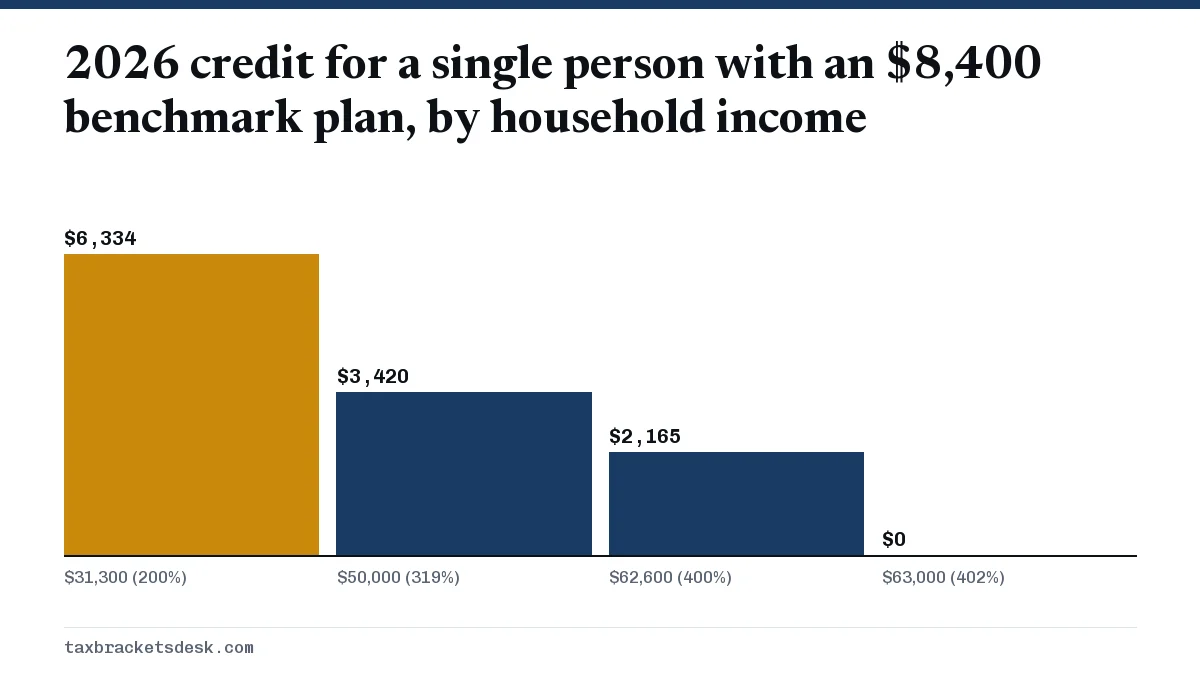
Worked example: a single person with household income of $50,000 is at 319% of the $15,650 poverty line, so the expected contribution is 9.96%, or $4,980 for the year. Assume the benchmark silver plan in their area costs $8,400 a year ($700 a month). The credit is $8,400 minus $4,980, which is $3,420. If they pick a cheaper plan costing $3,000, the credit is limited to $3,000.
What is the 400% subsidy cliff in 2026?
Because the credit stops completely above 400% of the poverty line, a small amount of extra income can cost the whole credit. Keep the same single person and the same $8,400 benchmark plan:
At $62,600 of household income, exactly 400%, the expected contribution is $6,234.96 and the credit is about $2,165.
At $63,000, about 402%, the credit is $0. Earning $400 more costs about $2,165 of credit.
2026 credit for a single person with an $8,400 benchmark plan, by household income
Do you have to pay back the premium tax credit in 2026?
You pay back whatever part of the advance credit you were not entitled to. Advance payments are based on the income you estimated when you enrolled. When you file, Form 8962 recomputes the credit with your actual income. If the advance payments were less than the credit, you get the difference as a refundable credit. If they were more, the excess is subtracted from your refund or added to your balance due.
For tax years before 2026, the excess was capped for households below 400% of the poverty line: from $375 to $3,250 under the 2025 Form 8962 instructions, depending on income and filing status. The IRS says that for tax years after 2025 there is no repayment cap, and you repay the full amount.
Single person, $8,400 benchmark plan: estimated vs actual 2026 income
Step
Amount
Income estimated at enrollment
$31,300 (200% of the poverty line)
Advance credit paid during 2026
$6,334.20 ($8,400 minus 6.60% of $31,300)
Actual 2026 household income
$50,000 (319%)
Credit allowed on Form 8962
$3,420 ($8,400 minus 9.96% of $50,000)
Excess advance credit repaid in 2027
$2,914.20, in full
Repayment under the caps used through 2025
$1,625 for a single filer between 300% and 400%
If advance credit was paid for anyone in your tax family, you must file a return with Form 8962 even if you would not otherwise have to file. The IRS warns that skipping it makes you ineligible for advance credit in future years. You need Form 1095-A from the Marketplace, which should arrive by early February.
How to avoid a large premium tax credit repayment
Report changes to the Marketplace promptly. The IRS lists changes in income, address, employment, other coverage, births and adoptions, and marriage or divorce. The Marketplace then adjusts the advance credit.
Estimate income generously. Include raises, bonuses, self-employment profit, capital gains and retirement withdrawals.
Take less than the full advance credit. The IRS lets you have all, some or none of the estimated credit paid in advance; any credit you leave unclaimed during the year comes back on Form 8962 if your income ends up as estimated.
Set money aside or adjust withholding. A larger withholding amount on Form W-4, or an estimated tax payment, covers a repayment you can see coming.
Lower modified AGI if you are near 400%. Pre-tax 401(k) contributions, deductible traditional IRA contributions and HSA contributions reduce the income Form 8962 uses.
The premium tax credit sits alongside the other changes on 2026 returns listed in our tax changes 2027 overview. To see how a repayment changes your refund, run your figures through the tax refund calculator and add the repayment to the tax line.
What about the premium tax credit for 2027 coverage?
The same structure carries into 2027: no credit above 400% of the poverty line and no repayment cap. Two inputs change. Plans for 2027 use the newer poverty guidelines, which HealthCare.gov lists as $15,960 for one person and $33,000 for a family of four (Alaska and Hawaii are higher), so the 400% line rises to $63,840 for one person and $132,000 for four. And Rev. Proc. 2026-26, published in July 2026, raises every expected contribution percentage:
Applicable percentage table, 2026 vs 2027 (Rev. Proc. 2025-25 and Rev. Proc. 2026-26)
Household income, % of poverty line
2026
2027
Less than 133%
2.10%
2.15%
133% to less than 150%
3.14% to 4.19%
3.23% to 4.30%
150% to less than 200%
4.19% to 6.60%
4.30% to 6.78%
200% to less than 250%
6.60% to 8.44%
6.78% to 8.66%
250% to less than 300%
8.44% to 9.96%
8.66% to 10.22%
300% to 400%
9.96%
10.22%
For 2027, employer coverage counts as affordable when the required contribution is no more than 10.22% of household income. With the same $8,400 benchmark premium used above, for illustration only, a single person with $50,000 of 2027 household income (313% of $15,960) would be expected to pay 10.22%, or $5,110, leaving a credit of $3,290, which is $130 less than for 2026. Benchmark premiums change every year, so rely on the Marketplace's own estimate when you enroll and update it as your income changes.
Common questions
What is the income limit for the premium tax credit in 2026?
Household income must be no more than 400% of the federal poverty line. For 2026 coverage in the 48 contiguous states and DC that is $62,600 for one person and $128,600 for a family of four. Alaska and Hawaii have higher lines.
Is there a repayment limit for the premium tax credit in 2026?
No. Starting with tax year 2026, any excess advance credit must be repaid in full, even if household income is below 400% of the poverty line. The caps of $375 to $3,250 applied only to earlier years.
Do I have to file Form 8962 if I received advance payments?
Yes. If advance credit was paid for you or anyone in your tax family, you must file a return with Form 8962 to reconcile it, even if you are not otherwise required to file.
Is the premium tax credit refundable?
Yes. If the credit figured on Form 8962 is larger than the advance payments, the difference reduces your tax and any amount left over is paid to you as a refund.
Did Congress extend the enhanced premium tax credit for 2026?
No. As of October 20, 2026, IRS guidance for tax year 2026 still applies the 400% limit, the 9.96% top contribution rate and full repayment of excess advance credit, because the enhanced 2021 to 2025 credit was not extended.
We check figures against these official pages. Rules change; confirm anything that affects a deadline or payment with the agency before you act.
Tell us what happened
Describe your situation and our editors will use it to improve this guide. If you leave your email, we may reply with a pointer to the right page or official contact. We never share your details.

 Education Tax Credits and Other Credits: 2026 Amounts
There are two federal education tax credits for 2026: the American Opportunity Credit, worth up to $2,500 per student with $1,000…
One Big Beautiful Bill Tax Changes for Individuals
The One Big Beautiful Bill (Public Law 119-21, signed July 4, 2025) made the seven tax rates and the larger standard deduction pe…
Tax Refund Calculator: Estimate Refund or Amount Owed
A tax refund calculator subtracts your total 2026 federal tax from everything already paid: Form W-2 box 2 withholding, estimated…
W-4 Withholding: How to Fill Out the Form W-4 for 2026
W-4 withholding is the federal income tax your employer takes from each paycheck based on the Form W-4 you give it. The 2026 Form…