
Tax Calculators and Salary Examples
How much tax on a 100k salary: 2026 federal tax, FICA and take-home pay
Short answer
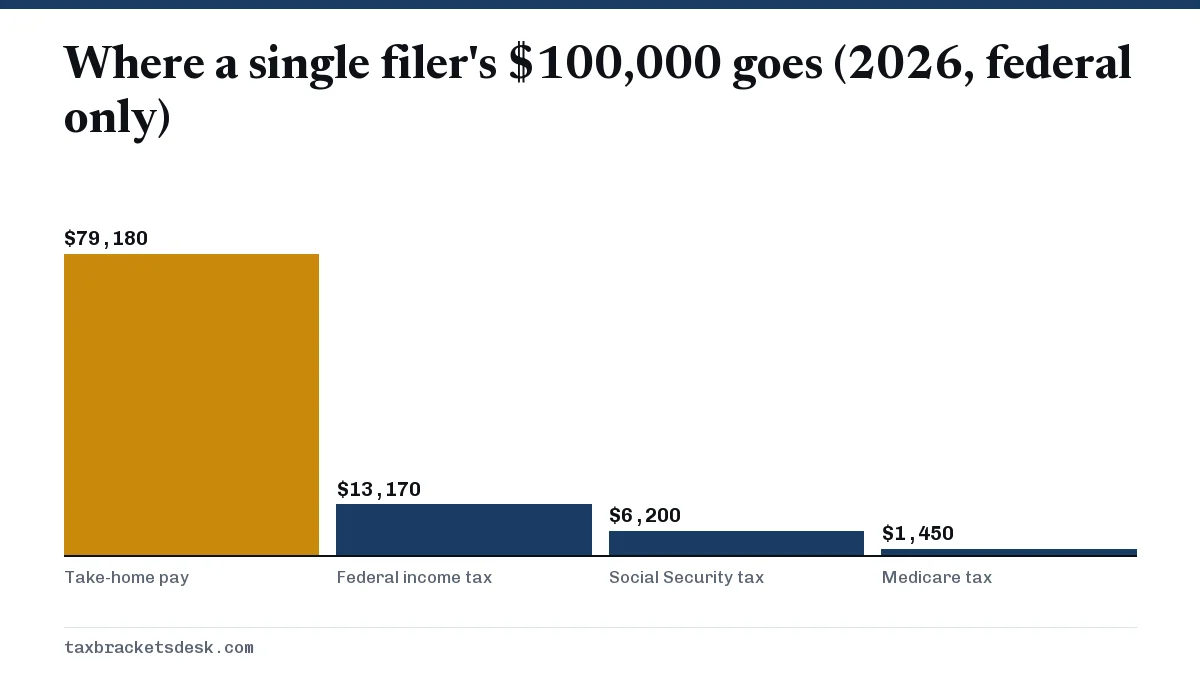
How much tax on a 100k salary? For tax year 2026, a single filer taking the standard deduction owes $13,170 of federal income tax and $7,650 of Social Security and Medicare tax, keeping $79,180 a year, or about $6,598 a month, before state tax. A married couple on one $100,000 income owes $7,640 of income tax before credits.
- 01Federal income tax on $100,000, single (2026)
- $13,170 (13.17% effective)
- 02Federal income tax on $100,000, married filing jointly
- $7,640 (7.64% effective)
- 03FICA on $100,000 of wages
- $7,650 ($6,200 Social Security + $1,450 Medicare)
- 04$100k after tax, single, federal only
- $79,180 a year / $6,598 a month
- 05Top bracket reached on $100,000, single
- 22%, with $21,800 of room before 24%
How much tax on a 100k salary by filing status?
The federal income tax on a $100,000 salary in tax year 2026 is $13,170 for a single filer, $9,588 for a head of household and $7,640 for a married couple filing jointly with one earner. Each figure assumes wages are the only income and the standard deduction is taken, using the brackets in IRS Revenue Procedure 2025-32. Credits come off afterward.
Social Security and Medicare add $7,650 no matter how you file. These are the amounts that apply to the 2026 return you file in the 2027 season.
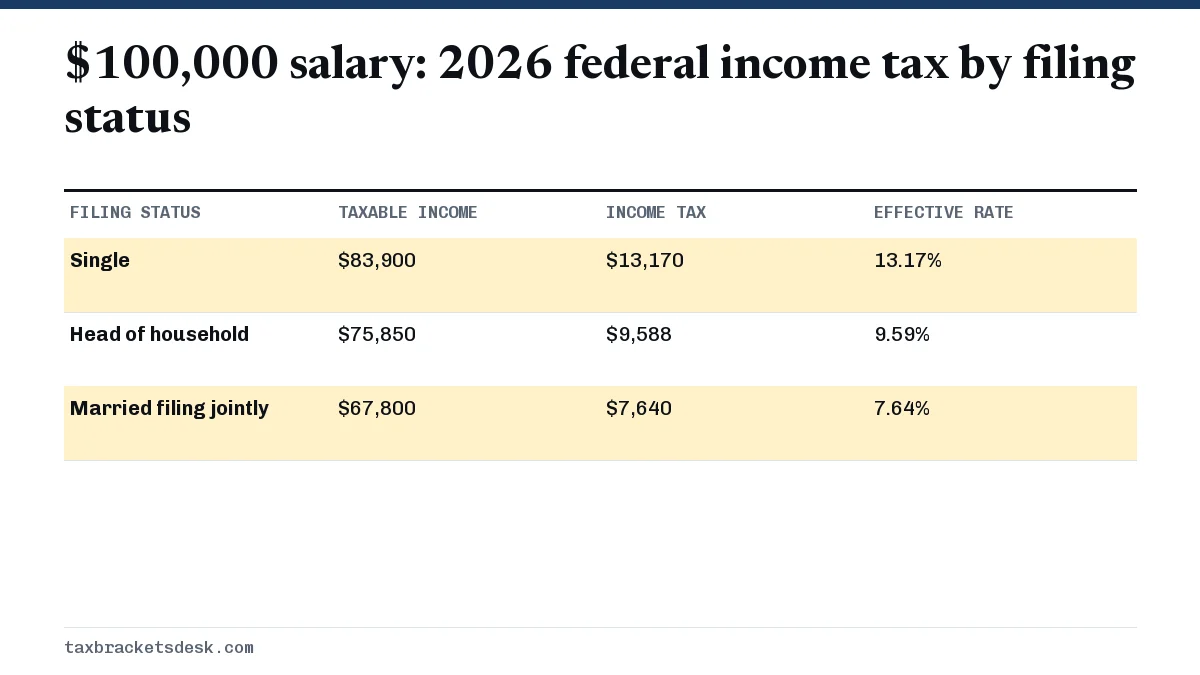
A married couple with two $50,000 salaries owes the same $7,640 as a couple with one $100,000 salary, because the joint return taxes combined income. Married filing separately at $100,000 each uses the single bracket math, $13,170 per spouse.
Single filer: the full calculation
A single filer earning $100,000 has $83,900 of taxable income after the $16,100 standard deduction for 2026. That income runs through three brackets.
| Bracket | Income in the bracket | Rate | Tax |
|---|---|---|---|
| $0 to $12,400 | $12,400 | 10% | $1,240 |
| $12,400 to $50,400 | $38,000 | 12% | $4,560 |
| $50,400 to $83,900 | $33,500 | 22% | $7,370 |
| Total | $83,900 | $13,170 |
So $100,000 lands in the 22% bracket for a single person, but only $33,500 of it is taxed at 22%. The effective rate on the whole salary is 13.17%. The single 22% band runs to $105,700 of taxable income, so a raise of up to $21,800 stays at 22%; the single filer tax brackets page lists every band.
Married filing jointly on $100,000
A married couple filing jointly subtracts the $32,200 standard deduction and has $67,800 of taxable income. The first $24,800 is taxed at 10% ($2,480) and the remaining $43,000 at 12% ($5,160), for $7,640.
That keeps the couple entirely in the 12% bracket, which runs to $100,800 of joint taxable income. They could add $33,000 of taxable income before any dollar is taxed at 22%, one reason married couples with a single $100,000 earner see a far lower effective rate (7.64%) than a single person. The married filing jointly brackets show the full table.
Head of household version
A single parent who qualifies as head of household subtracts $24,150, leaving $75,850 of taxable income. Tax is $1,770 at 10%, $5,970 at 12% on the band from $17,700 to $67,450, and $1,848 at 22% on the last $8,400, for $9,588.
The $2,200 Child Tax Credit for one qualifying child then cuts that to $7,388. At $100,000 the credit is not reduced, because the phaseout starts at $200,000 of modified AGI for this status. The Earned Income Tax Credit is not available at this income; it ends at $51,593 with one child for non-joint filers in 2026.
How much is FICA on $100,000, and what is 100k after tax per month?
FICA on $100,000 of wages is $7,650: 6.2% Social Security tax ($6,200) plus 1.45% Medicare tax ($1,450), per IRS Topic 751. The whole salary is under the $184,500 Social Security wage base for 2026 and under the $200,000 point where the 0.9% Additional Medicare Tax is withheld.
| Filing status | Per year | Per month | Every two weeks |
|---|---|---|---|
| Single | $79,180 | $6,598 | $3,045 |
| Head of household | $82,762 | $6,897 | $3,183 |
| Married filing jointly, one earner | $84,710 | $7,059 | $3,258 |
Real paychecks are lower once health premiums and retirement deferrals come out, and higher for parents who adjust Form W-4 Step 3 for their credits. The paycheck tax calculator works through the withholding for one pay period.
What does a raise above $100,000 actually keep?
Each extra $1,000 of salary for a single filer costs $220 of income tax at 22% and $76.50 of FICA, so $703.50 reaches the bank before state tax. That holds until taxable income passes $105,700, when the income tax rate on new dollars rises to 24%.
How deductions and credits change the tax on $100,000
At $100,000 the biggest levers are pretax retirement savings, the Child Tax Credit and the temporary deductions added for 2025 through 2028. Several income limits sit close to this salary, so small differences in modified AGI matter.
| Situation | Income tax | Change from base |
|---|---|---|
| Single, base case | $13,170 | None |
| Single, $10,000 into a traditional 401(k) | $10,970 | Saves $2,200 |
| Single, $5,000 of qualified overtime premium deducted | $12,070 | Saves $1,100 |
| Married jointly, two children under 17 | $3,240 | Saves $4,400 |
| Married jointly, $2,500 student loan interest | $7,340 | Saves $300 |
- Student loan interest is lost for single filers at this salary. The 2026 deduction phases out between $85,000 and $100,000 of modified AGI for single filers, so a single earner at $100,000 gets nothing. Joint filers keep it until $175,000.
- Overtime and tips deductions are fully available. Both phase out only above $150,000 of modified AGI ($300,000 joint). See the no tax on overtime deduction.
- Car loan interest is at the edge. The deduction for interest on a qualifying new US-assembled vehicle starts phasing out above $100,000 of modified AGI for single filers, so a small raise or bonus trims it.
- Senior deduction is reduced. A single filer age 65 or older gets the extra $2,050 standard deduction, but the $6,000 senior deduction phases out once modified AGI exceeds $75,000.
- Saver's Credit and EITC are out of reach. The 2026 Saver's Credit ends at $40,250 single and $80,500 joint AGI.
State income tax on a $100,000 salary
Every figure above is federal only. A worker in a state with no wage tax, such as Texas or Florida, keeps the full $79,180 as a single filer, while a flat 4.95% rate in Illinois applied to state taxable income takes several thousand dollars more. The state income tax rates page compares the largest states.
For nearby salaries worked the same way, see tax on a $75,000 salary and tax on a $150,000 salary, or enter your own numbers on the tax calculator tools hub.
Common questions
How much federal tax do I pay on $100,000 as a single person?
$13,170 of federal income tax for 2026 after the $16,100 standard deduction, plus $7,650 of Social Security and Medicare tax. That is a 13.17% effective income tax rate.
What tax bracket is $100,000 in 2026?
The 22% bracket for single filers and heads of household, and the 12% bracket for married couples filing jointly, assuming the standard deduction and no other income.
How much is $100k after tax per month?
About $6,598 a month for a single filer after 2026 federal income tax and FICA, and about $7,059 for a married couple on one income, before state tax and payroll deductions.
Is $100,000 taxed at 22%?
Only the slice of taxable income above $50,400 for a single filer is taxed at 22%, which is $33,500 on a $100,000 salary. The rest is taxed at 10% and 12%, and the first $16,100 is not taxed at all.
How can I lower taxes on a $100,000 salary?
Pretax 401(k) or 403(b) deferrals save 22 cents per dollar for a single filer in this bracket. Parents claim the $2,200 Child Tax Credit per child, and hourly workers can deduct qualified overtime premium pay.
Sources
- Rev. Proc. 2025-32 (2026 brackets, standard deduction, student loan interest) irs.gov
- Federal income tax rates and brackets (2025 comparison) irs.gov
- Topic no. 751, Social Security and Medicare withholding rates irs.gov
- One Big Beautiful Bill Act: tax deductions for working Americans and seniors irs.gov
- Publication 505 (2026), Tax Withholding and Estimated Tax irs.gov
We check figures against these official pages. Rules change; confirm anything that affects a deadline or payment with the agency before you act.
Tell us what happened
Describe your situation and our editors will use it to improve this guide. If you leave your email, we may reply with a pointer to the right page or official contact. We never share your details.