
Tax Calculators and Salary Examples
Paycheck tax calculator: how much of each paycheck you take home in 2026
Short answer
A paycheck tax calculator subtracts three federal taxes from each check: income tax withholding from the 2026 IRS Publication 15-T tables, 6.2% Social Security tax and 1.45% Medicare tax. A single worker paid $2,500 every two weeks with $210 of pretax deductions takes home about $1,912 before any state tax.
- 01Social Security tax, employee share (2026)
- 6.2% of wages up to $184,500
- 02Medicare tax, employee share
- 1.45% of all wages, plus 0.9% withheld over $200,000
- 03Withholding table source
- IRS Publication 15-T (2026), percentage method
- 04Amount the payroll worksheet subtracts (W-4 Step 2 unchecked)
- $8,600 single or head of household, $12,900 married filing jointly
- 05Example: $2,500 biweekly, single, $210 pretax deductions
- About $1,912 take-home
Calculator
- Federal taxable wages per check
- —
- Federal income tax withholding per check
- —
- Social Security tax
- —
- Medicare tax (including 0.9% Additional Medicare Tax when it applies)
- —
- State and local tax entered
- —
- Take-home pay per check and per year
- —
Estimates federal withholding, Social Security and Medicare from the 2026 Publication 15-T percentage method. Withholding is a prepayment, not your final tax. State and local tax is whatever you enter; employer payroll software may round differently.
What does a paycheck tax calculator subtract from my pay?
A paycheck tax calculator takes your gross pay for one pay period and removes federal income tax withholding, Social Security tax and Medicare tax, then any state or local income tax. What is left after pretax and after-tax deductions is your take-home pay, the amount that lands in your bank account.
Withholding is not the same thing as your final tax bill. It is a prepayment that your employer figures from your Form W-4, Employee's Withholding Certificate, and the IRS tables in Publication 15-T. The actual tax is settled on your return, which is why a tax refund calculator is the right tool for the year-end picture.
| Tax | Rate | Wage limit | Changed by your W-4? |
|---|---|---|---|
| Federal income tax withholding | 0% to 37% through the Pub. 15-T tables | None | Yes |
| Social Security | 6.2% | First $184,500 of wages in 2026 | No |
| Medicare | 1.45% | No limit | No |
| Additional Medicare Tax | 0.9% | Withheld on wages over $200,000 | No |
Inputs the take home pay calculator needs
Most of the inputs come straight from your pay stub and your Form W-4. If you do not have a recent W-4 on file, ask payroll for a copy or look in your employer's HR portal.
- Gross pay per period and pay frequency: weekly (52 periods), biweekly (26), semimonthly (24) or monthly (12).
- Filing status from W-4 Step 1(c): single or married filing separately, married filing jointly, or head of household.
- W-4 Step 2 checkbox: checked if you have two jobs or a working spouse and chose the checkbox method.
- W-4 Step 3: the dollar amount of credits you claimed, such as the Child Tax Credit.
- W-4 Steps 4(a), 4(b) and 4(c): other income, extra deductions and any extra withholding per period.
- Pretax deductions: traditional 401(k) or 403(b) deferrals, and section 125 cafeteria plan items such as health, dental and vision premiums or health FSA contributions.
- State of residence and work, for state income tax.
How federal withholding, FICA and state tax are figured
Federal withholding uses Worksheet 1A in IRS Publication 15-T (2026). Payroll annualizes your taxable pay, adjusts it for your W-4, looks up the annual tax in the percentage method table, then divides by the number of pay periods.
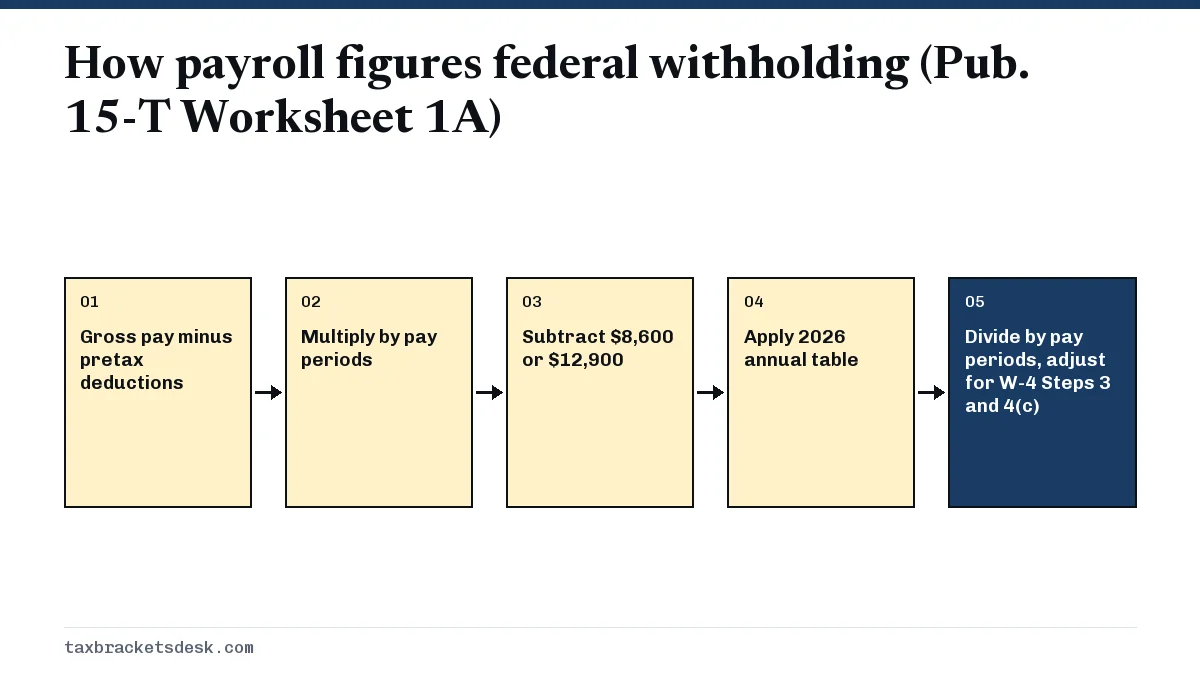
The withholding formula step by step
- Subtract pretax deductions from gross pay to get federal taxable wages for the period.
- Multiply by the number of pay periods in the year to annualize.
- Add W-4 Step 4(a) other income and subtract Step 4(b) deductions.
- If the Step 2 box is not checked, subtract $12,900 for married filing jointly or $8,600 for everyone else.
- Apply the 2026 STANDARD withholding rate schedule for your filing status (table below) to get the annual tentative amount.
- Divide by the pay periods, subtract the Step 3 credit amount divided by the pay periods, and add any Step 4(c) extra withholding.
| Adjusted annual wage | Single or MFS | Married filing jointly | Head of household |
|---|---|---|---|
| 0% band ends at | $7,500 | $19,300 | $15,550 |
| 10% band ends at | $19,900 | $44,100 | $33,250 |
| 12% band ends at | $57,900 | $120,100 | $83,000 |
| 22% band ends at | $113,200 | $230,700 | $121,250 |
The $8,600 subtraction plus the $7,500 zero band equals $16,100, the 2026 single standard deduction. For joint filers, $12,900 plus $19,300 equals the $32,200 joint standard deduction, and for heads of household $8,600 plus $15,550 equals $24,150. That is how the tables build the standard deduction into every paycheck.
FICA and state tax
Social Security and Medicare are flat percentages of FICA wages, which exclude section 125 premiums but include 401(k) deferrals. The FICA tax explained page covers the employer match and the self-employed version. State withholding follows each state's own tables, and nine states tax no wage income at all; see states with no income tax.
Example: a $2,500 biweekly paycheck after taxes
A single worker earns $65,000 a year, paid $2,500 every two weeks. Their 2026 Form W-4 shows single status, no Step 2 box, nothing in Steps 3 or 4. They defer $150 a check into a traditional 401(k) and pay $60 a check in pretax health premiums, and they live in a state with no wage tax.
- Federal taxable wages: $2,500 minus $150 minus $60 = $2,290.
- Annualized: $2,290 x 26 = $59,540. Subtract $8,600: adjusted annual wage $50,940.
- Table lookup (single, $19,900 to $57,900 row): $1,240 + 12% of ($50,940 minus $19,900) = $1,240 + $3,724.80 = $4,964.80.
- Per paycheck: $4,964.80 / 26 = $190.95 federal withholding.
- FICA wages: $2,500 minus the $60 section 125 premium = $2,440. Social Security $151.28, Medicare $35.38.
- Take-home: $2,500 minus $150 minus $60 minus $190.95 minus $151.28 minus $35.38 = $1,912.39.
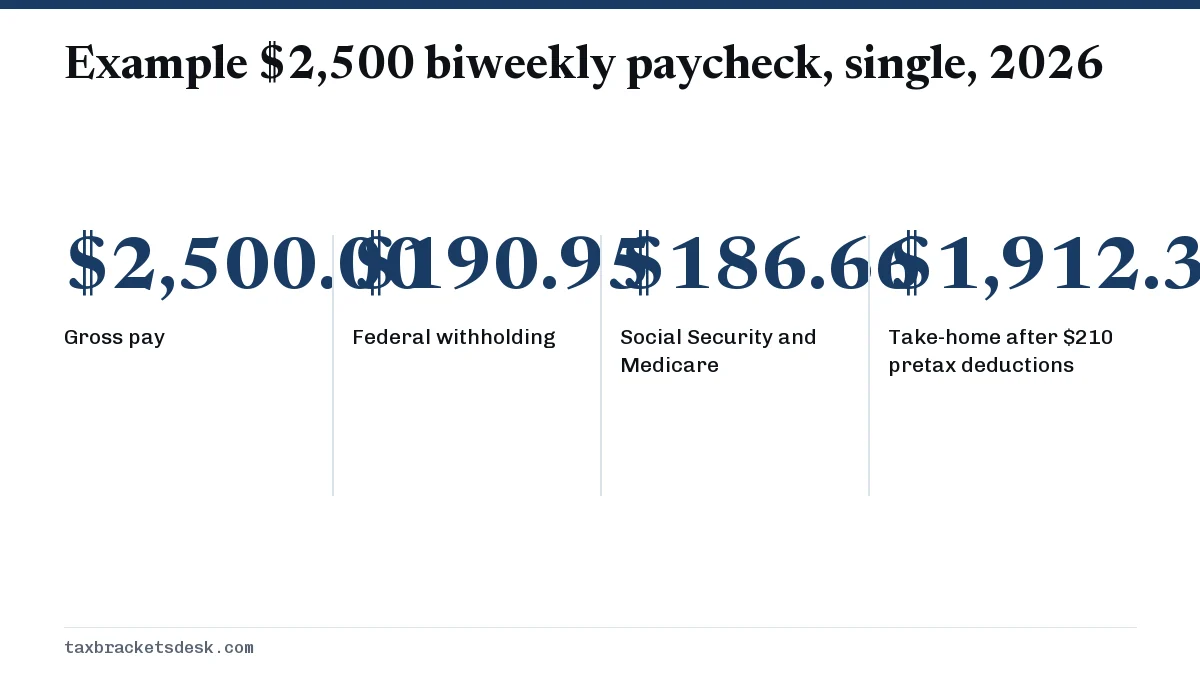
The $4,964.80 annual withholding matches the actual 2026 income tax on $59,540 of W-2 wages after the $16,100 standard deduction, so this worker should end the year close to even. The 401(k) deferral costs only $132 of take-home per check, because it cuts withholding by $18 at the 12% rate.
Same salary, other pay schedules
| Pay frequency | Gross per check | Federal withholding | FICA | Take-home |
|---|---|---|---|---|
| Weekly (52) | $1,250.00 | $108.08 | $95.63 | $1,046.29 |
| Biweekly (26) | $2,500.00 | $216.15 | $191.25 | $2,092.60 |
| Semimonthly (24) | $2,708.33 | $234.17 | $207.19 | $2,266.97 |
| Monthly (12) | $5,416.67 | $468.33 | $414.38 | $4,533.96 |
Annual federal withholding is $5,620 on every schedule; only the slice per check changes. Biweekly workers get 26 checks, so two months each year contain a third paycheck. For a lower salary worked out annually, see the tax on a $40,000 salary example.
How do pretax deductions change take-home pay?
Pretax deductions lower your taxable wages, so each dollar you put in costs less than a dollar of take-home pay. How much less depends on which taxes the deduction avoids.
- Traditional 401(k), 403(b) and governmental 457(b) deferrals avoid federal income tax withholding but not Social Security or Medicare.
- Section 125 cafeteria plan items (health, dental and vision premiums, health FSA and dependent care FSA contributions) avoid income tax and FICA.
- Roth 401(k) deferrals and after-tax deductions such as union dues or wage garnishments avoid nothing; they come out of pay that has already been taxed.
The 2026 health FSA salary reduction limit is $3,400, per IRS Revenue Procedure 2025-32. States set their own rules for these deductions and do not always follow the federal treatment, so check your state's withholding instructions before assuming a 401(k) deferral lowers state tax too.
Why is my paycheck smaller than expected?
Compare two pay stubs line by line before assuming a payroll error. These are the usual causes, in rough order of how often they explain a gap.
- A new benefit election or higher premium took effect, often in January.
- Your W-4 changed, for example the Step 2 box was checked or a Step 4(c) extra amount was added.
- A bonus was paid separately and withheld at the 22% flat supplemental rate; see bonus tax rate.
- Your wages crossed $200,000 for the year, so 0.9% Additional Medicare Tax withholding started; see Additional Medicare Tax.
- A garnishment or levy was added, which shows as an after-tax deduction.
- Overtime pushed one check into a higher annualized band, which raises withholding on that check only; the final tax is still figured on the year's total.
Checking your W-4 with the paycheck calculator result
If the calculator shows withholding far from your expected tax, change your Form W-4 and give it to your employer, not the IRS. Changes usually apply from the next payroll your employer can process.
- Estimate your 2026 total tax with the tax calculator tools.
- Add withholding to date (year-to-date federal tax on your latest stub) to withholding still to come on the remaining checks.
- If the total falls short, enter the gap divided by the remaining pay periods in Step 4(c).
- If it runs well over, claim credits in Step 3 or deductions in Step 4(b).
- Recheck after a new job, marriage, a birth or a raise. The W-4 withholding guide walks through each step.
Common questions
How much will I take home from a $2,500 paycheck?
A single filer paid $2,500 every two weeks with no pretax deductions and no state tax keeps about $2,092.60 in 2026, after $216.15 of federal withholding and $191.25 of Social Security and Medicare. Pretax benefits and state tax lower it further.
What percentage of my paycheck goes to taxes?
Social Security and Medicare take a fixed 7.65% of most paychecks. Federal withholding adds roughly 5% to 20% for typical salaries, and state tax adds 0% to about 10% depending on where you live and earn.
Does a 401(k) reduce Social Security tax on my paycheck?
No. Traditional 401(k) deferrals reduce federal income tax withholding, but Social Security and Medicare are still charged on them. Health premiums paid through a section 125 plan reduce both.
Why does my paycheck calculator 2026 result differ from my pay stub?
The most common reasons are pretax benefits the calculator was not told about, a W-4 Step 2 checkbox or Step 4(c) extra amount, state or local tax, and rounding in your employer's payroll software.
Is take home pay the same as net pay?
Yes. Take-home pay and net pay both mean gross pay minus all taxes and all deductions, the amount actually deposited.
Sources
- Publication 15-T (2026), Federal Income Tax Withholding Methods irs.gov
- Publication 15 (2026), Employer's Tax Guide (Circular E) irs.gov
- Topic no. 751, Social Security and Medicare withholding rates irs.gov
- Rev. Proc. 2025-32 (2026 standard deduction, health FSA limit) irs.gov
- Tax Withholding Estimator irs.gov
We check figures against these official pages. Rules change; confirm anything that affects a deadline or payment with the agency before you act.
Tell us what happened
Describe your situation and our editors will use it to improve this guide. If you leave your email, we may reply with a pointer to the right page or official contact. We never share your details.
Related guides
 FICA Tax: Social Security and Medicare Rates for 2026
FICA tax is the 7.65% payroll tax taken from an employee's wages in 2026: 6.2% for Social Security on the first $184,500 of pay a…
How Much Tax on a $40,000 Salary? 2026 Worked Example
How much tax on $40,000? For tax year 2026, a single filer with a $40,000 salary and the standard deduction owes $2,620 in federa…
Bonus Tax Rate 2026: 22% Federal Withholding Explained
The federal bonus tax rate for 2026 is a flat 22% income tax withholding rate that employers may use on bonuses paid separately f…