
Tax Calculators and Salary Examples
Tax bracket calculator: your bracket, tax in each band and effective rate
Short answer
A tax bracket calculator splits your taxable income across the seven federal rates, 10% to 37%, and adds up the tax in each band. For 2026, a single filer with $120,000 of taxable income owes $21,398: the top slice is taxed at 24%, but the effective rate is 17.83%. The tool also shows how far you are from the next bracket.
- 01Federal rates for 2026
- 10%, 12%, 22%, 24%, 32%, 35%, 37% (made permanent by Public Law 119-21)
- 02Example: single, $120,000 taxable income, 2026
- $21,398 tax, 24% marginal, 17.83% effective
- 03Same income under 2025 brackets
- $21,647
- 04Top of the 22% bracket, 2026
- $105,700 single and HoH; $211,400 joint
- 05Source of 2026 brackets
- IRS Rev. Proc. 2025-32, released October 9, 2025
Calculator
- Income and tax in each bracket
- —
- Total federal income tax before credits
- —
- Marginal tax rate
- —
- Effective rate on taxable income and on gross income
- —
- Dollars remaining before the next bracket
- —
- Difference versus the other tax year
- —
Tax before credits, figured from taxable income (Form 1040 line 15). If taxable income is under $100,000 the IRS Tax Table uses $50 bands, so a filed return can differ by a few dollars.
What the tax bracket calculator tells you
This tax bracket calculator answers three questions from one number: which bracket your last dollar falls in, how much tax each bracket contributes, and what share of your income goes to federal income tax overall. It uses the official 2026 and 2025 rate schedules published by the IRS.
A tax bracket is a range of taxable income taxed at one rate. Only the income inside each range pays that range's rate, so moving into a higher bracket never raises the tax on the dollars below it. The how tax brackets work page explains the idea with pictures; this page is about running the numbers.
Inputs: what to enter
- Tax year: 2026 (the return filed in 2027) or 2025 (filed in 2026). 2027 brackets are not yet announced; the IRS usually publishes them in October or November.
- Filing status: single, married filing jointly (also used by a qualifying surviving spouse), married filing separately, or head of household.
- Taxable income: Form 1040 line 15, which is income after adjustments, the standard or itemized deduction and the qualified business income deduction.
- Optional gross income: if you enter total income before deductions, the tool also reports your effective rate on gross income.
How the tool splits income by bracket
The calculator fills each bracket from the bottom up. It places income in the 10% band until that band is full, moves to the 12% band, and so on until all taxable income is assigned. Each band's income is multiplied by its rate and the results are added.
| Rate | Single | Married filing jointly | Head of household |
|---|---|---|---|
| 10% | $12,400 | $24,800 | $17,700 |
| 12% | $50,400 | $100,800 | $67,450 |
| 22% | $105,700 | $211,400 | $105,700 |
| 24% | $201,775 | $403,550 | $201,750 |
| 32% | $256,225 | $512,450 | $256,200 |
| 35% | $640,600 | $768,700 | $640,600 |
| 37% | Above $640,600 | Above $768,700 | Above $640,600 |
Married filing separately uses the single limits up to $256,225, then 35% to $384,350 and 37% above. The full history, including 2025 limits, is on federal tax brackets by year.
The shortcut the IRS uses
Instead of adding every band, the IRS rate schedules give a fixed amount plus a percentage of income over the band's floor. For a 2026 single filer in the 24% band, tax is $17,966 plus 24% of the amount over $105,700. The calculator's band-by-band total and the shortcut always match.
Example output: single filer with $120,000 of taxable income
A single filer with $120,000 of taxable income in 2026 owes $21,398 of federal income tax. The income fills four brackets.
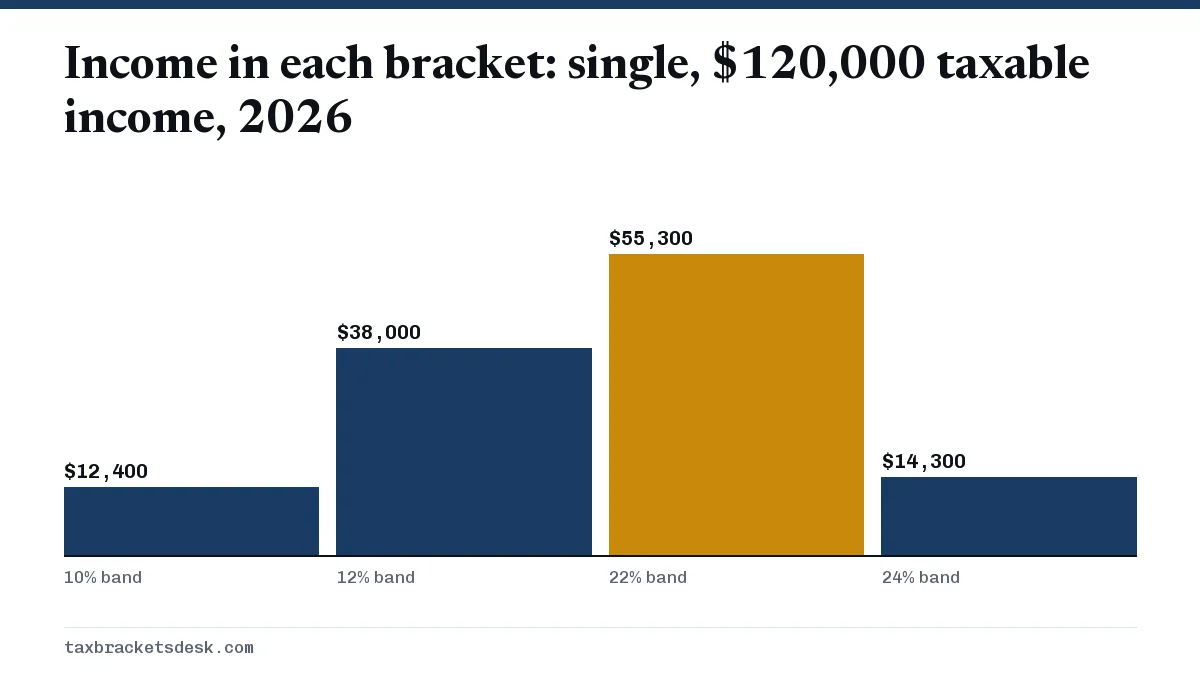
| Bracket | Income taxed | Rate | Tax |
|---|---|---|---|
| $0 to $12,400 | $12,400 | 10% | $1,240 |
| $12,400 to $50,400 | $38,000 | 12% | $4,560 |
| $50,400 to $105,700 | $55,300 | 22% | $12,166 |
| $105,700 to $120,000 | $14,300 | 24% | $3,432 |
| Total | $120,000 | $21,398 |
- Marginal rate: 24%, the rate on the next dollar.
- Effective rate on taxable income: $21,398 / $120,000 = 17.83%.
- Effective rate on gross income: with the $16,100 standard deduction, gross income was $136,100, so the rate is 15.72%.
- Room left in the 24% bracket: $81,775 before income reaches $201,775 and the 32% rate.
The same $120,000 under other filing statuses
At $120,000 of taxable income, a head of household owes $19,587 (also in the 24% bracket) and a married couple filing jointly owes $15,824 (in the 22% bracket, $91,400 below the 24% line). Married filing separately matches the single figure, $21,398.
Can I compare 2025 and 2026 brackets?
Yes. Switch the tax year and the calculator reruns the same taxable income through the 2025 schedule. Because the 2026 bracket limits rose with inflation, the same taxable income produces slightly less tax in 2026.
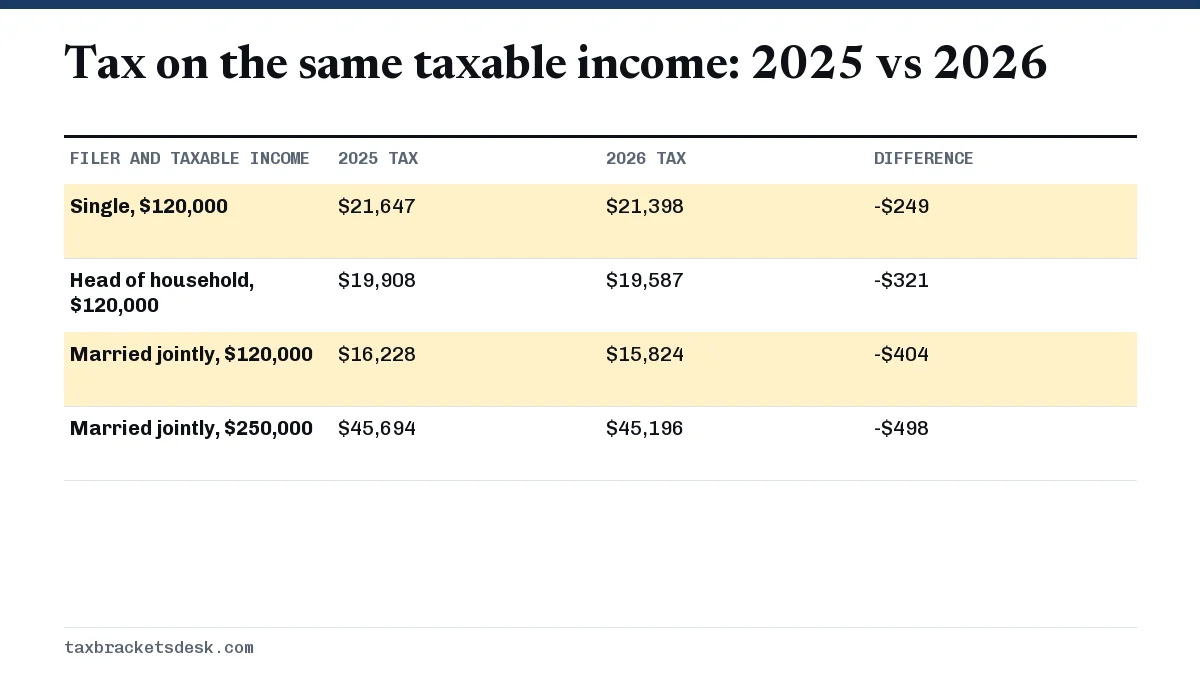
The single filer at $120,000 would have owed $21,647 under 2025 brackets, $249 more than in 2026. A joint couple at $250,000 of taxable income owes $45,196 for 2026, down from $45,694 under the 2025 schedule. The 2025 figures come from the IRS federal income tax rates page; the 2026 figures from Revenue Procedure 2025-32. See 2026 IRS tax brackets for the source table.
Is the marginal tax rate calculator result my true marginal rate?
Not always. A marginal tax rate calculator reports the bracket rate on your next dollar of ordinary income, but other rules can change what an extra dollar actually costs. Check these before acting on the result.
- Phaseouts. Above $200,000 of modified AGI ($400,000 joint), the Child Tax Credit shrinks by $50 per $1,000 of income, which adds about 5 points to the real marginal rate.
- Capital gains and qualified dividends use separate 0%, 15% and 20% rates stacked on top of ordinary income, so a bracket calculator that treats them as wages overstates tax.
- Payroll taxes. Wages also carry 7.65% FICA up to the $184,500 Social Security wage base, and 1.45% Medicare above it.
- Net investment income tax. A 3.8% surtax applies to investment income once modified AGI passes $200,000 single or $250,000 joint.
- Alternative minimum tax. A separate AMT calculation can override regular tax for some high-income filers.
Using the result
- Price a pretax contribution. A traditional 401(k) or deductible IRA dollar saves your marginal rate, so 24 cents per dollar in the example above.
- Time extra income. If you are $3,000 from the next bracket, a year-end bonus larger than that pushes only the excess into the higher rate.
- Check a Roth conversion. Convert only up to the top of your current bracket if you want to avoid the next rate.
- Compare with withholding. Put the calculator total next to Form W-2 box 2 to see whether you are headed for a refund or a balance due, then confirm with the tax refund calculator.
The result is tax before credits. Subtract the Child Tax Credit and other credits to get the final figure, or use the tax calculator tools hub for a full estimate.
Common questions
What bracket am I in if I make $85,000?
A single filer earning $85,000 in wages has $68,900 of taxable income after the 2026 standard deduction, which is in the 22% bracket. A married couple filing jointly on one $85,000 income has $52,800 of taxable income, which is in the 12% bracket.
Does the tax bracket calculator 2026 show my effective rate?
Yes. It divides total tax by taxable income, and by gross income when you enter it, so you can see both effective rates next to the marginal rate.
Do I pay my top bracket rate on all my income?
No. Each rate applies only to the income inside its band. A single filer with $120,000 of taxable income pays 24% on just $14,300 of it.
Are the 2027 tax brackets in the calculator?
Not yet. The 2027 brackets are not yet announced; the IRS normally releases next-year figures in October or November, and the 2026 figures came out on October 9, 2025.
Why is my tax on Form 1040 a few dollars different from the calculator?
If taxable income is under $100,000, Form 1040 uses the IRS Tax Table, which figures tax at the midpoint of $50 income ranges. The formula result can differ by a few dollars.
Sources
- Rev. Proc. 2025-32 (2026 tax rate tables) irs.gov
- Federal income tax rates and brackets irs.gov
- IRS releases tax inflation adjustments for tax year 2026 irs.gov
- Child Tax Credit irs.gov
We check figures against these official pages. Rules change; confirm anything that affects a deadline or payment with the agency before you act.
Tell us what happened
Describe your situation and our editors will use it to improve this guide. If you leave your email, we may reply with a pointer to the right page or official contact. We never share your details.