
Tax Calculators and Salary Examples
How much tax on $60,000: employee and self-employed math for 2026
Short answer
How much tax on $60,000? A single employee earning $60,000 in tax year 2026 owes $5,020 in federal income tax after the $16,100 standard deduction, plus $4,590 in Social Security and Medicare tax, and keeps $50,390, or $4,199 a month. The same $60,000 earned as self-employment profit costs about $2,140 more in federal tax.
- 01Federal income tax, single employee, $60,000 (2026)
- $5,020
- 02FICA withheld from a $60,000 salary
- $4,590
- 03Take-home pay, single, before state tax
- $50,390 a year / $4,199.17 a month
- 04Salary where a single filer first reaches 22%
- $66,500
- 05Total federal tax on $60,000 of self-employment profit
- About $11,749
How much tax on $60,000 in tax year 2026?
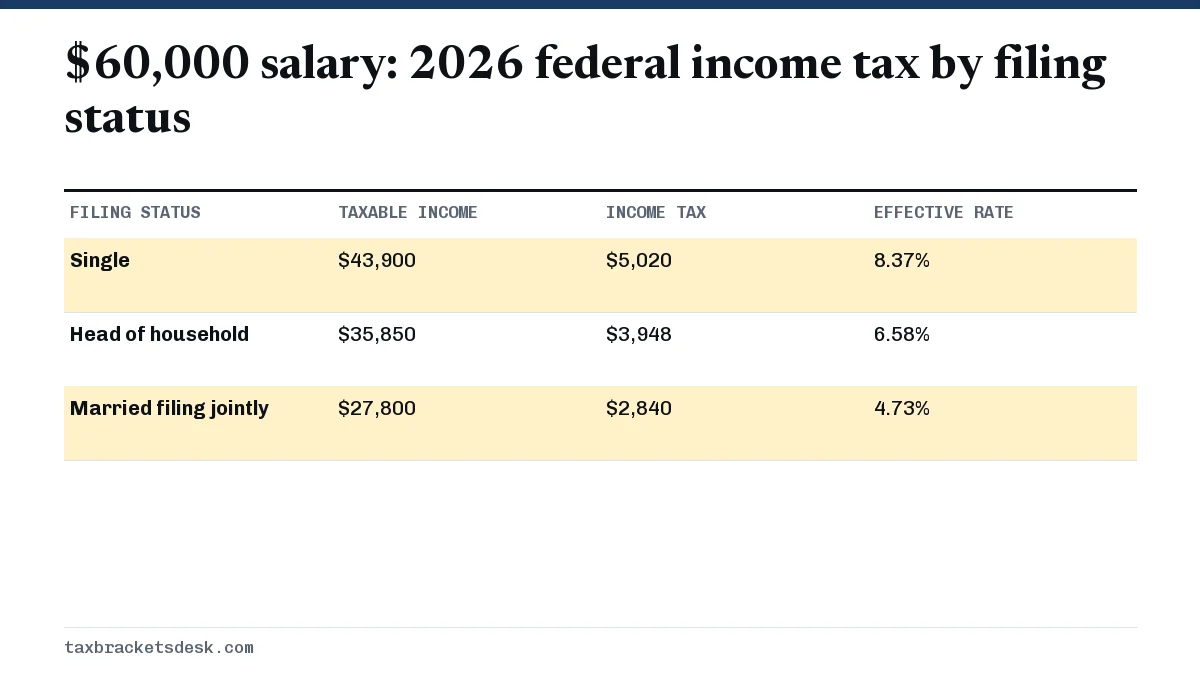
A $60,000 salary carries $5,020 of federal income tax for a single filer, $3,948 for a head of household and $2,840 for a married couple filing jointly on that one income, for tax year 2026. These amounts apply the 2026 standard deduction and brackets from IRS Revenue Procedure 2025-32 to wages only, before any credit.
Social Security and Medicare take another $4,590 from every $60,000 salary, whatever the filing status. The 2026 return is the one most people file between January and April 2027.
| Filing status | Taxable income | Income tax | Effective rate | Marginal rate |
|---|---|---|---|---|
| Single | $43,900 | $5,020 | 8.37% | 12% |
| Head of household | $35,850 | $3,948 | 6.58% | 12% |
| Married filing jointly (one earner) | $27,800 | $2,840 | 4.73% | 12% |
Federal tax on $60,000 income for a single filer, step by step
Taxable income for a single filer on $60,000 is $43,900, and the tax on it is $5,020: $1,240 from the 10% layer plus $3,780 from the 12% layer.
- Salary: $60,000.
- Minus the 2026 single standard deduction, $16,100, gives $43,900 of taxable income.
- The first $12,400 is taxed at 10%, which is $1,240.
- The remaining $31,500 is taxed at 12%, which is $3,780.
- Federal income tax: $1,240 + $3,780 = $5,020.
What tax bracket is $60,000? For a single filer it is the 12% bracket. The 22% rate starts at $50,400 of taxable income, so a single employee does not pay 22% on any wages until the salary passes $66,500. Only the slice of income inside each band pays that band's rate.
What a raise from $50,000 to $60,000 is worth
The extra $10,000 adds $1,200 of income tax (12%) and $765 of FICA (7.65%), so a single filer keeps $8,035 of it before state tax. The $50,000 salary example has the starting figures.
Married filing jointly and head of household on $60,000
A married couple with $60,000 of combined wages has $27,800 of taxable income after the $32,200 joint standard deduction. The first $24,800 is taxed at 10% ($2,480) and the last $3,000 at 12% ($360), for $2,840.
A head of household subtracts $24,150 and is left with $35,850 of taxable income. Tax is $1,770 on the first $17,700 plus $2,178 on the next $18,150, a total of $3,948. With one qualifying child, the $2,200 Child Tax Credit brings that to $1,748.
A couple with two children fares better still: $4,400 of Child Tax Credit more than covers the $2,840 bill, and the unused $1,560 can be paid out as the refundable Additional Child Tax Credit. The Child Tax Credit guide covers the rules.
What is a 60k salary after tax per month?
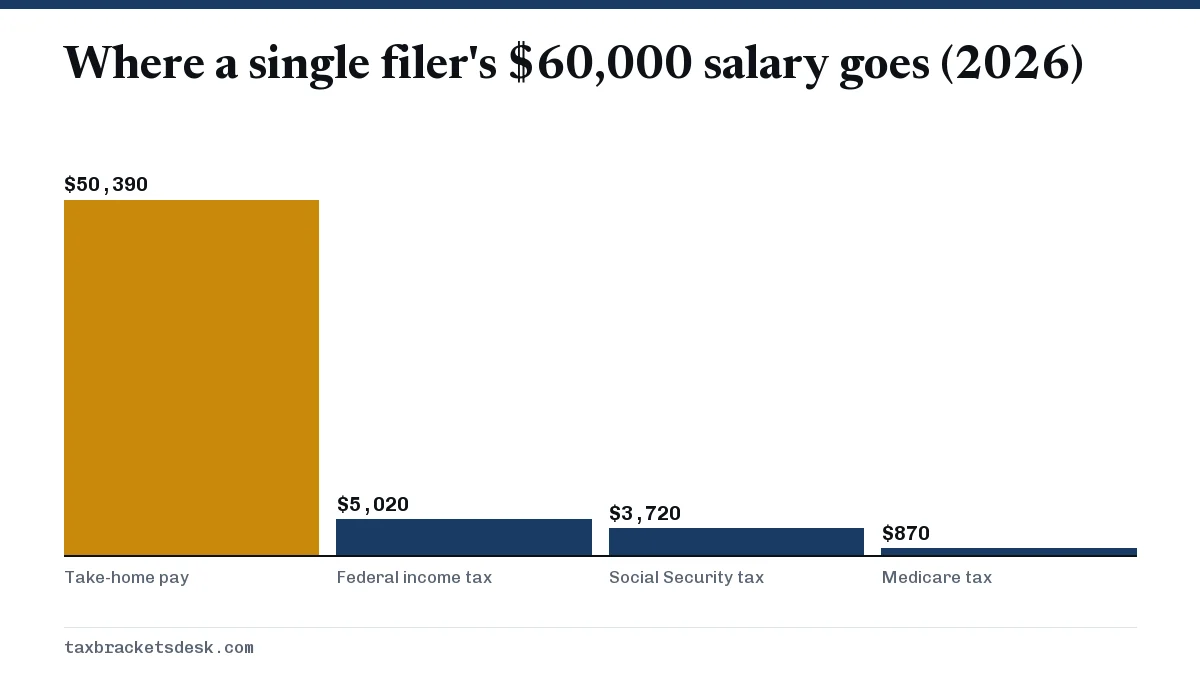
A single employee with a $60,000 salary takes home $50,390 a year, or $4,199.17 a month, after federal income tax and FICA for 2026. FICA is $3,720 of Social Security tax at 6.2% and $870 of Medicare tax at 1.45%, the rates in IRS Topic 751.
| Filing status | Per year | Per month | Every two weeks |
|---|---|---|---|
| Single | $50,390 | $4,199.17 | $1,938.08 |
| Head of household (before credits) | $51,462 | $4,288.50 | $1,979.31 |
| Married filing jointly, one earner (before credits) | $52,570 | $4,380.83 | $2,021.92 |
Your paycheck will be lower once state tax, insurance premiums and 401(k) deferrals come out. The paycheck tax calculator adds those in per pay period.
How much tax on $60,000 if you are self-employed?
About $11,749 in federal tax, roughly $2,140 more than an employee with the same $60,000 pays, because a self-employed person pays both halves of Social Security and Medicare. Self-employment tax is 15.3% of 92.35% of net earnings, figured on Schedule SE, and half of it is deductible (IRS Topic 554).
- Net profit: $60,000. Multiply by 92.35%: $55,410 of net earnings from self-employment.
- Self-employment tax at 15.3%: $8,477.73.
- Deduct half of it, $4,238.87, as an adjustment to income. AGI is $55,761.13.
- Subtract the $16,100 standard deduction: taxable income is $39,661.13.
- Income tax: $1,240 + 12% of $27,261.13 = $3,271.34.
- Total federal tax: $8,477.73 + $3,271.34 = $11,749.07.
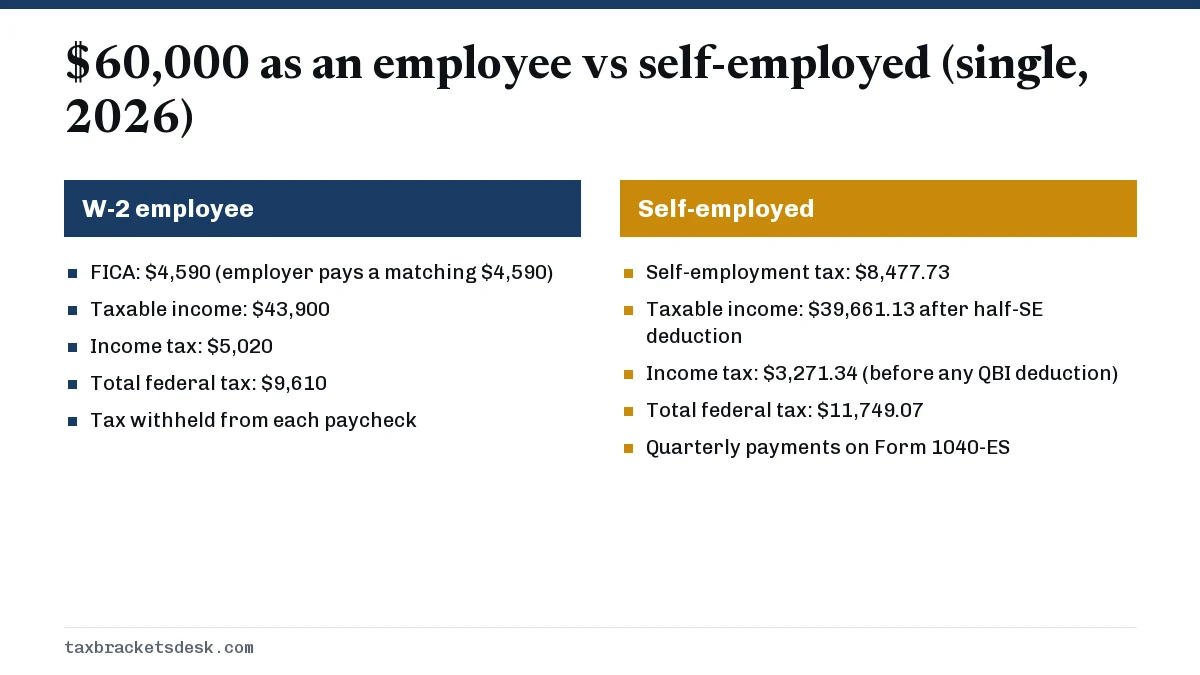
This example leaves out the qualified business income deduction, which many sole proprietors can also claim and which lowers the income tax figure. Because no employer withholds anything, a freelancer expecting to owe $1,000 or more usually pays quarterly with Form 1040-ES; the last 2026 installment is due January 15, 2027. See estimated taxes for the self-employed and the self-employment tax calculator.
Which credits still apply at a $60,000 income?
At $60,000, the Earned Income Tax Credit (EITC) has ended for single parents and heads of household with one or two children, but not for larger families or most married couples with children. The 2026 cutoffs come from Revenue Procedure 2025-32.
| Household | Credit ends at | Approximate credit at $60,000 |
|---|---|---|
| Single or HoH, one or two children | $51,593 / $58,629 | $0 |
| Single or HoH, three or more children | $62,974 | About $630 |
| Married jointly, one child | $58,863 | $0 |
| Married jointly, two children | $65,899 | About $1,240 |
| Married jointly, three or more children | $70,244 | About $2,160 |
The Saver's Credit is out of reach for a single filer at this income, since the 2026 ceiling is $40,250, but a married couple at $60,000 is under the $80,500 joint ceiling. Each full list of cutoffs is on the EITC income limits table, and other salary levels are on the tax calculator tools hub, including the $75,000 salary example.
Common questions
How much federal tax do I pay on $60,000 a year?
For 2026, a single filer pays $5,020 of federal income tax on a $60,000 salary and $4,590 of FICA, for $9,610 in total. That is 16% of the salary.
Is $60,000 in the 22% tax bracket?
No, not for a single, married or head of household filer with only wage income. After the standard deduction, a single filer has $43,900 of taxable income, below the $50,400 point where 22% begins in 2026.
How much is FICA on $60,000?
$4,590 for an employee: $3,720 of Social Security tax and $870 of Medicare tax. A self-employed person owes $8,477.73 of self-employment tax on $60,000 of profit instead.
What is $60,000 a year biweekly after taxes?
About $1,938 every two weeks for a single filer after federal income tax and FICA, from a gross check of $2,307.69. State tax and benefits come out on top of that.
Do I get the earned income credit making $60,000?
Only in some cases. A married couple filing jointly with two or more children, or any filer with three or more children, can still get a partial EITC at $60,000 in 2026; single parents with one or two children cannot.
Sources
- Rev. Proc. 2025-32 (2026 brackets, standard deduction, EITC, Child Tax Credit) irs.gov
- Topic no. 751, Social Security and Medicare withholding rates irs.gov
- Topic no. 554, Self-employment tax irs.gov
- Publication 505 (2026), Tax Withholding and Estimated Tax irs.gov
- Retirement Savings Contributions Credit (Saver's Credit) irs.gov
We check figures against these official pages. Rules change; confirm anything that affects a deadline or payment with the agency before you act.
Tell us what happened
Describe your situation and our editors will use it to improve this guide. If you leave your email, we may reply with a pointer to the right page or official contact. We never share your details.