
Tax Calculators and Salary Examples
How much tax on $150,000: brackets, take-home pay and the phaseouts that start here
Short answer
How much tax on $150,000? A single filer with a $150,000 salary owes $24,734 in federal income tax for tax year 2026, plus $11,475 in Social Security and Medicare tax, leaving $113,791, or about $9,483 a month, before state tax. A married couple on the same income owes $15,340. At $150,000 several deductions begin to phase out for single filers.
- 01Federal income tax, single, $150,000 (2026)
- $24,734
- 02Federal income tax, married filing jointly, $150,000
- $15,340
- 03FICA on $150,000 (employee share)
- $11,475
- 04Take-home pay, single, before state tax
- $113,791 a year / $9,482.58 a month
- 05Marginal federal rate, single
- 24%
How much tax on $150,000 by filing status?
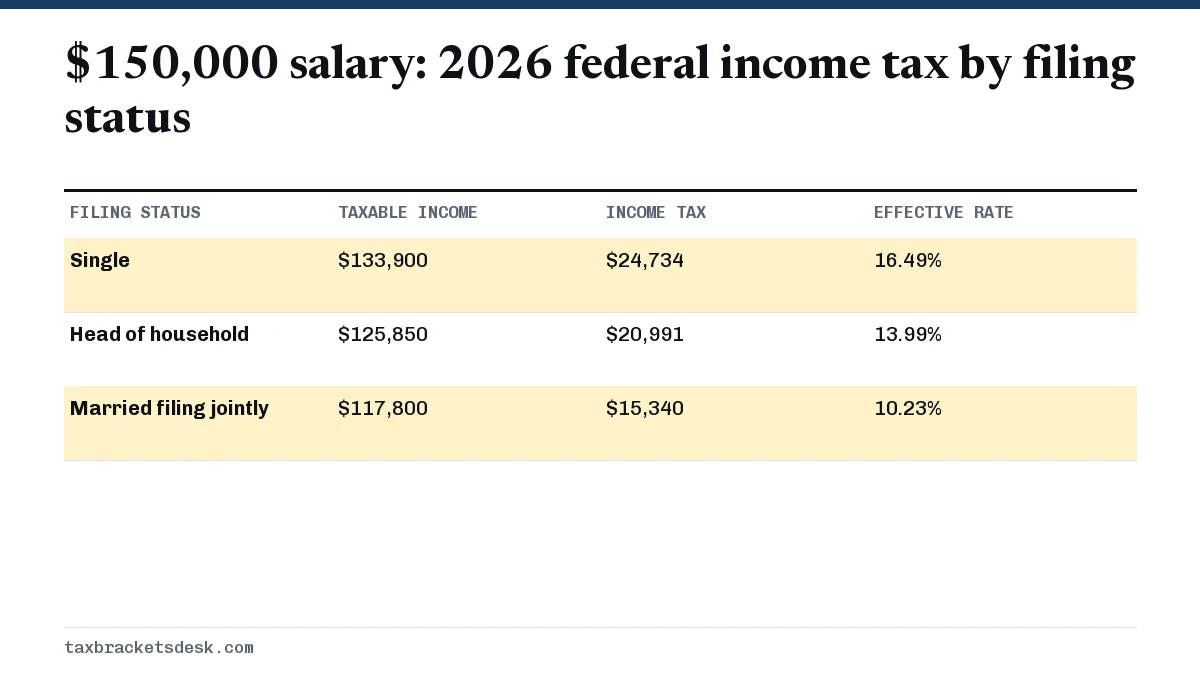
For tax year 2026, federal income tax on a $150,000 salary is $24,734 if you file single, $20,991 as a head of household and $15,340 as a married couple filing jointly. The figures take the standard deduction and the 2026 brackets from IRS Revenue Procedure 2025-32, with no other income and no credits.
The gap between single and joint is $9,394, which is why the same salary feels very different depending on filing status. FICA is $11,475 for any status because the whole $150,000 is below the $184,500 Social Security wage base for 2026.
| Filing status | Taxable income | Income tax | Effective rate | Marginal rate |
|---|---|---|---|---|
| Single | $133,900 | $24,734 | 16.49% | 24% |
| Head of household | $125,850 | $20,991 | 13.99% | 24% |
| Married filing jointly | $117,800 | $15,340 | 10.23% | 22% |
Federal tax on $150,000 for a single filer, bracket by bracket
A single filer's $150,000 salary becomes $133,900 of taxable income after the $16,100 standard deduction, and it touches four brackets. The 24% slice is $28,200.
| Bracket | Income taxed | Rate | Tax |
|---|---|---|---|
| $0 to $12,400 | $12,400 | 10% | $1,240 |
| $12,400 to $50,400 | $38,000 | 12% | $4,560 |
| $50,400 to $105,700 | $55,300 | 22% | $12,166 |
| $105,700 to $133,900 | $28,200 | 24% | $6,768 |
| Total | $133,900 | $24,734 |
There is $67,875 of room before the 32% rate begins at $201,775. Long-term capital gains and qualified dividends on top of this salary are taxed at 15%, since taxable income is well past the $49,450 limit for the 0% rate.
Married filing jointly and head of household on $150,000
A married couple with $150,000 of combined wages subtracts $32,200 and owes $15,340 on $117,800 of taxable income: $2,480 at 10%, $9,120 at 12% and $3,740 on the $17,000 above $100,800 at 22%. The married filing jointly brackets show the full table.
A head of household subtracts $24,150, leaving $125,850. The tax is $1,770 at 10%, $5,970 at 12%, $8,415 at 22% and $4,836 at 24%, for $20,991. Two qualifying children bring it to $16,591 through the $4,400 Child Tax Credit, which is still paid in full below $200,000 of income.
What is a 150k salary after tax?
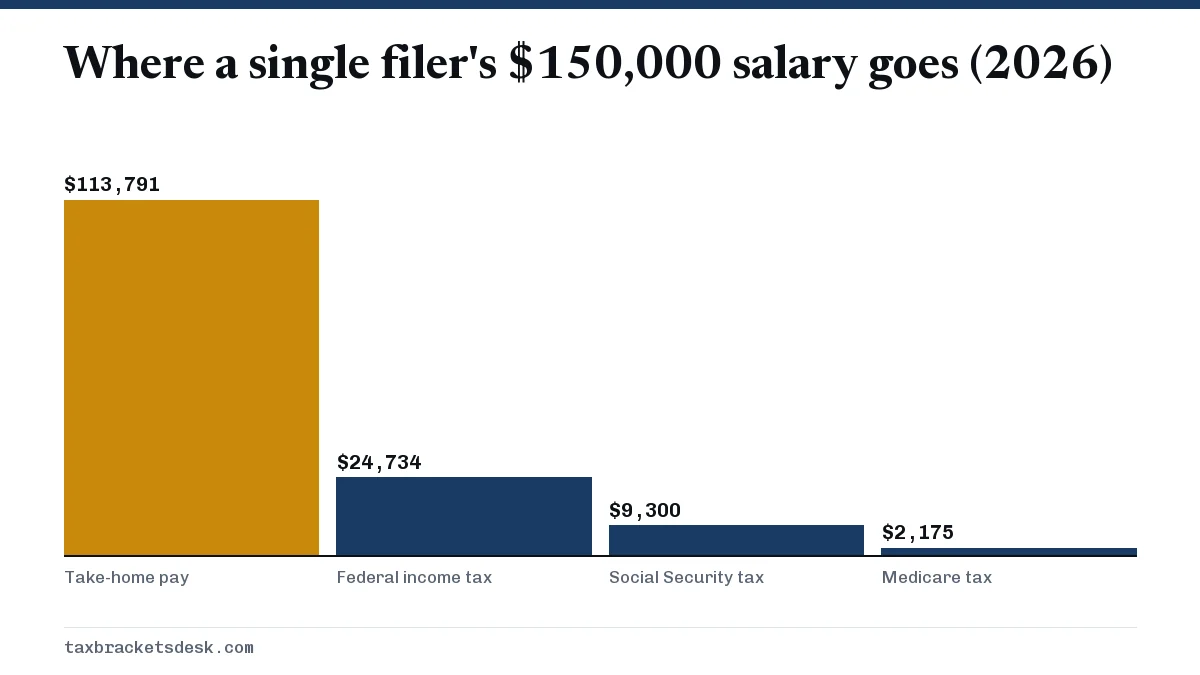
A single filer takes home $113,791 of a $150,000 salary after federal income tax and FICA, or $9,482.58 a month. FICA on $150,000 is $9,300 of Social Security tax and $2,175 of Medicare tax (IRS Topic 751). No Additional Medicare Tax applies until wages pass $200,000.
| Filing status | Per year | Per month | Every two weeks |
|---|---|---|---|
| Single | $113,791 | $9,482.58 | $4,376.58 |
| Head of household (before credits) | $117,534 | $9,794.50 | $4,520.54 |
| Married filing jointly (before credits) | $123,185 | $10,265.42 | $4,737.88 |
Which tax breaks phase out around $150,000?
$150,000 is a dividing line in the 2026 rules: several deductions are already gone for a single filer at this income, while a married couple filing jointly keeps nearly all of them. The table assumes modified adjusted gross income (MAGI) equals the salary.
| Tax break | Single at $150,000 | Married jointly at $150,000 |
|---|---|---|
| Tips and overtime deductions | Full; drops $100 per $1,000 above $150,000 | Full; phaseout starts above $300,000 |
| Car loan interest deduction | Eliminated ($200 per $1,000 above $100,000) | Full; phaseout starts above $200,000 |
| Senior deduction ($6,000 each) | $1,500 left (cut by 6% of MAGI over $75,000) | Full $12,000 if both qualify |
| Student loan interest deduction | None (ends at $100,000) | Full (phaseout $175,000 to $205,000) |
| American Opportunity Credit | None (ends at $90,000) | Available (ends at $180,000) |
| Child Tax Credit | Full ($200,000 threshold) | Full ($400,000 threshold) |
The phaseout steps come from the 2025 Schedule 1-A (Form 1040). The car loan interest deduction page shows the reduction worked for other incomes.
The estimated tax safe harbor changes above $150,000
If your prior-year AGI was more than $150,000 ($75,000 married filing separately), avoiding the underpayment penalty requires paying 110% of last year's tax through withholding and estimates rather than 100%. At exactly $150,000 the 100% rule still applies. See the estimated tax safe harbor.
How to lower federal tax on a $150,000 income
- Pretax retirement deferrals. Each $1,000 put into a traditional 401(k) saves a single filer $240 at the 24% rate, and keeps MAGI closer to the thresholds above.
- Itemizing. State and local taxes are deductible up to $40,400 for 2026. With mortgage interest and charitable gifts, itemizing can beat the $16,100 single standard deduction; see itemize or take the standard deduction.
- Health FSA. The 2026 salary reduction limit is $3,400, which avoids both income tax and FICA on that pay.
Compare with the $100,000 salary example and the $200,000 salary example, or see all levels on the tax calculator tools hub.
Common questions
How much federal tax do I pay on $150,000?
A single filer pays $24,734 of federal income tax on a $150,000 salary in 2026, plus $11,475 of FICA. Married couples filing jointly pay $15,340 of income tax on the same wages.
What tax bracket is $150,000?
The 24% bracket for single and head of household filers, and the 22% bracket for married couples filing jointly. The effective income tax rate is 16.49% single and 10.23% joint.
How much is $150,000 a year per month after taxes?
About $9,483 a month for a single filer after federal income tax and FICA for 2026. State income tax, where it applies, lowers that further.
How much is FICA on $150,000?
$11,475 for an employee: $9,300 of Social Security tax and $2,175 of Medicare tax. The salary is below both the $184,500 wage base and the $200,000 Additional Medicare Tax threshold.
Can I deduct student loan interest making $150,000?
Not as a single filer, because the 2026 deduction ends at $100,000 of MAGI. A married couple filing jointly at $150,000 can deduct up to $2,500, since their phaseout does not start until $175,000.
Is $150,000 a year too much for the no tax on overtime deduction?
No. The deduction phases out only when MAGI is over $150,000 for single filers ($300,000 joint), losing $100 for each $1,000 above that.
Sources
- Rev. Proc. 2025-32 (2026 brackets, standard deduction, student loan interest) irs.gov
- Topic no. 751, Social Security and Medicare withholding rates irs.gov
- Schedule 1-A (Form 1040), Additional Deductions irs.gov
- Publication 505 (2026), Tax Withholding and Estimated Tax irs.gov
- Publication 970, Tax Benefits for Education irs.gov
- Form 1040-ES, Estimated Tax for Individuals irs.gov
We check figures against these official pages. Rules change; confirm anything that affects a deadline or payment with the agency before you act.
Tell us what happened
Describe your situation and our editors will use it to improve this guide. If you leave your email, we may reply with a pointer to the right page or official contact. We never share your details.