
Tax Calculators and Salary Examples
Tax refund calculator: will you get money back for 2026?
Short answer
A tax refund calculator subtracts your total 2026 federal tax from everything already paid: Form W-2 box 2 withholding, estimated payments and refundable credits. If payments are larger, the difference is your refund. A single filer earning $58,000 with $5,400 withheld owes $4,780 in tax and would get about $620 back.
- 01Refund formula
- Payments plus refundable credits minus total tax
- 02Example: single, $58,000 wages, $5,400 withheld
- About $620 refund
- 03Example: same worker plus $10,000 of 1099 income
- About $1,988 owed
- 04Refundable child credit cap, 2026
- $1,700 per child
- 05Estimated payments generally required if you expect to owe
- $1,000 or more
Calculator
- Taxable income
- —
- Income tax before credits
- —
- Self-employment tax
- —
- Total tax after nonrefundable credits
- —
- Total payments and refundable credits
- —
- Estimated refund or balance due
- —
Estimates for tax year 2026. Credits other than the Child Tax Credit and anything you enter as a refundable credit are not included, and neither are state tax, the alternative minimum tax or the separate rates on qualified dividends and long-term gains.
How the tax refund calculator works
The tax refund calculator works out your total 2026 federal tax and compares it with what you have already paid. A tax refund is simply the amount by which your payments and refundable credits exceed the tax you owe; it is not a bonus, only money returned. If you are looking for a tax refund calculator for 2027, this is the one to use: refunds paid in the 2027 filing season come from 2026 returns, which use these 2026 figures.
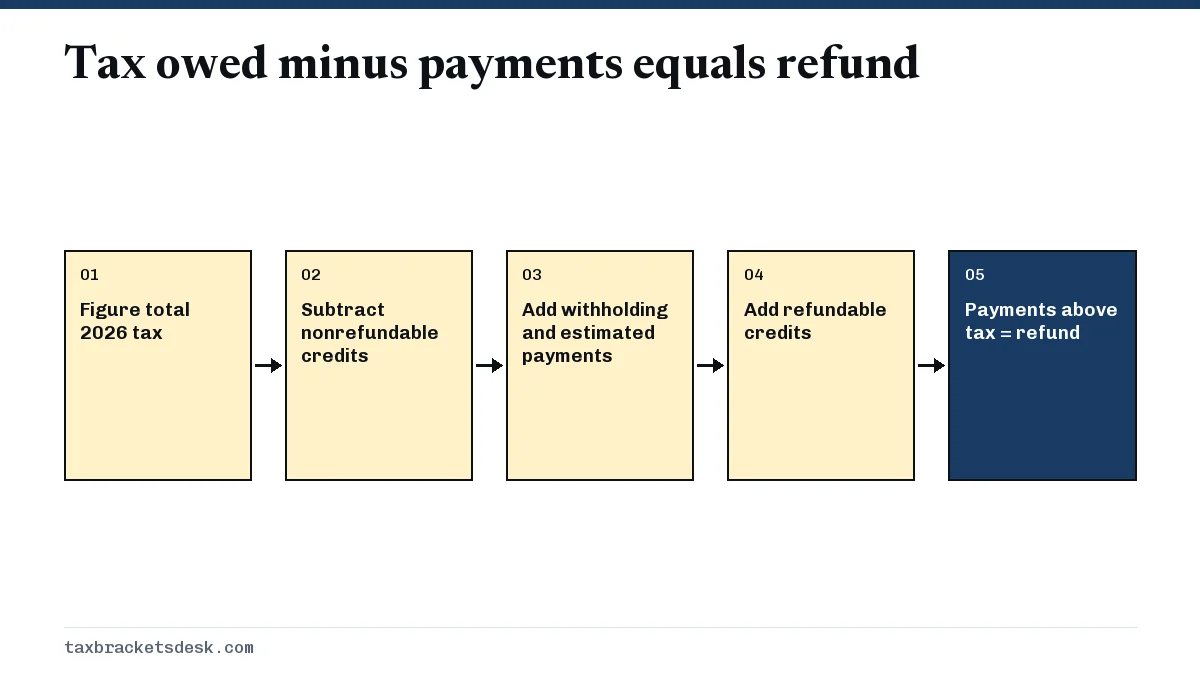
The tax side uses the same 2026 brackets and standard deduction as our income tax calculator, plus self-employment tax if you had 1099 income. The payment side adds withholding, estimated payments and refundable credits.
What documents do I need to estimate my refund?
You need two sets of numbers: what you earned and what was already paid toward your tax. Most of both are on forms you receive in January and February.
| Input | Where to find it |
|---|---|
| Wages | Form W-2 box 1; before year end, the year-to-date line on your last pay stub |
| Federal tax withheld | Form W-2 box 2; Form 1099-R, 1099-G or 1099-NEC box 4 for other income |
| Self-employment profit | Your Schedule C figures: 1099-NEC and 1099-K income minus expenses |
| Estimated payments | Your IRS online account payment history or bank records |
| Children and credits | Children's ages and SSNs; Form 1098-T for education credits |
If you are estimating mid-year, divide year-to-date withholding by the number of pay periods so far and multiply by the periods in a full year. The paycheck tax calculator shows how much each check should be withholding.
Worked example: will I get a refund?
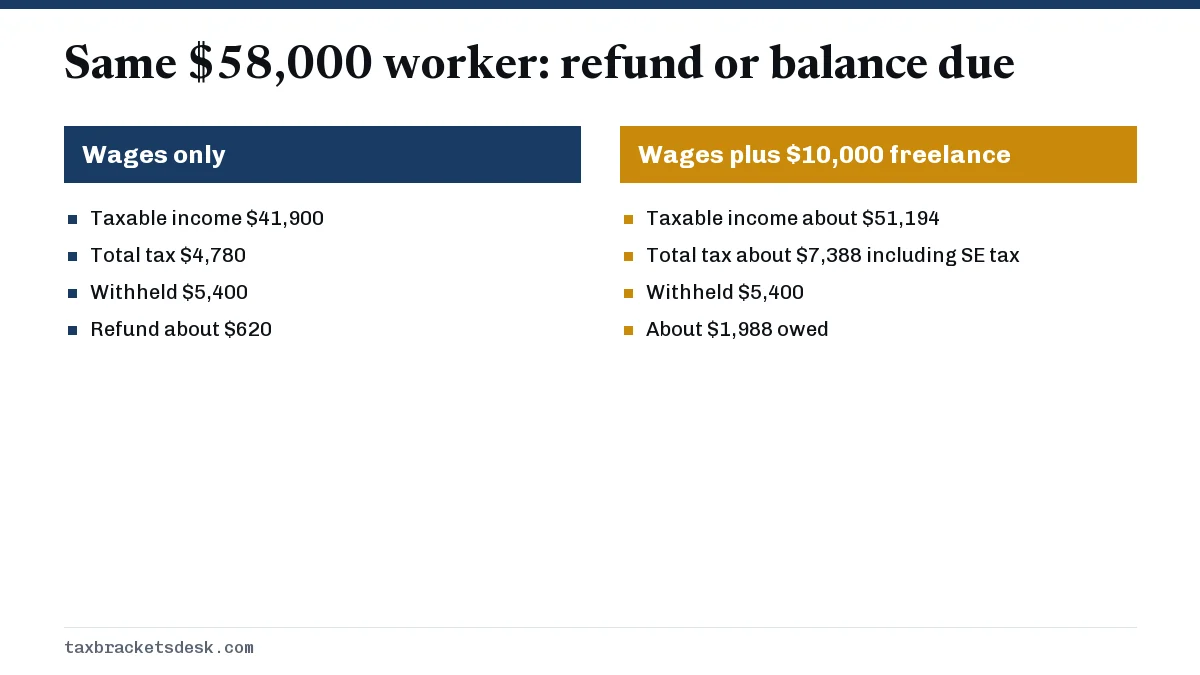
A single filer earned $58,000 in wages, Form W-2 box 2 shows $5,400 withheld, and there is no other income. The standard deduction of $16,100 leaves $41,900 of taxable income.
- 10% on $12,400 = $1,240.
- 12% on the remaining $29,500 = $3,540.
- Total tax: $4,780.
- Payments: $5,400 withheld.
- Refund estimate: $5,400 minus $4,780 = $620.
Head of household with one child
A head of household parent earns $62,000, has one child aged 9, and had $3,100 withheld. Taxable income is $37,850 after the $24,150 standard deduction, and tax from the brackets is $4,188.
The $2,200 Child Tax Credit cuts tax to $1,988. Payments of $3,100 exceed that by $1,112, which is the estimated refund. For the refundable part of the credit when tax is low, see the additional child tax credit.
Why might I owe instead of getting a refund?
You owe when withholding and payments fall short of your tax. Go back to the single filer above and add $10,000 of freelance income with no estimated payments made.
- Self-employment tax: $10,000 x 92.35% x 15.3% = about $1,413.
- Half of that, about $706, is subtracted as an adjustment, so taxable income becomes about $51,194.
- Income tax rises to about $5,975, because the top slice now reaches the 22% bracket.
- Total tax of about $7,388 minus $5,400 withheld leaves about $1,988 owed.
Other common reasons for a balance due:
- Two jobs, or two working spouses, each withholding as if it were the only income, so the combined income is taxed at a higher bracket than either job withheld for.
- A bonus withheld at the 22% flat rate when your top bracket is 24% or higher.
- A child turning 17, which ends the $2,200 Child Tax Credit and leaves only the $500 credit for other dependents.
- Unemployment or retirement income with no tax withheld.
If you expect to owe $1,000 or more after withholding, the IRS generally expects estimated payments during the year; our estimated taxes guide covers the dates and safe harbor rules.
Do the new deductions raise my refund?
They can, because many employers do not reduce withholding for the Schedule 1-A deductions. If the $58,000 single filer above received $5,000 of qualified tips, the no-tax-on-tips deduction cuts taxable income to $36,900 and tax to $4,180.
With the same $5,400 withheld, the refund estimate grows from $620 to $1,220. The increase equals the deduction times the 12% top rate. The deductions for tips and overtime phase out once modified AGI passes $150,000 ($300,000 joint).
What refund size really means
A large refund means you paid more tax during the year than you owed. A balance due means you paid less. Neither changes your actual tax bill, which depends only on income, deductions and credits.
To aim for a smaller refund and larger paychecks, or to stop owing each April, adjust Form W-4 with your employer. Steps 3 and 4 of the form let you account for credits, other income and extra withholding; our W-4 withholding guide walks through each line.
Common questions
How big will my tax refund be in 2027?
Your 2027 refund is the gap between your 2026 withholding and your 2026 tax. Run your W-2 box 1 and box 2 figures through the calculator to estimate it; a single filer with $58,000 of wages and $5,400 withheld would get about $620.
Is a tax refund calculator accurate?
It is close for wage earners with standard deductions. Results drift when you have investment income, credits the calculator does not model, or income phaseouts.
Why is my refund smaller this year?
Common causes are a raise that pushed income into a higher bracket, less withholding after a W-4 change, a lost credit, or new income with no withholding. Compare box 2 on this year's and last year's W-2 first.
Does the Earned Income Tax Credit increase my refund?
Yes. The EITC is fully refundable, up to $8,231 for 2026 with three or more children, so it is added to your payments even if you owe no tax.
Can I get a refund if I had no tax withheld?
Only through refundable credits such as the EITC or the additional child tax credit. Without withholding or refundable credits there is nothing to refund.
Sources
- Rev. Proc. 2025-32 (tax year 2026 inflation adjustments) irs.gov
- IRS Tax Withholding Estimator irs.gov
- Publication 505, Tax Withholding and Estimated Tax irs.gov
- Topic 554, Self-employment tax irs.gov
- Child Tax Credit irs.gov
We check figures against these official pages. Rules change; confirm anything that affects a deadline or payment with the agency before you act.
Tell us what happened
Describe your situation and our editors will use it to improve this guide. If you leave your email, we may reply with a pointer to the right page or official contact. We never share your details.