
Gambling winnings tax: rates, Form W-2G and the 2026 loss limit
Short answer
Gambling winnings tax is ordinary federal income tax at your bracket rate, from 10% to 37%, on every dollar you win, whether or not you get a Form W-2G. Payers withhold 24% on large lottery and wagering prizes, which is often less than the final bill. Starting with 2026 returns, itemizers can deduct only 90% of gambling losses, capped at winnings.
- 01Tax rate on winnings
- Ordinary income, 10% to 37%
- 02Regular gambling withholding
- 24% when winnings minus wager exceed $5,000 (lotteries, pools, sports wagering)
- 03Form W-2G minimum threshold, 2026 payments
- $2,000 (indexed after 2026)
- 04Loss deduction from 2026
- Lesser of 90% of losses or winnings, itemizers only
- 05Where winnings go
- Schedule 1 (Form 1040), line 8b
How much tax do I pay on gambling winnings?
You pay federal income tax on gambling winnings at your ordinary rates; there is no separate gambling winnings tax rate. The winnings are added to wages and other income on Schedule 1, line 8b, and taxed through the 2026 brackets for your filing status. The IRS says all gambling income must be reported, including lotteries, raffles, sports betting, horse races and casinos (Topic 419).
Prizes that are not cash, such as a car or trip, are taxed at their fair market value. Winnings are reported for the year you receive them, and a small win with no form is just as taxable as a jackpot with one. For the full sequence from income to tax, see how taxable income is calculated.
Withholding at 24%: why it may not cover the tax
Payers must withhold 24% federal income tax when winnings minus the wager are more than $5,000 from lotteries, sweepstakes, wagering pools, parimutuel pools and sports wagering that also pay at least 300 times the bet (Instructions for Forms W-2G and 5754, January 2026). Bingo, keno and slot machine wins are not subject to this regular withholding.
Separately, backup withholding at 24% can apply to any reportable win if you do not give the payer a correct taxpayer identification number. Withholding is shown in box 4 of Form W-2G and counts toward your total tax, just like wage withholding.
How are lottery winnings taxed? A lump sum example
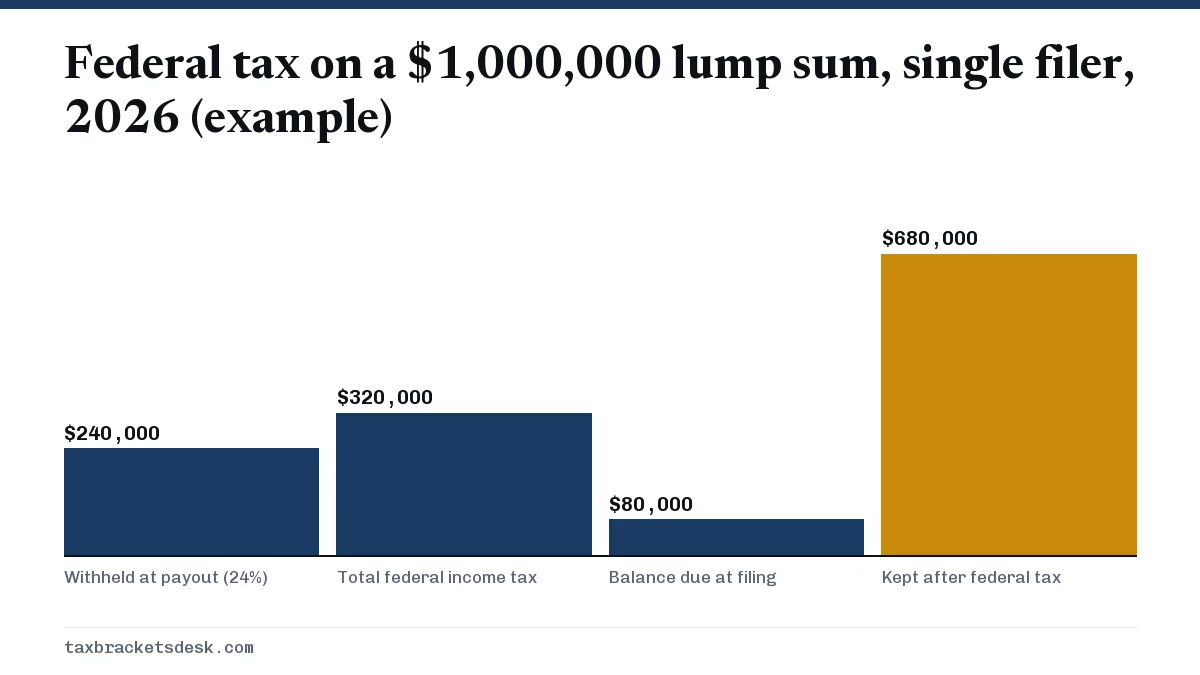
Tax on lottery winnings follows the same ordinary income rules. Take a single filer with no other income who takes a $1,000,000 lump sum in 2026. The lottery withholds 24%, or $240,000. On the return, taxable income is $983,900 after the $16,100 standard deduction.
| Item | Amount |
|---|---|
| Prize | $1,000,000 |
| Taxable income after standard deduction | $983,900 |
| Tax through $640,600 (2026 single schedule) | $192,979 |
| 37% on the remaining $343,300 | $127,021 |
| Total federal income tax | $320,000 |
| Withheld by the lottery (24%) | $240,000 |
| Still owed at filing | $80,000 |
Choosing an annuity instead spreads the income so each year's payment is taxed in that year, often in lower brackets. State income tax, where it applies, is extra. Every 2026 rate band is on our 2026 IRS tax brackets page.
Gambling winnings tax 2026: the 90% loss limit
The biggest gambling winnings tax change for 2026 is that deductible losses are now limited to the lesser of 90% of your losses or your winnings (IRS Publication 505, 2026). Before 2026, losses were deductible in full up to the amount of winnings. The change comes from the 2025 tax law and applies to returns filed in 2027.
| Winnings | Losses | Deductible loss | Net taxable gambling income |
|---|---|---|---|
| $10,000 | $10,000 | $9,000 | $1,000 |
| $10,000 | $4,000 | $3,600 | $6,400 |
| $5,000 | $20,000 | $5,000 | $0 |
| $50,000 | $60,000 | $50,000 | $0 |
The first row is the key point: a gambler who exactly broke even for the year now reports $1,000 of taxable income. When losses are large relative to winnings, the cap at winnings still controls, as in the last two rows.
You must itemize to deduct losses
Gambling losses go on Schedule A as an other itemized deduction, so they help only if your itemized total beats the $16,100 single or $32,200 joint standard deduction. A casual player who takes the standard deduction pays tax on gross winnings with no loss offset. Our list of itemized deductions shows what else can be combined to make itemizing worth it.
When do I get a W-2G?
You get Form W-2G, Certain Gambling Winnings, when a win meets the reporting threshold for its type or when federal tax was withheld. For payments made in calendar 2026 the minimum threshold is $2,000, and from then on it is adjusted for inflation each year; the 2027 figure is not yet announced and would normally appear in the IRS inflation adjustments released in October or November.
| Type of gambling | W-2G is issued when |
|---|---|
| Bingo, keno, slot machines | Winnings meet the $2,000 threshold |
| Poker tournaments | Net winnings meet the $2,000 threshold |
| Horse or dog racing, jai alai, sports wagering | Winnings meet the threshold and are at least 300 times the wager |
| Lotteries, sweepstakes, wagering pools | Winnings meet the threshold and are at least 300 times the wager |
| Any type with federal tax withheld | Always |
No W-2G does not mean no tax. Winnings below the threshold, online sportsbook profits and office pool prizes are all still reportable income.
Records to keep and what to do if the IRS questions your return
The IRS expects a diary or similar record of each session, plus tickets, receipts, statements and W-2G forms (Topic 419). Without records, you may lose the loss deduction entirely.
- Log the date, place, type of game, amounts won and lost, and who you were with.
- Keep losing tickets, casino win/loss statements and sportsbook account histories.
- Match each W-2G to Schedule 1 so the IRS matching system does not flag a missing form.
- If you receive a CP2000 notice proposing tax on an unreported W-2G, respond by the date shown with your records rather than ignoring it.
Winnings of a child are the child's unearned income and can fall under the kiddie tax. And because winnings raise AGI, a big year can also make more Social Security taxable or change how a 401(k) withdrawal is taxed that same year.
Common questions
Do I have to pay taxes on gambling winnings under $2,000?
Yes. The $2,000 figure only decides whether the payer must send a Form W-2G. All gambling winnings are taxable income regardless of amount.
Can I deduct gambling losses without itemizing?
No. Casual gamblers can deduct losses only on Schedule A. If you take the standard deduction, winnings are taxed in full.
Is the gambling tax rate 24%?
24% is the withholding rate, not the tax rate. Your actual rate depends on your bracket and can be anywhere from 10% to 37%, so you may get money back or owe more.
Are sports betting winnings taxable?
Yes. Sports wagering profits are gambling income reported on Schedule 1, and sportsbooks issue Form W-2G when a win meets the threshold and 300-times-the-wager test.
Do I pay tax on gambling winnings if I lost more than I won?
For 2026 and later, possibly a little. If you itemize, you can deduct 90% of losses up to your winnings, so equal wins and losses leave 10% of the winnings taxable.
Sources
- Topic 419, Gambling income and losses irs.gov
- Instructions for Forms W-2G and 5754 (01/2026) irs.gov
- Publication 505 (2026), Tax Withholding and Estimated Tax irs.gov
- Rev. Proc. 2025-32, 2026 inflation adjustments irs.gov
We check figures against these official pages. Rules change; confirm anything that affects a deadline or payment with the agency before you act.
Tell us what happened
Describe your situation and our editors will use it to improve this guide. If you leave your email, we may reply with a pointer to the right page or official contact. We never share your details.
Related guides
 How Taxable Income Is Calculated: Gross to Taxable
Taxable income is calculated in three steps: add up all gross income that is not excluded by law, subtract adjustments such as de…
Kiddie Tax 2026: Thresholds, Rules and How It Is Figured
The kiddie tax makes a child's unearned income above $2,700 taxable at the parent's marginal rate instead of the child's lower ra…
Tax on 401(k) Withdrawal: How Much You Will Owe and Why
The tax on a 401(k) withdrawal is ordinary federal income tax at your normal bracket rates, because pre-tax money was never taxed…
Itemized Deductions: What You Can Deduct on Schedule A
Itemized deductions are the expenses you list on Schedule A (Form 1040) in place of the standard deduction: medical and dental co…
Tax Brackets 2026: 10% to 37% IRS Tables by Filing Status
The IRS tax brackets for 2026 are 10%, 12%, 22%, 24%, 32%, 35% and 37%: single filers pay 10% on the first $12,400 of taxable inc…