
Kiddie tax 2026: when a child's investment income is taxed at the parent's rate
Short answer
The kiddie tax makes a child's unearned income above $2,700 taxable at the parent's marginal rate instead of the child's lower rate for tax year 2026. It covers children under 18, and students up to age 23 whose earned income is not over half their support. It is figured on Form 8615, or parents can report the income themselves on Form 8814 in some cases.
- 012026 threshold for parent's rate
- Unearned income over $2,700
- 02Taxed at child's own rate
- The $1,350 slice above the first $1,350
- 03Form 8814 limit
- Child's gross income under $13,500
- 04Maximum tax on the child-rate slice via Form 8814
- $135
- 05Ages covered
- Under 18; 18; full-time students 19 to 23 (support test)
- 06Form
- Form 8615, filed with the child's return
What is the kiddie tax?
The kiddie tax is a rule that taxes part of a child's unearned income, such as interest, dividends and capital gains, at the parent's tax rate when that rate is higher. It exists to stop families from moving investments into a child's name so the income is taxed in the 10% bracket. For 2026 it reaches unearned income above $2,700, the same threshold as 2025 (Rev. Proc. 2025-32).
Unearned income here means all taxable income other than pay for work: interest, dividends, capital gains, rents, royalties, the taxable part of Social Security and pensions, unemployment compensation, taxable scholarships not reported on a W-2 and trust income (Instructions for Form 8615). A child's wages from a job are earned income and are always taxed at the child's own rates.
Who does the kiddie tax apply to?
The kiddie tax applies to a child who has more than $2,700 of unearned income, must file a return, does not file jointly, has at least one living parent at year end, and meets one of three age tests (IRS Topic 553).
- Under age 18 at the end of the year.
- Age 18 at the end of the year, with earned income not more than half of the child's own support.
- A full-time student at least 19 and under 24 at the end of the year, with earned income not more than half of the child's support.
A 20-year-old college student living on a trust fund is covered; a 20-year-old who is not a student is not, and neither is an 18-year-old whose wages pay for more than half of their own support. The child does not have to be claimed as a dependent for the rule to apply.
What is the kiddie tax threshold for 2026?
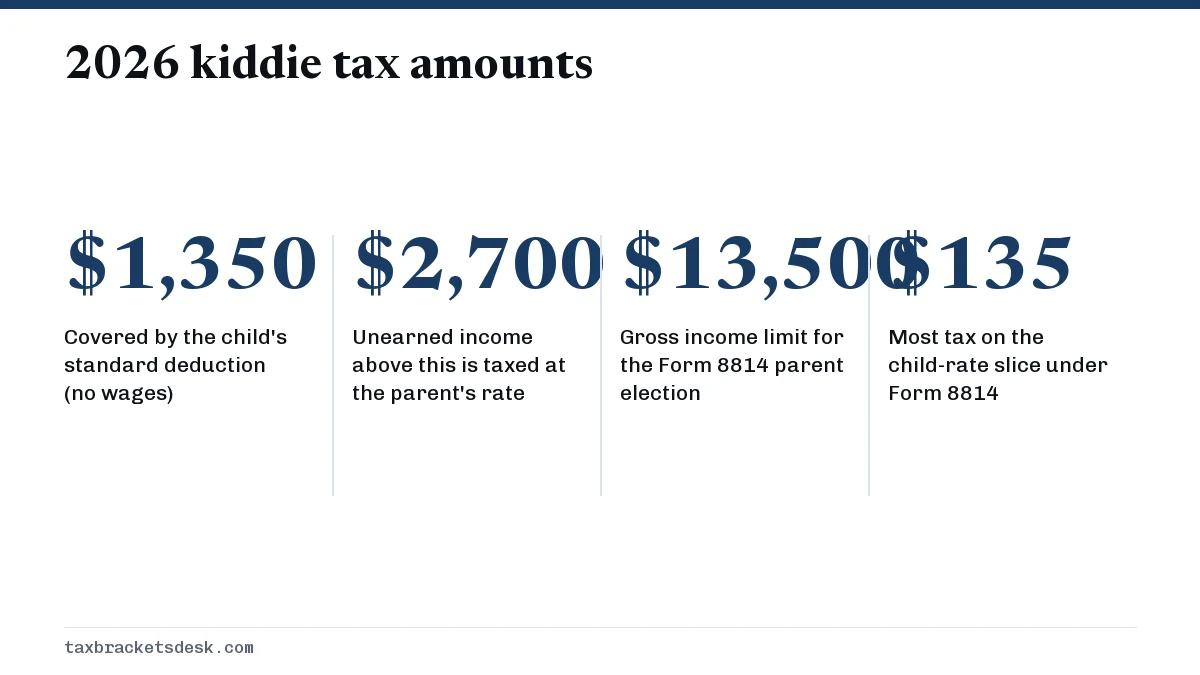
The 2026 kiddie tax threshold is $2,700 of unearned income, built from a $1,350 reference amount in Revenue Procedure 2025-32. The first $1,350 is generally covered by the child's standard deduction, the next $1,350 is taxed at the child's rates, and anything above $2,700 is taxed at the parent's rate.
For 2027 the reference amount and threshold are not yet announced; the IRS normally publishes them in its annual inflation adjustment revenue procedure in October or November. A dependent child's own standard deduction for 2026 is the greater of $1,350 or earned income plus $450, as explained on our 2026 standard deduction page.
How the kiddie tax is calculated on Form 8615
Form 8615, Tax for Certain Children Who Have Unearned Income, splits the child's taxable income into two parts. Net unearned income, which is unearned income minus $2,700, is taxed as if it were added on top of the parent's taxable income. The rest of the child's taxable income is taxed at the child's own rates.
Worked example: $6,000 of interest in 2026
| Step | Amount |
|---|---|
| Unearned income | $6,000 |
| Child's standard deduction | -$1,350 |
| Child's taxable income | $4,650 |
| Net unearned income ($6,000 - $2,700) | $3,300 taxed at parent's 24% = $792 |
| Remaining taxable income ($4,650 - $3,300) | $1,350 taxed at child's 10% = $135 |
| Total tax on the child's return | $927 |
| Tax without the kiddie tax ($4,650 x 10%) | $465 |
The kiddie tax added $462 in this example. If the income were qualified dividends or long-term gains instead of interest, the net unearned income would be taxed at the parent's capital gains rate, which may be 0% or 15%; see qualified dividends tax rate.
Which parent's rate is used?
For married parents filing jointly, use their joint return. If they file separately, use the parent with the greater taxable income. For divorced or separated parents, use the custodial parent, the one the child lived with for most of the year, with special rules if that parent remarried. If the parent's figures are not available by the due date, the child can file Form 4868 for an extension or request the information from the IRS in writing.
Can parents report a child's income on their own return (Form 8814)?
Yes, if conditions are met: parents can elect to report a child's interest and dividends on their own return using Form 8814, Parents' Election To Report Child's Interest and Dividends. The child then does not file. The election is available only when all of the following are true (IRS Topic 553).
- The child was under 19, or under 24 if a full-time student, at year end.
- The child's only income was interest and dividends, including capital gain distributions and Alaska Permanent Fund dividends.
- The child's gross income was less than $13,500.
- No estimated tax payments were made in the child's name and no federal tax was withheld, including backup withholding.
Under the election, the child's income between $1,350 and $2,700 is taxed at 10%, a maximum of $135, and income above $2,700 is added to the parent's income. In the example above the total tax is the same $927, but the parent's AGI rises by $3,300.
Common situations and what to do
- Custodial brokerage accounts (UTMA/UGMA): income belongs to the child, so it counts toward the $2,700. Holding growth investments and timing sales can keep realized income lower.
- Survivor Social Security benefits: the taxable part is unearned income; our Social Security tax guide explains how the taxable share is found.
- A lottery or contest prize won by a child: it is unearned income and can trigger the kiddie tax; see gambling winnings tax.
- Teen with a summer job and investments: wages stay at the child's rates; only the unearned part above $2,700 moves to the parent's rate.
For the order in which a child's income, deductions and rates are applied, the same framework as an adult return applies; see how taxable income is calculated.
Common questions
At what age does the kiddie tax stop?
It stops at 18 for children whose earned income covers more than half their support, at 19 for non-students, and at 24 for full-time students. A child who is 24 or older at year end is never subject to it.
Does the kiddie tax apply to a child's wages?
No. Earned income from a job or self-employment is taxed at the child's own rates. Only unearned income above $2,700 for 2026 can be taxed at the parent's rate.
Does a child have to file a tax return for investment income?
A dependent child generally must file when unearned income is more than $1,350 for 2026, unless the parents make the Form 8814 election and meet its conditions.
Is the kiddie tax the same as the gift tax?
No. The gift tax concerns the person giving money, with a $19,000 per recipient annual exclusion for 2026. The kiddie tax concerns the income the gifted money later earns in the child's name.
Does the kiddie tax use trust tax rates?
Not anymore for most families. Since 2020 the net unearned income is taxed at the parent's rate, not the estates and trusts rate schedule.
Sources
- Topic 553, Tax on a child's investment and other unearned income (kiddie tax) irs.gov
- Instructions for Form 8615 irs.gov
- Instructions for Form 8814 irs.gov
- Rev. Proc. 2025-32, 2026 inflation adjustments irs.gov
We check figures against these official pages. Rules change; confirm anything that affects a deadline or payment with the agency before you act.
Tell us what happened
Describe your situation and our editors will use it to improve this guide. If you leave your email, we may reply with a pointer to the right page or official contact. We never share your details.
Related guides
 How Taxable Income Is Calculated: Gross to Taxable
Taxable income is calculated in three steps: add up all gross income that is not excluded by law, subtract adjustments such as de…
Tax on Social Security Benefits: 50% and 85% Rules
Federal tax on Social Security benefits applies only when your other income plus half of your benefits is more than $25,000 (sing…
Gambling Winnings Tax: Rates, Forms and 2026 Changes
Gambling winnings tax is ordinary federal income tax at your bracket rate, from 10% to 37%, on every dollar you win, whether or n…
Qualified Dividends Tax Rate 2026 vs Ordinary Dividends
The qualified dividends tax rate for 2026 is 0%, 15% or 20%, the same rates that apply to long-term capital gains. A single filer…
Standard Deduction 2026: $16,100 Single, $32,200 Joint, 65+
The 2026 standard deduction is $16,100 for single filers and married filing separately, $32,200 for married filing jointly and su…