
Tax on Social Security benefits: how much of your check is taxable
Short answer
Federal tax on Social Security benefits applies only when your other income plus half of your benefits is more than $25,000 (single or head of household) or $32,000 (married filing jointly). Above that line up to 50% of benefits become taxable income, and above $34,000 or $44,000 up to 85%. No one pays tax on more than 85% of benefits (IRS Publication 915).
- 01Base amount, single or head of household
- $25,000
- 02Base amount, married filing jointly
- $32,000
- 0385% tier starts
- $34,000 single, $44,000 joint
- 04Maximum taxable share
- 85% of benefits
- 05Married filing separately, lived together
- $0 base amount
- 06Voluntary withholding rates (Form W-4V)
- 7%, 10%, 12% or 22%
What is combined income for Social Security?
Combined income is your adjusted gross income from all other sources, plus tax-exempt interest, plus half of your net Social Security benefits. It is not the same as AGI: municipal bond interest that is otherwise tax free is added back in, and so are a few excluded items such as foreign earned income and employer adoption benefits (Publication 915).
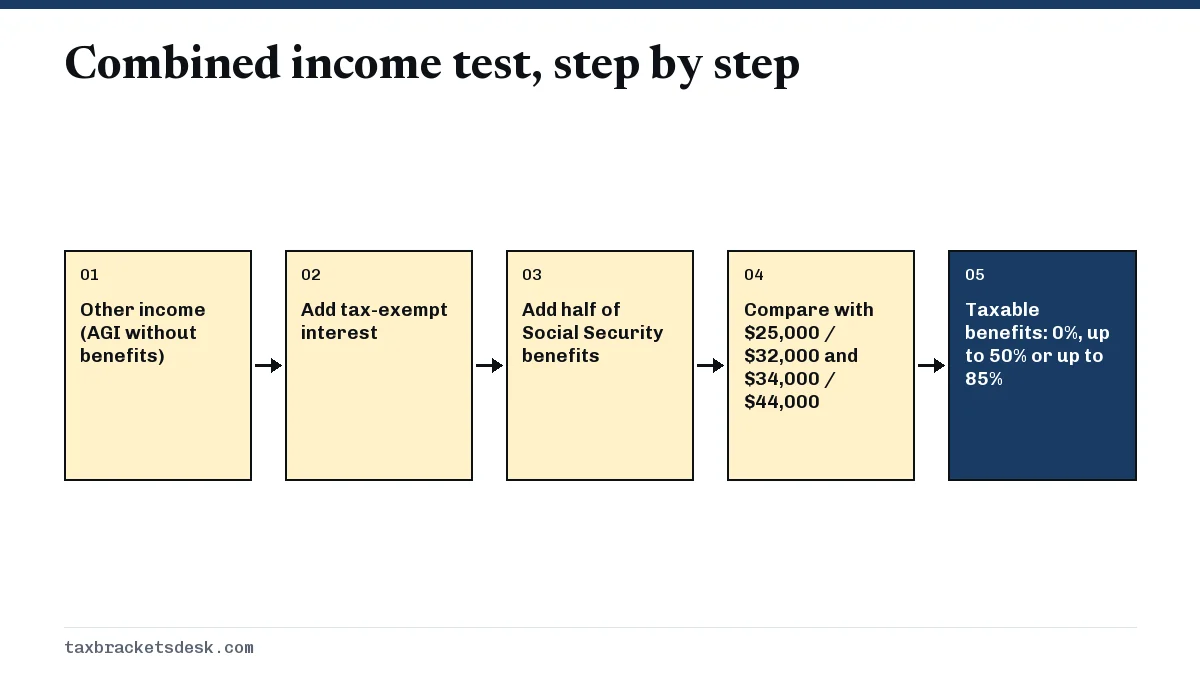
Pension payments, wages, interest, dividends, capital gains and traditional IRA or 401(k) withdrawals all count. That is why a single large retirement account withdrawal can make benefits taxable in a year when they normally are not; our page on tax on a 401(k) withdrawal shows how that payout itself is taxed.
Worked example: how much federal tax on my Social Security?
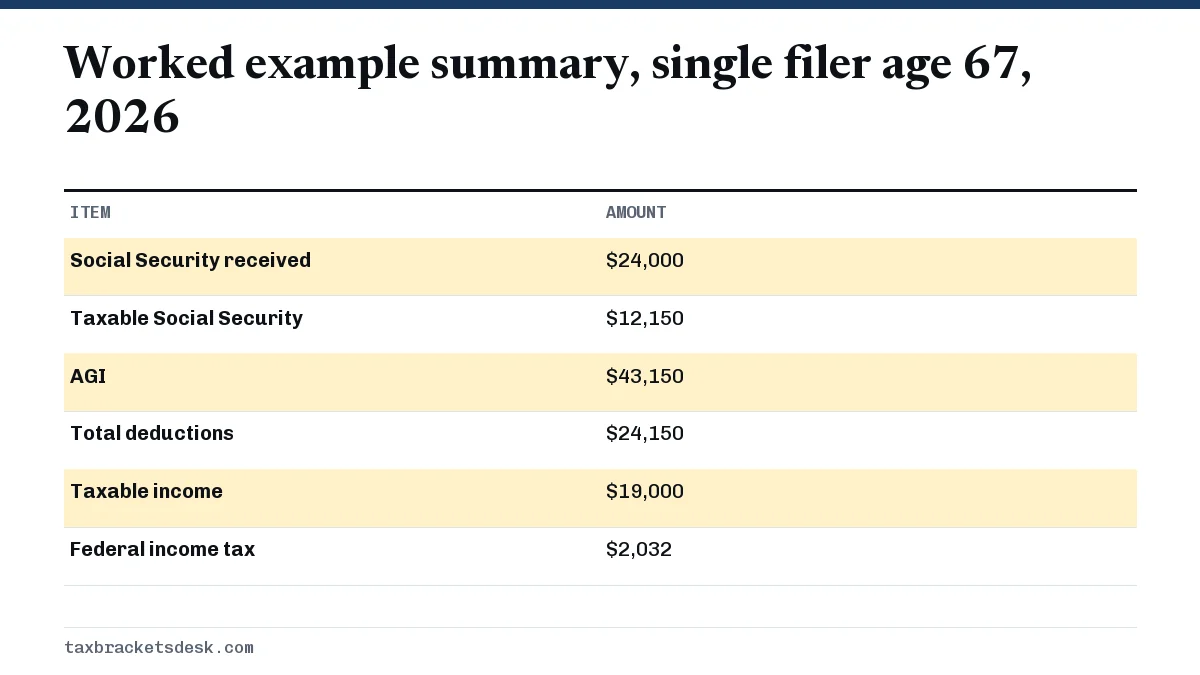
Take a single filer aged 67 in 2026 with $24,000 of Social Security, a $30,000 pension and $1,000 of bank interest. Combined income is $31,000 of other income plus $12,000 (half the benefits), or $43,000, which is above the $34,000 second threshold.
| Step | Amount |
|---|---|
| Combined income | $43,000 |
| Excess over $34,000, times 85% | $9,000 x 85% = $7,650 |
| Plus the smaller of $4,500 or half of benefits ($12,000) | $4,500 |
| Tentative taxable benefits | $12,150 |
| 85% of benefits ($24,000 x 85%) | $20,400 |
| Taxable Social Security (smaller of the two) | $12,150 |
Her AGI is $31,000 plus $12,150, or $43,150. She subtracts the $16,100 single standard deduction, the $2,050 additional amount for age 65, and the $6,000 senior deduction (her modified AGI is under $75,000), leaving taxable income of $19,000. Federal tax is $1,240 on the first $12,400 plus 12% of $6,600, or $2,032. Without any benefits being taxable she would have owed $685, so about $1,347 of her bill is the tax on Social Security.
Special cases: lump-sum back payments and children's benefits
If a lump-sum payment includes benefits for earlier years, you can elect to figure the taxable part as if each prior year's benefits had been received in that year, which often lowers the amount. Publication 915 has separate worksheets for this, and you check the box on Form 1040 line 6c. You do not amend the earlier returns.
Benefits paid to a child, such as survivor benefits, are the child's income, not the parent's, even if deposited to the parent's account. The same combined income test applies to the child, and the taxable part is unearned income that can fall under the kiddie tax rules. For how benefits fit into the full income calculation, see how taxable income is calculated.
Common questions
At what age is Social Security no longer taxable?
There is no such age. The taxable share depends only on income and filing status, so an 85-year-old with a large pension can still have 85% of benefits taxed. Age 65 does bring extra deductions that reduce the tax.
Is Social Security taxable in 2027, and will the COLA make more of it taxable?
Yes, under the same rules as 2026, and the COLA can make more of it taxable. The 3.6% COLA raises benefits paid from January 2027, but the $25,000 and $32,000 base amounts do not change. A $2,000 monthly benefit becomes $2,072, which adds $864 for the year and puts $432, half of the increase, into combined income on the 2027 return.
Is Social Security disability (SSDI) taxable?
It can be. SSDI follows the same $25,000 and $32,000 base amounts as retirement benefits. SSI payments are not taxable, including the $1,029 monthly federal payment for an individual in 2027.
Do I pay tax on 85% of my Social Security?
Only if your income is high enough. 85% is the maximum share that can be included in income, not a rate; many retirees have 0% or a partial amount taxable.
Does Roth IRA income count toward Social Security taxation?
Qualified Roth IRA distributions are not included in AGI, so they do not raise combined income. Traditional IRA and 401(k) withdrawals do.
Do states tax Social Security benefits?
Most states do not, but a few do in some form. Check your state revenue department, since this page covers only federal tax.
Sources
- Publication 915, Social Security and Equivalent Railroad Retirement Benefits irs.gov
- Topic 423, Social Security and equivalent railroad retirement benefits irs.gov
- Form W-4V, Voluntary Withholding Request irs.gov
- Publication 505 (2026), Tax Withholding and Estimated Tax irs.gov
- Rev. Proc. 2025-32, 2026 inflation adjustments irs.gov
We check figures against these official pages. Rules change; confirm anything that affects a deadline or payment with the agency before you act.
Tell us what happened
Describe your situation and our editors will use it to improve this guide. If you leave your email, we may reply with a pointer to the right page or official contact. We never share your details.
Related guides
 How Taxable Income Is Calculated: Gross to Taxable
Taxable income is calculated in three steps: add up all gross income that is not excluded by law, subtract adjustments such as de…
Social Security Wage Base 2027: $192,300 Official Limit
The Social Security wage base for 2027 is $192,300, up from $184,500 in 2026. The Social Security Administration announced it on…
Tax on 401(k) Withdrawal: How Much You Will Owe and Why
The tax on a 401(k) withdrawal is ordinary federal income tax at your normal bracket rates, because pre-tax money was never taxed…
Kiddie Tax 2026: Thresholds, Rules and How It Is Figured
The kiddie tax makes a child's unearned income above $2,700 taxable at the parent's marginal rate instead of the child's lower ra…
Senior Deduction: $6,000 Extra for Age 65 and Older
The senior deduction is a temporary extra deduction of up to $6,000 for each taxpayer age 65 or older, or $12,000 when both spous…
Standard Deduction for Seniors Over 65: 2026 Amounts
The 2026 standard deduction for seniors is the regular amount plus an extra $2,050 for a single or head of household filer who is…