
Payroll and Self-Employment Tax
Self-employment tax: the 15.3% rate, the 92.35% step and the half you can deduct
Short answer
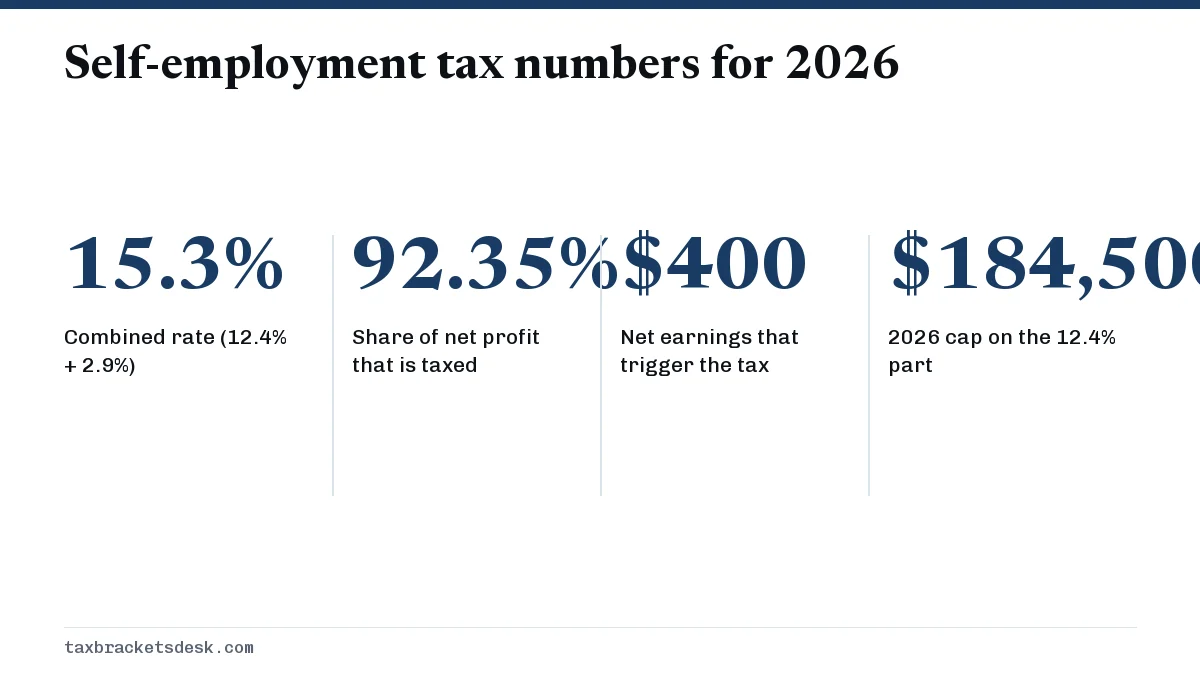
Self-employment tax is 15.3% (12.4% Social Security plus 2.9% Medicare) charged on 92.35% of your net earnings from self-employment, and you owe it once those net earnings reach $400 (IRS Topic 554). For 2026 the 12.4% part stops at $184,500, and half of the tax is deductible when you figure adjusted gross income.
- 01Self-employment tax rate
- 15.3% (12.4% Social Security + 2.9% Medicare)
- 02Share of profit taxed
- 92.35% of net earnings
- 03Filing threshold
- $400 of net earnings ($108.28 for church employee income)
- 042026 Social Security cap
- $184,500, shared with W-2 wages
- 05Effective rate below the cap
- About 14.13% of net profit
- 06Form
- Schedule SE (Form 1040)
What is the self-employment tax rate?
The self-employment tax rate is 15.3%: 12.4% for Social Security and 2.9% for Medicare, applied to 92.35% of net earnings from self-employment (IRS Topic 554). Because only 92.35% of profit is taxed, the real rate on each dollar of net profit is about 14.13% until you reach the Social Security wage base.
Self-employment tax is the Social Security and Medicare tax for people who work for themselves. An employee splits these taxes with an employer; a sole proprietor, independent contractor or partner in a business pays both halves. The rate for self-employment tax 2026 returns is the same 15.3% used for many years; only the wage base changes.
Who has to pay self-employment tax?
You must pay self-employment tax if your net earnings from self-employment are $400 or more for the year. The threshold for church employee income is lower, at $108.28, unless you hold an exemption (IRS Topic 554).
- Sole proprietors and single-member LLC owners who report on Schedule C.
- Independent contractors paid on Form 1099-NEC or through payment apps that issue Form 1099-K.
- Members of partnerships that carry on a trade or business, from their Schedule K-1.
- Farmers reporting on Schedule F.
The tax applies even if you owe no income tax. A part-time seller with $9,000 of profit and a large standard deduction can have zero income tax and still owe about $1,272 of self-employment tax. Not receiving a Form 1099 does not change this: the income is taxable whether or not a payer sends a form.
How is self-employment tax calculated on Schedule SE?
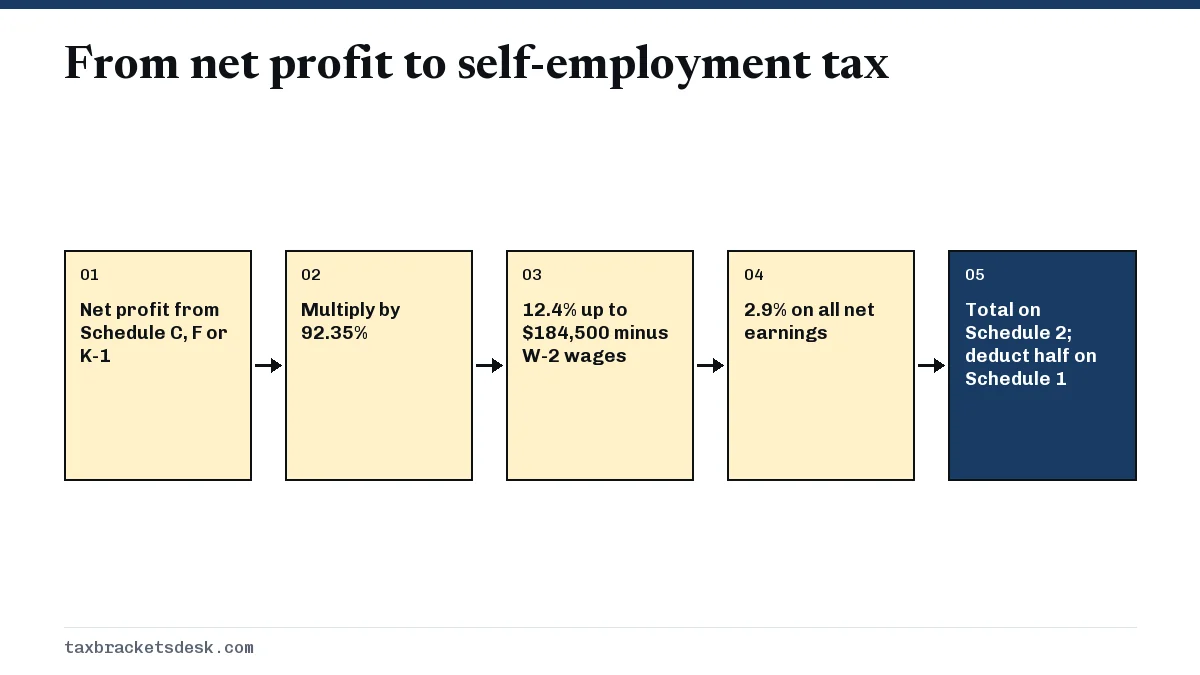
Schedule SE (Form 1040) turns net profit into self-employment tax in four moves. The result goes on Schedule 2 of Form 1040 and is added to your total tax.
- Start with net profit from Schedule C (line 31), Schedule F, or your partnership K-1.
- Multiply by 92.35% to get net earnings from self-employment. If the result is under $400, stop; you owe no self-employment tax.
- Apply 12.4% to net earnings up to $184,500 for 2026, minus any Social Security wages you already had from a job.
- Apply 2.9% to all net earnings, with no cap, and add the two amounts.
The 92.35% figure equals 100% minus 7.65%. It mirrors the way an employer's half of FICA is not counted as the employee's wages, so a self-employed person is not taxed on the portion that stands in for the employer share.
Worked example: $80,000 of net profit
A single graphic designer has $80,000 of net profit on Schedule C for 2026 and no W-2 job. Here is the Schedule SE math.
| Step | Calculation | Amount |
|---|---|---|
| Net earnings | $80,000 x 92.35% | $73,880.00 |
| Social Security part | $73,880 x 12.4% | $9,161.12 |
| Medicare part | $73,880 x 2.9% | $2,142.52 |
| Self-employment tax | Sum | $11,303.64 |
| Deduction for half | $11,303.64 / 2 | $5,651.82 |
The designer pays $11,303.64 of self-employment tax and subtracts $5,651.82 when figuring adjusted gross income. To run your own figures, use our self-employment tax calculator.
Can I deduct half of self-employment tax?
Yes. You deduct one-half of your self-employment tax as an adjustment to income on Schedule 1 (Form 1040), whether or not you itemize (IRS Topic 554). It lowers income tax, but it does not reduce the self-employment tax itself.
- The deduction is figured on Schedule SE and carried to Schedule 1.
- The 0.9% Additional Medicare Tax is not part of the deductible half.
- The qualified business income deduction lowers income tax only; it does not reduce net earnings for self-employment tax.
- Business expenses on Schedule C are the main legal way to lower self-employment tax, because they reduce net profit before the 92.35% step.
Special cases on Schedule SE
Married couples
If both spouses have self-employment income, each files a separate Schedule SE, even on a joint return. Each spouse has a separate $184,500 cap and a separate $400 threshold, and earnings are credited to each person's own Social Security record.
A net loss
A self-employment loss means no self-employment tax for that business, but it cannot reduce the FICA already withheld from a W-2 job. Low-profit filers can look at the optional methods in the Schedule SE instructions to keep earning Social Security credits.
Paying self-employment tax during the year
No employer withholds self-employment tax, so you prepay it through estimated taxes if you expect to owe at least $1,000 for the year after withholding and credits. The 2026 due dates are April 15, June 15 and September 15, 2026 and January 15, 2027. Our page on estimated taxes for the self-employed shows how to size each payment, and the FICA tax hub compares this with what employees pay.
Common questions
Is self-employment tax 15.3% of gross income?
No. It is 15.3% of 92.35% of net profit, meaning income after business expenses. That works out to about 14.13% of net profit below the Social Security wage base.
Do I pay self-employment tax if I also have a W-2 job?
Yes, if your self-employment net earnings are $400 or more. Your W-2 Social Security wages reduce how much self-employment income is hit by the 12.4% part, but the 2.9% Medicare part still applies to all of it.
Where does self-employment tax go on Form 1040?
You figure it on Schedule SE, report the tax on Schedule 2, and take the deduction for half of it on Schedule 1. Both schedules feed into Form 1040.
Does an LLC pay self-employment tax?
A single-member LLC taxed as a sole proprietorship reports on Schedule C, and the owner pays self-employment tax on the profit. An LLC that elects to be taxed as a corporation follows different payroll rules.
What is the maximum self-employment tax for 2026?
The Social Security part tops out at $22,878, which is 12.4% of $184,500. The 2.9% Medicare part has no maximum, so total self-employment tax keeps rising with profit. For 2027 the Social Security part tops out at $23,845.20, 12.4% of $192,300.
Sources
- Topic 554, Self-employment tax irs.gov
- Instructions for Schedule SE (Form 1040) irs.gov
- Topic 751, Social Security and Medicare withholding rates irs.gov
- Publication 505, Tax Withholding and Estimated Tax irs.gov
We check figures against these official pages. Rules change; confirm anything that affects a deadline or payment with the agency before you act.
Tell us what happened
Describe your situation and our editors will use it to improve this guide. If you leave your email, we may reply with a pointer to the right page or official contact. We never share your details.
Related guides
 FICA Tax: Social Security and Medicare Rates for 2026
FICA tax is the 7.65% payroll tax taken from an employee's wages in 2026: 6.2% for Social Security on the first $184,500 of pay a…
Self-Employment Tax Calculator for 2026: Estimate SE Tax
This self-employment tax calculator estimates 2026 Schedule SE tax by taking 92.35% of your net profit and applying 12.4% up to t…
Social Security Tax 2026: 6.2% Rate Up to the $184,500 Cap
Social Security tax is 6.2% of an employee's wages up to the 2026 wage base of $184,500, which makes the maximum employee tax $11…
Additional Medicare Tax: 0.9% Over $200,000 Explained
Additional Medicare Tax is a 0.9% tax on Medicare wages and self-employment income above $200,000 for single and head of househol…
Estimated Taxes for Self-Employed Workers: How to Plan
Estimated taxes for self-employed people must cover both federal income tax and self-employment tax of 15.3% on 92.35% of net pro…