
Capital Gains and Investment Tax
Qualified dividends tax rate for 2026, and how ordinary dividends differ
Short answer
The qualified dividends tax rate for 2026 is 0%, 15% or 20%, the same rates that apply to long-term capital gains. A single filer pays 0% on qualified dividends that fall within the first $49,450 of taxable income, and a joint filer within the first $98,900. Ordinary (nonqualified) dividends are taxed at regular bracket rates from 10% to 37%.
- 01Qualified dividend rates, 2026
- 0%, 15% or 20%
- 020% rate ends (taxable income)
- $49,450 single; $98,900 joint; $66,200 head of household
- 0320% rate starts above
- $545,500 single; $613,700 joint; $579,600 head of household
- 04Holding period, common stock
- More than 60 days in the 121-day window around the ex-dividend date
- 05Where to find them
- Form 1099-DIV box 1b (qualified); box 1a (total ordinary)
What is the qualified dividends tax rate?
The qualified dividends tax rate is the preferential 0%, 15% or 20% rate the IRS applies to dividends that meet the holding period and payer rules. It is not a separate rate table: qualified dividends are stacked on top of your ordinary income and taxed with the long-term capital gains brackets, per Topic 404.
A qualified dividend is an ordinary dividend from a U.S. corporation or qualifying foreign corporation that you held long enough before and after the ex-dividend date. Everything else your broker reports as a dividend is taxed like wages.
Qualified vs ordinary dividends: how is each taxed?
Ordinary dividends tax is figured at your regular marginal rate. Qualified dividends get the capital gain rates. The difference can be as large as 37% versus 20% for a high earner, or 12% versus 0% for a retiree with modest income.
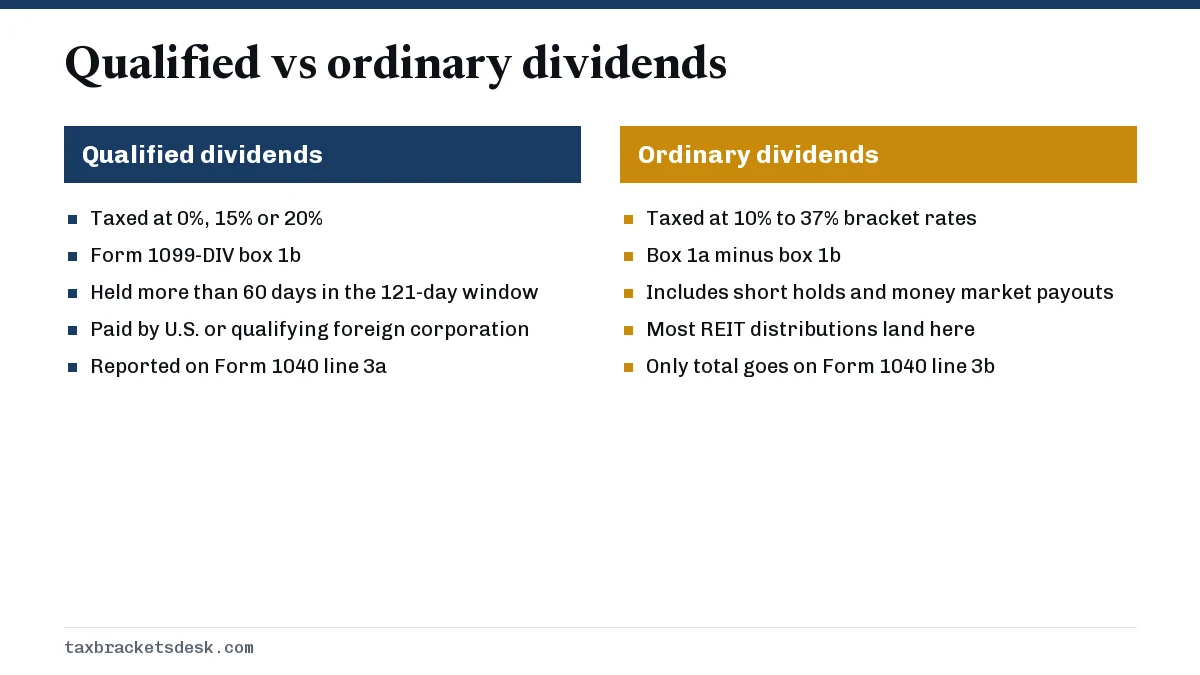
Common dividends that do not qualify include money market fund payouts (which are really interest), most REIT distributions, dividends on shares held too briefly, payments tied to short sales, and dividends paid on employer stock in an ESOP that the company deducts. Mutual fund capital gain distributions are a separate item: they are always long-term capital gains, whatever your holding period in the fund.
Dividend tax rate 2026 by filing status
These thresholds come from Rev. Proc. 2025-32 and apply to returns filed in 2027. They are measured against total taxable income, not just your dividends.
| Filing status | 0% up to | 15% up to | 20% above |
|---|---|---|---|
| Single | $49,450 | $545,500 | $545,500 |
| Married filing jointly | $98,900 | $613,700 | $613,700 |
| Head of household | $66,200 | $579,600 | $579,600 |
| Married filing separately | $49,450 | $306,850 | $306,850 |
For comparison, the 2025 0% ceiling was $48,350 single and $96,700 joint. The 2027 thresholds are not yet announced; the IRS usually publishes them in October or November, as covered on when the 2027 tax brackets will be released.
What makes a dividend qualified? The 60-day holding rule
For common stock, you must hold the shares for more than 60 days during the 121-day period that starts 60 days before the ex-dividend date, according to the Form 1099-DIV instructions. For certain preferred stock the test is more than 90 days in a 181-day window.
Holding period example
Say a stock goes ex-dividend on June 1. The 121-day window runs from April 2 through July 31. If you buy on May 20 and sell on June 15, you held it for 26 days in that window, so the dividend is ordinary. Buy on May 20 and hold through at least July 20 and it qualifies. The day you buy does not count; the day you sell does.
Brokers do their best to apply this test when filling in box 1b, but they cannot see hedges or positions at another firm. If you sold shortly after an ex-dividend date or held offsetting options, check the count yourself before relying on the form.
Where are qualified dividends on Form 1099-DIV?
- Box 1a, total ordinary dividends: all dividends, including the qualified ones. This goes on Form 1040 line 3b.
- Box 1b, qualified dividends: the portion of box 1a eligible for 0%, 15% or 20%. This goes on Form 1040 line 3a.
- Box 2a, total capital gain distributions: long-term gains from funds, reported on Schedule D or directly on Form 1040 line 7 if you have no other gains.
- Box 5, section 199A dividends: qualified REIT dividends, usually taxed as ordinary but eligible for the qualified business income deduction.
- Box 7, foreign tax paid: may support a foreign tax credit.
- Box 12, exempt-interest dividends: from municipal bond funds; generally not taxed federally.
If your taxable ordinary dividends are over $1,500, you also list each payer on Schedule B. Tax software then runs the Qualified Dividends and Capital Gain Tax Worksheet from the Form 1040 instructions to apply the lower rates.
Worked example: how much tax on $15,000 of dividends?
A single filer has $60,000 of taxable income in 2026, of which $15,000 is qualified dividends and $45,000 is wages after the standard deduction. Figures use the 2026 rate schedule.
- Tax the $45,000 of ordinary income at regular rates: $1,240 plus 12% of $32,600, which is $5,152.
- Stack the dividends from $45,000 to $60,000. The first $4,450 (up to $49,450) is taxed at 0%.
- The remaining $10,550 is taxed at 15%, or $1,582.50.
- Total federal income tax: $6,734.50.
If the same $15,000 had been ordinary dividends, tax on $60,000 of ordinary income would be $7,912. The qualified treatment saves $1,177.50. For a married couple with $90,000 of taxable income including $20,000 of qualified dividends, every dividend dollar sits under the $98,900 line and is taxed at 0%.
To see how the stacking works for sold shares as well as dividends, compare the full 2026 capital gains tax rates or start at the capital gains tax guide.
What to do if box 1b looks wrong
- Compare your trade dates against each ex-dividend date using the 61-day test above.
- Ask the broker for a corrected Form 1099-DIV if their classification is wrong; many issue corrections into March.
- Report only the amount you can support as qualified on line 3a, and keep your trade confirmations.
- If you already filed and a corrected form changes your tax, file Form 1040-X.
Children with large dividend income face a different rule: unearned income above $2,700 in 2026 can be taxed at the parent's rate. See the kiddie tax rules.
Common questions
Are qualified dividends taxed at 0% if I am in the 12% bracket?
Usually yes. For 2026 the 0% rate covers qualified dividends that fall within the first $49,450 of taxable income for single filers and $98,900 for joint filers, which roughly lines up with the top of the 12% bracket. Any portion above that line is taxed at 15%.
Do qualified dividends count toward taxable income?
Yes. They are part of taxable income and push up your total, but they are taxed at the lower capital gain rates. They also raise adjusted gross income, which can affect credits and Social Security taxation.
Why is box 1b smaller than box 1a on my 1099-DIV?
Box 1a is total ordinary dividends and box 1b is only the qualified part. The gap is usually money market dividends, REIT or bond fund income, short-term gain distributions, or dividends on shares you did not hold long enough.
Are dividends in an IRA or 401(k) qualified?
Dividends earned inside a traditional IRA or 401(k) are not taxed when paid. Withdrawals are taxed as ordinary income, so the qualified dividend rates do not apply to that money. Qualified Roth withdrawals are tax free.
Is the qualified dividend tax rate the same as the capital gains rate?
Yes. Qualified dividends and long-term capital gains share the 0%, 15% and 20% rates and the same 2026 income thresholds. They are combined when the worksheet decides how much falls in each band.
Sources
- Topic 404, Dividends irs.gov
- Instructions for Form 1099-DIV irs.gov
- Rev. Proc. 2025-32 (2026 capital gain thresholds) irs.gov
- Topic 409, Capital gains and losses irs.gov
We check figures against these official pages. Rules change; confirm anything that affects a deadline or payment with the agency before you act.
Tell us what happened
Describe your situation and our editors will use it to improve this guide. If you leave your email, we may reply with a pointer to the right page or official contact. We never share your details.
Related guides
 Capital Gains Tax: Rates, Rules and Worked Examples
Capital gains tax is the federal tax on profit from selling an asset such as stock, a fund, crypto or real estate. For 2026, gain…
Capital Gains Tax Rate 2026: 0%, 15%, 20% Income Brackets
The capital gains tax rate for 2026 is 0% on long-term gains that fit under $49,450 of taxable income for single filers ($98,900…
Long-Term Capital Gains Tax: Rates and How It Is Figured
Long term capital gains tax is the lower federal tax on profit from assets held more than one year: 0%, 15% or 20% depending on t…
Net Investment Income Tax 2026: 3.8% Rate and Thresholds
For 2026, the net investment income tax (NIIT) is 3.8% of the smaller of your net investment income or the amount your modified a…
Kiddie Tax 2026: Thresholds, Rules and How It Is Figured
The kiddie tax makes a child's unearned income above $2,700 taxable at the parent's marginal rate instead of the child's lower ra…