
Payroll and Self-Employment Tax
Social Security wage base 2027: $192,300, and the most Social Security tax you can pay
Short answer
The Social Security wage base for 2027 is $192,300, up from $184,500 in 2026. The Social Security Administration announced it on October 14, 2026, together with a 3.6% cost-of-living adjustment (COLA). It applies to wages paid from January 1, 2027, so the maximum 6.2% Social Security tax is $11,922.60 each for the employee and the employer, and $23,845.20 for a self-employed person at 12.4%.
- 012027 wage base
- $192,300
- 022027 maximum employee Social Security tax
- $11,922.60 (employer pays the same)
- 032027 maximum self-employed Social Security tax
- $23,845.20 (12.4%)
- 042026 wage base
- $184,500
- 05Announced
- October 14, 2026, with the 3.6% COLA
- 06Applies to
- Wages paid on or after January 1, 2027
When does the 2027 limit take effect?
The 2027 Social Security tax limit applies to wages paid on or after January 1, 2027. What counts is the date wages are paid, not when they were earned. A paycheck for late-December 2026 work that is paid on January 8, 2027 counts toward the 2027 limit.
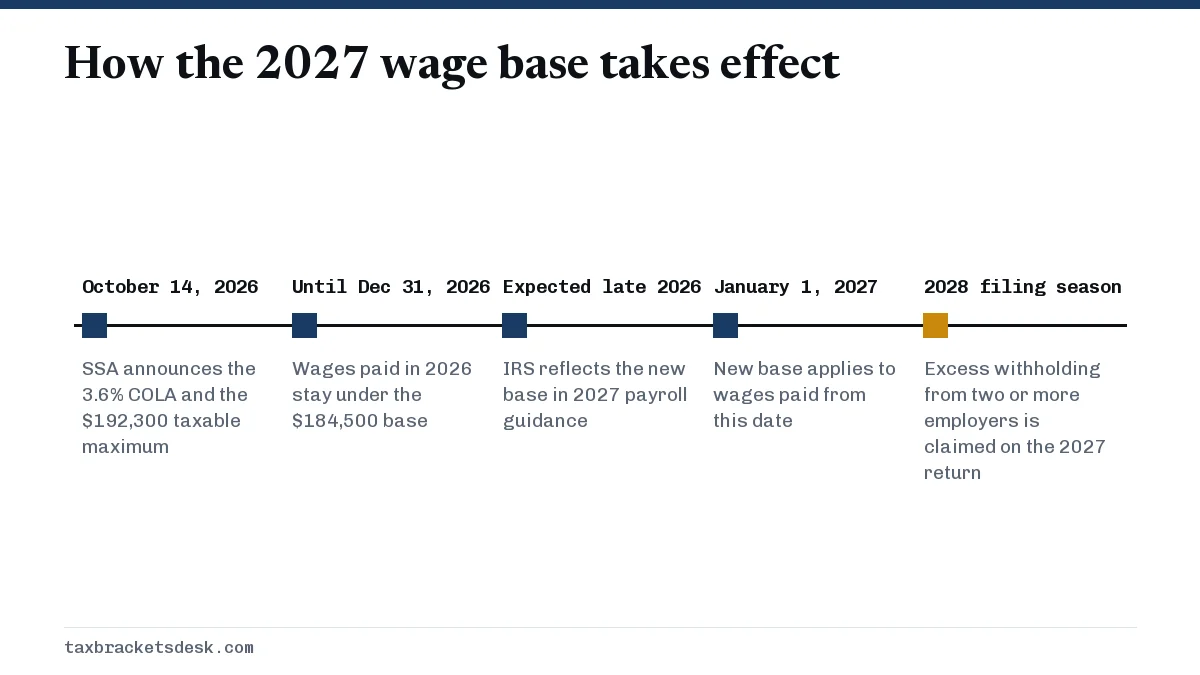
Employers need the new base in their payroll systems before the first pay date of 2027. Medicare tax is unaffected: it has no wage base, so 1.45% applies to every dollar of wages in both years (see Medicare tax rate).
How was the 2027 taxable maximum calculated?
The taxable maximum is set by a formula in the Social Security Act, not by Congress each year. SSA explains the method on its Contribution and Benefit Base Determination page: the base for a year equals the 1994 base of $60,600 multiplied by the ratio of the national average wage index (AWI) from two years earlier to the AWI for 1992, rounded to the nearest multiple of $300.
Two safeguards come with the formula. The base is never reduced, even if average wages fall. And the formula applies only if a COLA takes effect for December of the year the determination is made. When there is no COLA, the base stays where it was.
The 2027 calculation, step by step
- Start with the 1994 base: $60,600.
- Multiply by the 2025 AWI of 72,800.33 and divide by the 1992 AWI of 22,935.42.
- The result is $192,353.14.
- Round to the nearest $300: $192,300.
- Because $192,300 is higher than the 2026 base of $184,500 and a COLA of 3.6% takes effect for December 2026, the 2027 base became $192,300.
The 2025 AWI is 4.23% higher than the 2024 AWI of 69,846.57, which is what drove the $7,800 increase. The 2026 base came from the same steps: $60,600 times 69,846.57 divided by 22,935.42 gave $184,548.71, rounded to $184,500.
Social Security wage base history, 2017 to 2027
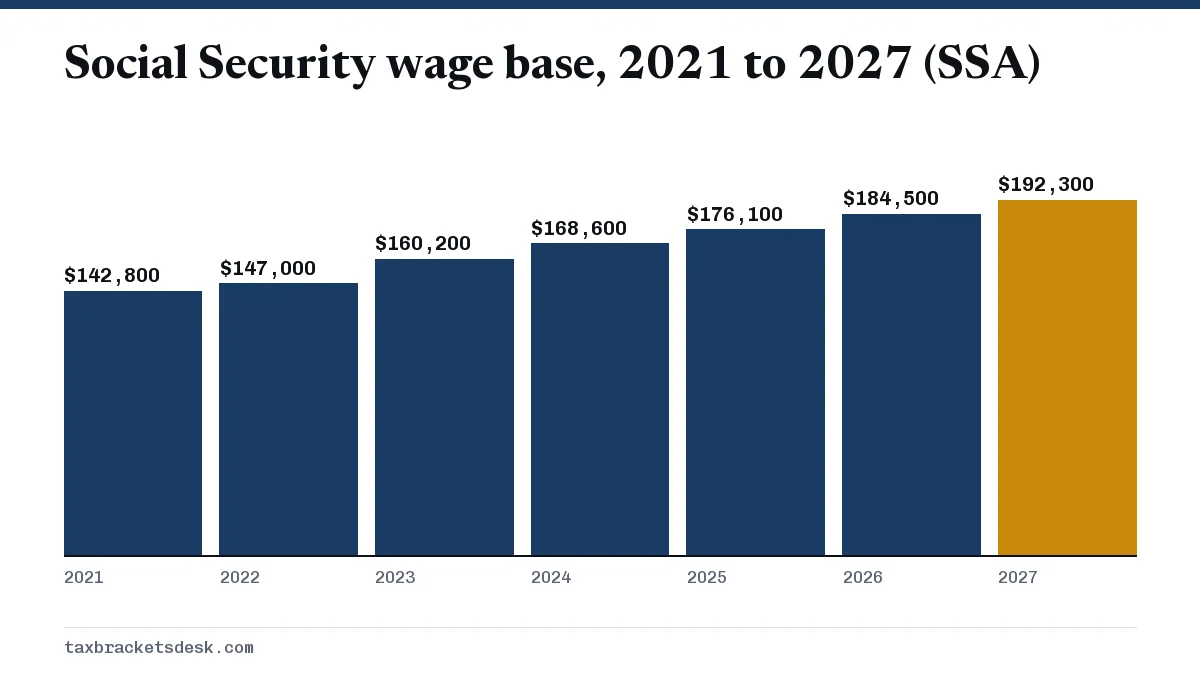
The table below lists the official taxable maximums from SSA, including the newly announced 2027 figure, with the maximum employee tax at 6.2%. The years 2010, 2011 and 2016, not all shown here, had no COLA, which is why the base did not move in those years ($106,800 for 2009 through 2011 and $118,500 for 2015 and 2016).
| Year | Wage base | Maximum employee tax (6.2%) | Change from prior year |
|---|---|---|---|
| 2017 | $127,200 | $7,886.40 | +$8,700 |
| 2018 | $128,400 | $7,960.80 | +$1,200 |
| 2019 | $132,900 | $8,239.80 | +$4,500 |
| 2020 | $137,700 | $8,537.40 | +$4,800 |
| 2021 | $142,800 | $8,853.60 | +$5,100 |
| 2022 | $147,000 | $9,114.00 | +$4,200 |
| 2023 | $160,200 | $9,932.40 | +$13,200 |
| 2024 | $168,600 | $10,453.20 | +$8,400 |
| 2025 | $176,100 | $10,918.20 | +$7,500 |
| 2026 | $184,500 | $11,439.00 | +$8,400 |
| 2027 | $192,300 | $11,922.60 | +$7,800 |
How does the 2027 limit affect high earners?
Only people whose Social Security wages or self-employment earnings exceed $184,500 are affected. Anyone earning $184,500 or less pays 6.2% on every dollar in both years. Between $184,500 and $192,300, more of your pay is taxed in 2027; at $192,300 or more, an employee pays the full $483.60 extra.
- Employees above the cap: Social Security withholding continues for more pay periods before it stops. On a $240,000 salary paid in 26 equal checks of about $9,230.77, withholding now stops partway through the 21st check instead of the 20th.
- Self-employed people: Social Security tax is 12.4% of net self-employment earnings up to the base, and W-2 wages use up the base first, so the $7,800 increase can add up to $967.20 of self-employment tax for 2027. Our self-employment tax calculator shows the 2026 figure, and the self-employment tax rate page explains Schedule SE.
- Workers with two employers: each employer withholds up to the full $192,300, so combined withholding can exceed $11,922.60. The excess employee tax is claimed back as a credit on your 2027 return, filed in 2028, not by your employers.
- Future benefits: the same base caps the earnings SSA counts when it figures retirement benefits, so up to $192,300 of 2027 earnings is credited to your record.
Planning notes for 2027
- Keep using $184,500 for the rest of 2026 payroll and for 2026 Schedule SE and estimated tax worksheets.
- Employers should load $192,300 into payroll systems before the first January 2027 pay date.
- Self-employed people can now use $192,300 when sizing 2027 estimated payments. The first one is expected on April 15, 2027; see 2027 estimated tax due dates.
- If you expect a large bonus paid in early January 2027, the 2027 base, not the 2026 base, applies to it.
- Check our FICA tax guide for the combined employee and employer totals.
Common questions
What is the Social Security wage base for 2027?
It is $192,300, up from $184,500 in 2026. SSA announced it on October 14, 2026, and it applies to wages paid on or after January 1, 2027.
What is the maximum Social Security tax for 2027?
$11,922.60 for an employee, matched by the employer. A self-employed person pays 12.4% on net earnings up to the base, a maximum of $23,845.20.
Why does the Social Security wage base go up every year?
The law ties it to the national average wage index. When average wages rise and a COLA is paid, the base rises in proportion, rounded to the nearest $300. For 2027 the 2025 wage index rose 4.23% and the COLA was 3.6%.
Can the Social Security wage base go down?
No. SSA's formula states that if the computed amount is lower than the current base, the base is not reduced. In years with no COLA, it stays the same.
Does the 2027 limit apply to wages earned in December 2026 but paid in January 2027?
Yes. Social Security wages count in the year they are paid, so a January 2027 paycheck falls under the 2027 limit even if the work was done in 2026.
What was the Social Security wage base in 2023?
It was $160,200, a jump of $13,200 from $147,000 in 2022, the largest one-year increase in the 2017 to 2027 period.
Sources
- SSA, Contribution and benefit base ssa.gov
- SSA, Contribution and benefit base determination ssa.gov
- SSA, Cost-of-living adjustment information ssa.gov
- Topic 751, Social Security and Medicare withholding rates irs.gov
- SSA, 2027 Cost-of-Living Adjustment (COLA) Fact Sheet ssa.gov
- SSA, National average wage index ssa.gov
- SSA, Exempt amounts under the earnings test ssa.gov
We check figures against these official pages. Rules change; confirm anything that affects a deadline or payment with the agency before you act.
Tell us what happened
Describe your situation and our editors will use it to improve this guide. If you leave your email, we may reply with a pointer to the right page or official contact. We never share your details.
Related guides
 FICA Tax: Social Security and Medicare Rates for 2026
FICA tax is the 7.65% payroll tax taken from an employee's wages in 2026: 6.2% for Social Security on the first $184,500 of pay a…
Medicare Tax Rate 2026: 1.45% Rate With No Wage Base Cap
The Medicare tax rate for 2026 is 1.45% of all wages for the employee, matched by another 1.45% from the employer, for 2.9% in to…
Self-Employment Tax: 15.3% Rate and How to Figure It
Self-employment tax is 15.3% (12.4% Social Security plus 2.9% Medicare) charged on 92.35% of your net earnings from self-employme…
Tax on Social Security Benefits: 50% and 85% Rules
Federal tax on Social Security benefits applies only when your other income plus half of your benefits is more than $25,000 (sing…
Estimated Tax Due Dates 2027: Apr 15, Jun 15, Sep 15, Jan 18
The estimated tax due dates for 2027 are expected to be April 15, June 15 and September 15, 2027, and January 18, 2028, applying…