
Michigan income tax rate: 4.25% for 2026, plus the 24 cities that add their own tax
Short answer
The Michigan income tax rate is a flat 4.25% for tax year 2026, the Michigan Department of Treasury confirmed on April 15, 2026, because general fund revenue did not grow faster than inflation. Michigan subtracts a personal exemption ($5,900 per person in the 2026 withholding guide), and 24 cities levy their own income tax, including Detroit at 2.4% for residents.
- 01Michigan rate, tax year 2026
- 4.25% flat
- 02Personal exemption
- $5,800 (2025); $5,900 (2026 withholding guide)
- 03Rate for 2023 only
- 4.05% (formula-triggered cut)
- 04Cities with an income tax
- 24
- 05Detroit city rate
- 2.4% residents, 1.2% nonresidents
- 06Typical city rate
- 1% residents, 0.5% nonresidents
What is the Michigan income tax rate for 2026?
The Michigan income tax rate for 2026 is 4.25% of taxable income, the same for every filer and every income level. The Michigan Department of Treasury announced on April 15, 2026, that the 4.25% rate in state law applies to the 2026 tax year, which you report on the MI-1040 filed in 2027.
Michigan has used a single rate for decades, so there are no Michigan tax brackets to look up. Your Michigan income tax is taxable income times 4.25%, minus credits. That puts Michigan between its neighbors: below Illinois at 4.95% and above the flat 2.75% that Ohio applies above its zero bracket (see Ohio income tax rates).
How is the Michigan rate set each year?
Michigan's rate is tied to a formula. A 2015 law requires a rate cut for any tax year starting with 2023 if general fund revenue in the prior state fiscal year grew faster than inflation. The State Treasurer and the directors of the Senate and House Fiscal Agencies publish the calculation after the state's annual financial report is released.
| Tax year | Rate | Why |
|---|---|---|
| 2022 | 4.25% | Rate in statute |
| 2023 | 4.05% | Formula cut after strong revenue growth, one year only |
| 2024 | 4.25% | Back to statutory rate |
| 2025 | 4.25% | No cut; determination published May 1, 2025 |
| 2026 | 4.25% | No cut; general fund revenue fell 1.56% while inflation was 2.70% |
| 2027 | Not yet announced | Determination expected in spring 2027 |
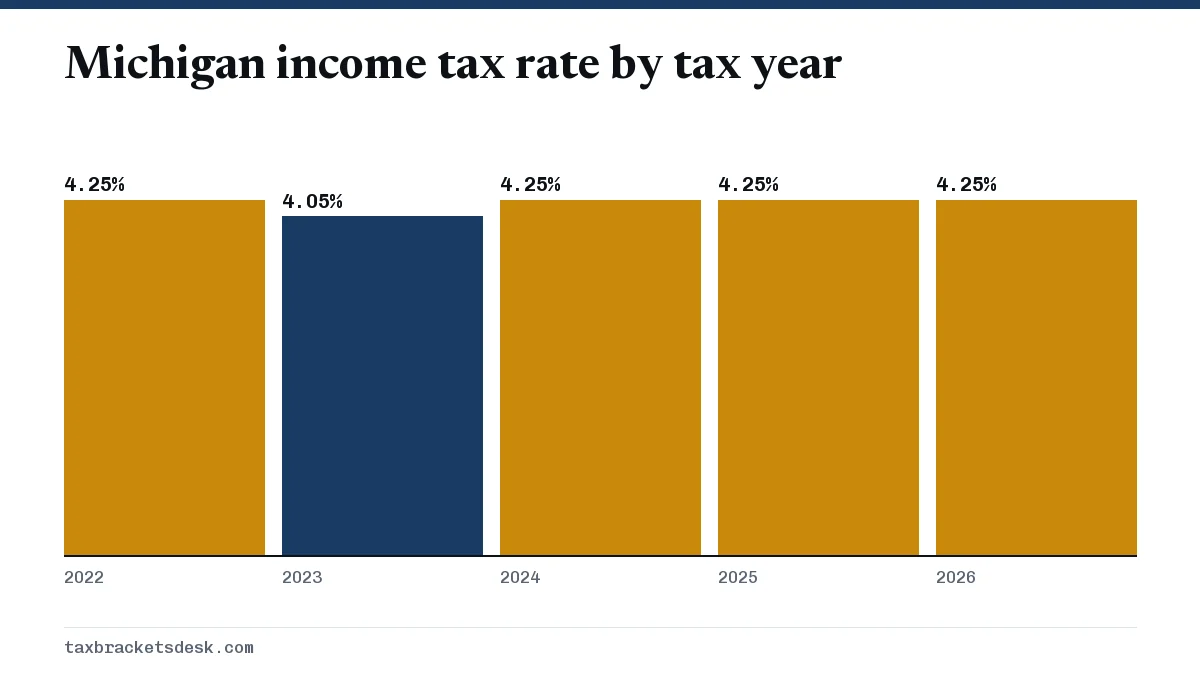
Because the test uses a fiscal year that ends September 30, the Michigan income tax rate for 2027 will not be known until well into 2027. Budget at 4.25% until Treasury says otherwise.
Michigan personal exemption and deductions
Michigan has no standard deduction. Instead, Michigan taxable income is federal adjusted gross income, plus or minus Michigan adjustments on Schedule 1, minus a personal exemption for you, your spouse and each dependent. The exemption was $5,800 for 2025, and the 2026 Michigan Income Tax Withholding Guide (Form 446) uses $5,900.
Tips and overtime deductions for 2026 to 2028
Public Act 24 of 2025 created Michigan deductions for qualified tips and qualified overtime compensation for tax years 2026, 2027 and 2028. They are not available for 2025. Eligibility follows the federal definitions in Internal Revenue Code sections 224 and 225, so if an amount qualifies for the federal no tax on tips deduction, it is the starting point for Michigan too.
Retirement income from 2026
Michigan's retirement subtraction finishes phasing in with 2026. Treasury says everyone born after 1945 can subtract qualified retirement benefits in 2026, up to the private retirement maximum, which for most retirees restores the rules in place before 2012. Many pensions will stop withholding Michigan tax as a result.
Does Michigan have local income taxes?
Yes. Twenty-four Michigan cities levy an income tax, according to the Michigan Department of Treasury. Most use the rates in the City Income Tax Act, 1% for residents and 0.5% for nonresidents who work in the city. A few charge more. Few states have this layer; the state income tax rates hub notes which large states stop at the state level.
| City | Resident rate | Nonresident rate |
|---|---|---|
| Detroit | 2.4% | 1.2% |
| Grand Rapids | 1.5% | 0.75% |
| Flint | 1% | 0.5% |
| Lansing | 1% | 0.5% |
Nonresidents pay city tax only on work done inside the city. Detroit's income tax is administered by the Michigan Department of Treasury, and the city forms are posted on michigan.gov, while most other cities run their own income tax offices.
Worked example: Michigan income tax for a Michigan resident
These examples use the 4.25% rate and the $5,900 exemption from the 2026 withholding guide, with no other adjustments or credits.
- Single, $60,000 of wages, lives outside any taxing city. $60,000 minus one $5,900 exemption leaves $54,100. At 4.25% the Michigan tax is $2,299.25.
- Same worker living and working in Detroit. Add Detroit resident tax of 2.4%, about $1,440 on $60,000 before the city's own exemptions, for roughly $3,739 of state and city tax.
- Married filing jointly, two children, $100,000 of wages. Four exemptions total $23,600, leaving $76,400. At 4.25% the tax is $3,247.
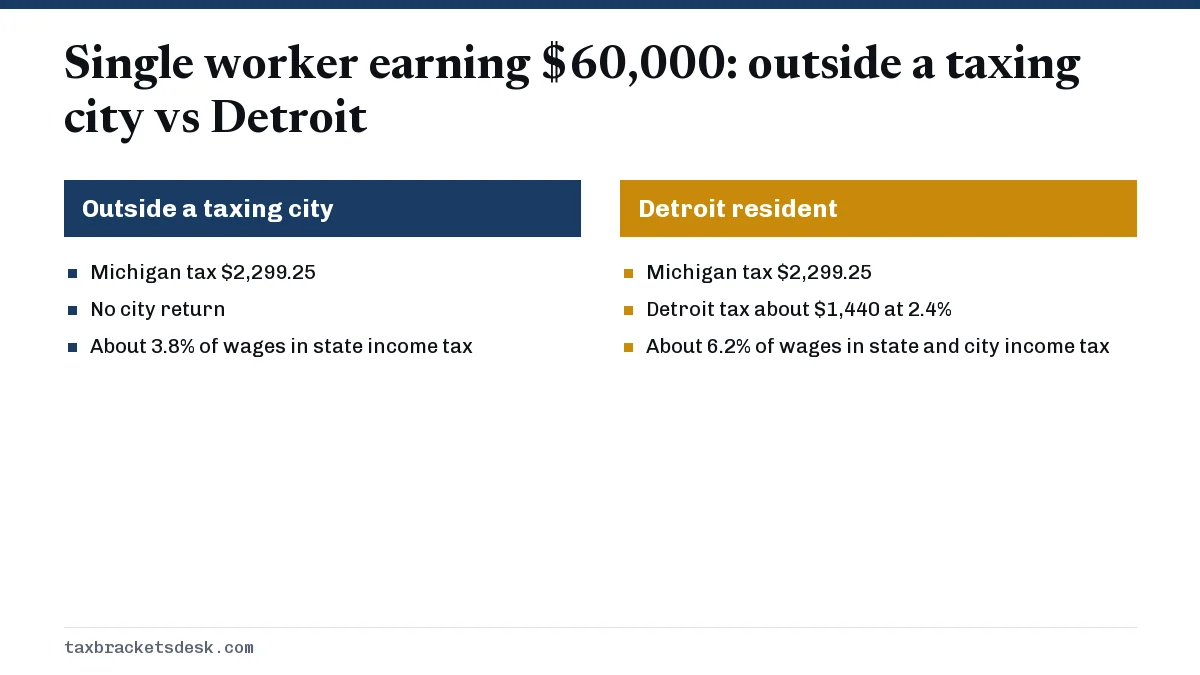
The Detroit worker pays about 6.2% of wages in state and city income tax combined, compared with about 3.8% for the same salary outside a taxing city. Our page on effective tax rate explains that comparison.
Checklist for Michigan filers in 2027
- Update Form MI-W4 with your employer if your household or number of exemptions changed.
- If you live in or work in a taxing city, check that your employer withholds city tax; if not, plan to pay with the city return or city estimated payments.
- Retirees born after 1945: confirm your pension payer has stopped or reduced Michigan withholding for 2026 if your benefits are now fully subtractable.
- Tipped and hourly workers: keep the W-2 and pay records that show qualified tips and overtime, because the Michigan deductions follow the federal amounts.
- Self-employed filers: make MI-1040ES estimated payments at 4.25%; see our estimated taxes guide for the federal schedule.
Common questions
Is Michigan a flat tax state?
Yes. Michigan taxes all taxable income at one rate, 4.25% for 2026. The only recent exception was 2023, when a revenue formula cut the rate to 4.05% for that year.
What is the Michigan personal exemption for 2026?
The 2026 Michigan Income Tax Withholding Guide uses $5,900 per exemption, up from $5,800 for 2025. Confirm the final figure in the 2026 MI-1040 instructions.
Why did the Michigan income tax rate not drop for 2026?
The formula cuts the rate only when general fund revenue grows faster than inflation. For the fiscal year ended September 30, 2025, revenue fell 1.56% while inflation was 2.70%, so no cut applied.
Do I pay Detroit city income tax if I work from home outside Detroit?
Nonresidents owe Detroit tax only on work performed inside the city. Days worked from a home outside Detroit are generally not subject to the 1.2% nonresident tax, so keep a record of where you worked.
Does Michigan tax Social Security benefits?
No. Michigan subtracts Social Security benefits that are included in federal adjusted gross income.
Sources
- Michigan Department of Treasury, State individual income tax rate for 2026 tax year determined michigan.gov
- Michigan Department of Treasury, 2026 Michigan Income Tax Withholding Guide (Form 446) michigan.gov
- Michigan Department of Treasury, New deductions for qualified overtime compensation and qualified tips michigan.gov
- Michigan Department of Treasury, Which cities impose an income tax? michigan.gov
- City of Detroit, Income tax information detroitmi.gov
- City of Grand Rapids, Other Michigan cities with income tax grandrapidsmi.gov
We check figures against these official pages. Rules change; confirm anything that affects a deadline or payment with the agency before you act.
Tell us what happened
Describe your situation and our editors will use it to improve this guide. If you leave your email, we may reply with a pointer to the right page or official contact. We never share your details.