
New Jersey income tax rates and brackets: 1.4% to 10.75%
Short answer
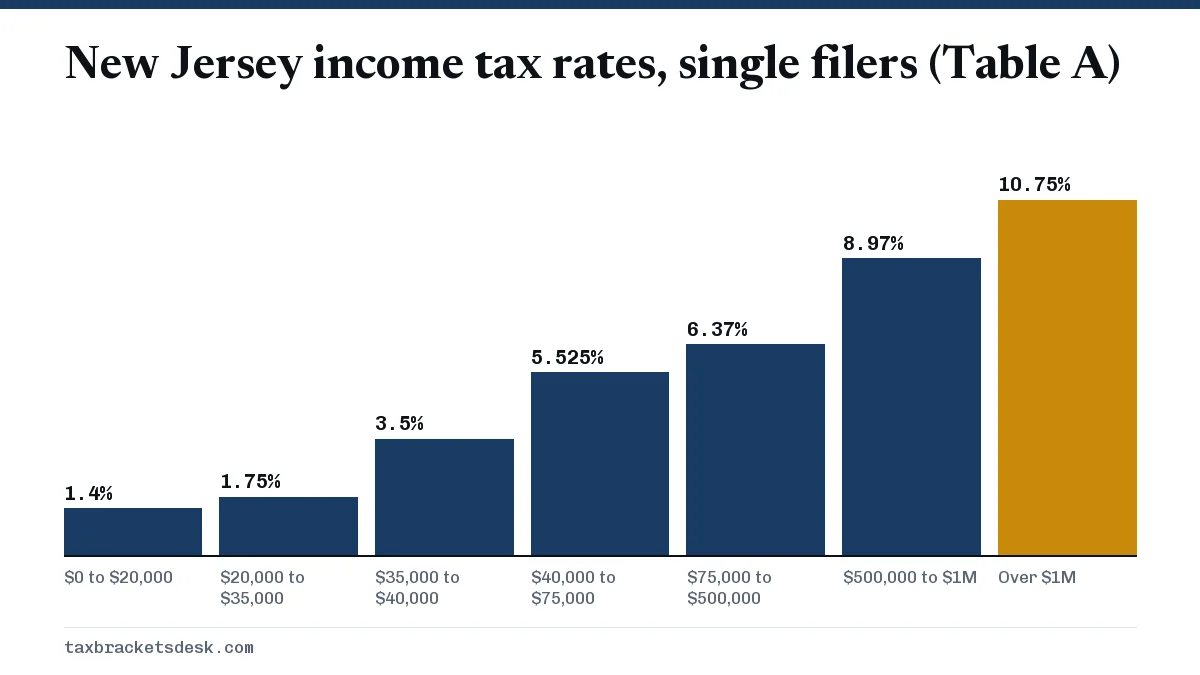
New Jersey income tax rates run from 1.4% to 10.75%. Single filers have seven brackets and joint filers and heads of household have eight, with the top 10.75% rate starting at $1,000,000 of taxable income. The New Jersey Division of Taxation still labels this schedule "2020 and After", so the same rates apply to 2025 and 2026 returns.
- 01New Jersey income tax rates
- 1.4% to 10.75%
- 02Top rate starts at
- $1,000,000 of taxable income, all filing statuses
- 03Personal exemption
- $1,000 each; $1,500 per dependent
- 04Property Tax Deduction
- Up to $15,000 ($7,500 married filing separately)
- 05Filing threshold
- $10,000 single; $20,000 joint or head of household
- 06Resident return due
- April 15 (Form NJ-1040)
What are the New Jersey income tax rates?
New Jersey income tax rates are 1.4%, 1.75%, 2.45%, 3.5%, 5.525%, 6.37%, 8.97% and 10.75%. The 2.45% rate exists only for married couples filing jointly, heads of household and qualifying widow(er)s, so single filers have seven brackets and everyone else has eight. Residents report the tax on Form NJ-1040, New Jersey Resident Return.
New Jersey calls its tax the Gross Income Tax, and the name is a clue: it does not start from federal adjusted gross income. It builds its own total from categories of income, subtracts New Jersey exemptions and a few New Jersey deductions, and applies the rates to what remains. For a broader comparison with other states, see state income tax rates.
NJ tax brackets by filing status
The NJ tax brackets below come from the Division of Taxation's current rate schedules, labeled "2020 and After". Each schedule gives a multiply-and-subtract shortcut: multiply your New Jersey taxable income by the rate for your bracket, then subtract the amount shown. The result equals the tax you would get by adding up each bracket separately.
| Taxable income over | But not over | Rate | Subtract |
|---|---|---|---|
| $0 | $20,000 | 1.4% | $0 |
| $20,000 | $35,000 | 1.75% | $70.00 |
| $35,000 | $40,000 | 3.5% | $682.50 |
| $40,000 | $75,000 | 5.525% | $1,492.50 |
| $75,000 | $500,000 | 6.37% | $2,126.25 |
| $500,000 | $1,000,000 | 8.97% | $15,126.25 |
| $1,000,000 | and over | 10.75% | $32,926.25 |
| Taxable income over | But not over | Rate | Subtract |
|---|---|---|---|
| $0 | $20,000 | 1.4% | $0 |
| $20,000 | $50,000 | 1.75% | $70.00 |
| $50,000 | $70,000 | 2.45% | $420.00 |
| $70,000 | $80,000 | 3.5% | $1,154.50 |
| $80,000 | $150,000 | 5.525% | $2,775.00 |
| $150,000 | $500,000 | 6.37% | $4,042.50 |
| $500,000 | $1,000,000 | 8.97% | $17,042.50 |
| $1,000,000 | and over | 10.75% | $34,842.50 |
Tax table under $100,000, rate schedule above it
If your New Jersey taxable income is under $100,000, the NJ-1040 booklet tells you to look up the tax in the New Jersey Tax Table, which lists tax in $50 income bands. At $100,000 or more you must use the rate schedules above. The two methods land within a few dollars of each other.
The brackets are not indexed for inflation. The $75,000 point where single filers move from 5.525% to 6.37% has not moved since the schedule took effect, which differs from the federal system explained in how tax brackets work, where the IRS resets the thresholds every year.
Exemptions and deductions that lower New Jersey income tax
New Jersey has no standard deduction. Instead, the 2025 Form NJ-1040 instructions list fixed exemptions on lines 6 through 12, and these amounts are written into law rather than adjusted each year.
| Exemption | Amount | Who qualifies |
|---|---|---|
| Regular | $1,000 | You, and your spouse or CU partner on a joint return |
| Senior 65+ | $1,000 | Each spouse age 65 or older on December 31 |
| Blind or disabled | $1,000 | Each spouse who is blind or disabled on December 31 |
| Veteran | $6,000 | Each spouse honorably discharged from active duty |
| Dependent | $1,500 | Each child or other federal dependent |
| Dependent in college | $1,000 extra | Full-time student under 22 whose costs you paid at least half of |
Property Tax Deduction
Homeowners and renters whose home was their main residence can take either a Property Tax Deduction of up to $15,000 of property taxes paid ($7,500 for married couples filing separately who share a home) or a Property Tax Credit. Worksheet H in the NJ-1040 instructions compares the two and tells you which one saves more. For most middle-income homeowners the deduction wins, because it is taken against income taxed at 5.525% or 6.37%.
Pension and retirement income exclusion
Residents age 62 or older, or disabled, can exclude pension, annuity and IRA income on line 28a. The maximum is $100,000 for a joint return, $75,000 for single, head of household and qualifying widow(er), and $50,000 for married filing separately when total income is $100,000 or less. It shrinks to a percentage of that limit between $100,001 and $150,000 and disappears above $150,000.
Does New Jersey have local income taxes?
No. New Jersey counties and municipalities do not charge a personal income tax on residents, and Form NJ-1040 has no line for one. Local governments in New Jersey are funded mainly through property taxes, which is why the Property Tax Deduction and the Property Tax Credit carry so much weight on the state return.
Commuters are the exception worth knowing. A New Jersey resident who works in New York City does not pay the city's resident income tax, but does pay New York State tax as a nonresident and then claims a credit on Schedule NJ-COJ for income taxes paid to another jurisdiction. The New York income tax rates page covers the New York side of that return.
Did New Jersey change its income tax rates for 2026?
No rate change has been made for 2026. As of September 2026, the rate schedule on the Division of Taxation's tax tables page is still the one labeled "2020 and After", which first applied to tax year 2020 when the 10.75% rate began at $1,000,000 instead of $5,000,000.
The 2026 Form NJ-1040 and its instructions are usually posted in January 2027, so treat any 2026 figure not listed above as not yet announced. Because the exemptions and brackets are fixed dollar amounts, the main year-to-year changes tend to be new credits and income limits rather than new rates.
Worked example: New Jersey income tax on $85,000
Take a single New Jersey homeowner with $85,000 of wages, no other income, no dependents and $9,000 of property tax paid on the home. The steps below follow the NJ-1040 order using the Table A rate schedule; the tax table would give a figure a few dollars different.
- New Jersey gross income: $85,000 of wages.
- Subtract the $1,000 regular exemption: $84,000.
- Subtract the Property Tax Deduction of $9,000 (less than the $15,000 cap): $75,000 taxable income.
- Apply Table A for the $40,000 to $75,000 band: $75,000 x 5.525% = $4,143.75.
- Subtract $1,492.50: New Jersey tax of $2,651.25.
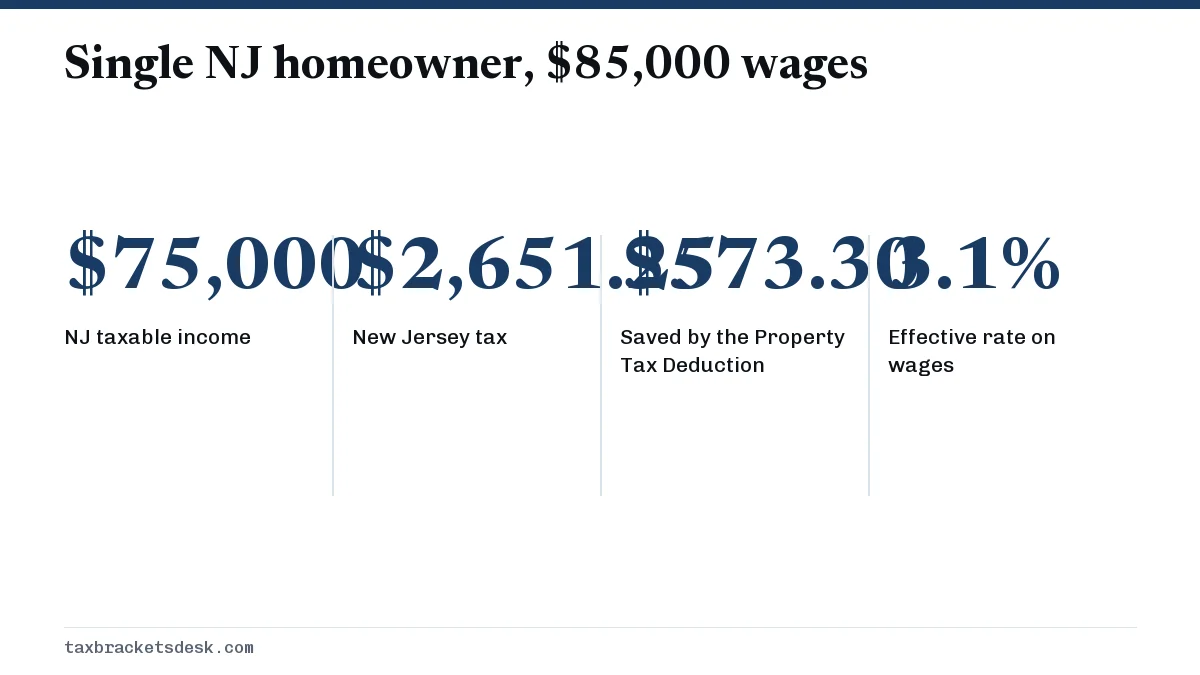
Without the Property Tax Deduction, taxable income would be $84,000, which falls in the 6.37% band: $84,000 x 6.37% minus $2,126.25 equals $3,224.55. The deduction saves $573.30, which is why it should not be skipped. On the federal side, the same property tax counts toward the SALT deduction cap if you itemize.
The effective New Jersey rate here is about 3.1% of wages, well under the 5.525% marginal rate. A household in a flat-rate state such as Illinois would pay a single rate on nearly every dollar, so the comparison depends heavily on income level.
Common questions
What is the New Jersey state income tax rate for $100,000?
A single filer with $100,000 of New Jersey taxable income is in the 6.37% bracket. Using Table A, the tax is $100,000 x 6.37% minus $2,126.25, or $4,243.75, an average rate of about 4.2%.
Why do NJ tax brackets differ for single and joint filers?
Table B, used by joint filers, heads of household and qualifying widow(er)s, has an extra 2.45% bracket from $50,000 to $70,000 and wider lower bands. Single filers reach the 5.525% rate at $40,000, while joint filers reach it at $80,000.
Does New Jersey tax Social Security benefits?
No. Social Security benefits are not taxable on the New Jersey return. Pension and IRA income is taxable, but residents 62 or older or disabled may exclude up to $100,000 on a joint return if income is $100,000 or less.
Are New Jersey tax brackets adjusted for inflation?
No. The New Jersey brackets, exemptions and filing thresholds are fixed dollar amounts in state law. The same $20,000, $35,000 and $75,000 break points have applied since the 2020 schedule took effect.
Do I get a New Jersey standard deduction?
No. New Jersey gives exemptions instead: $1,000 for you and a spouse, $1,500 per dependent, and extra $1,000 exemptions for age 65 or older and blindness or disability. Homeowners and renters can also take the Property Tax Deduction of up to $15,000.
Sources
- NJ Division of Taxation, Tax Rate Schedules 2020 and After nj.gov
- NJ Division of Taxation, Tax tables and rate schedules nj.gov
- NJ Division of Taxation, 2025 Form NJ-1040 instructions nj.gov
- NJ Division of Taxation, Dependents and exemptions nj.gov
We check figures against these official pages. Rules change; confirm anything that affects a deadline or payment with the agency before you act.
Tell us what happened
Describe your situation and our editors will use it to improve this guide. If you leave your email, we may reply with a pointer to the right page or official contact. We never share your details.