
Massachusetts income tax rate: 5% flat, 8.5% on short-term gains, plus a 4% surtax
Short answer
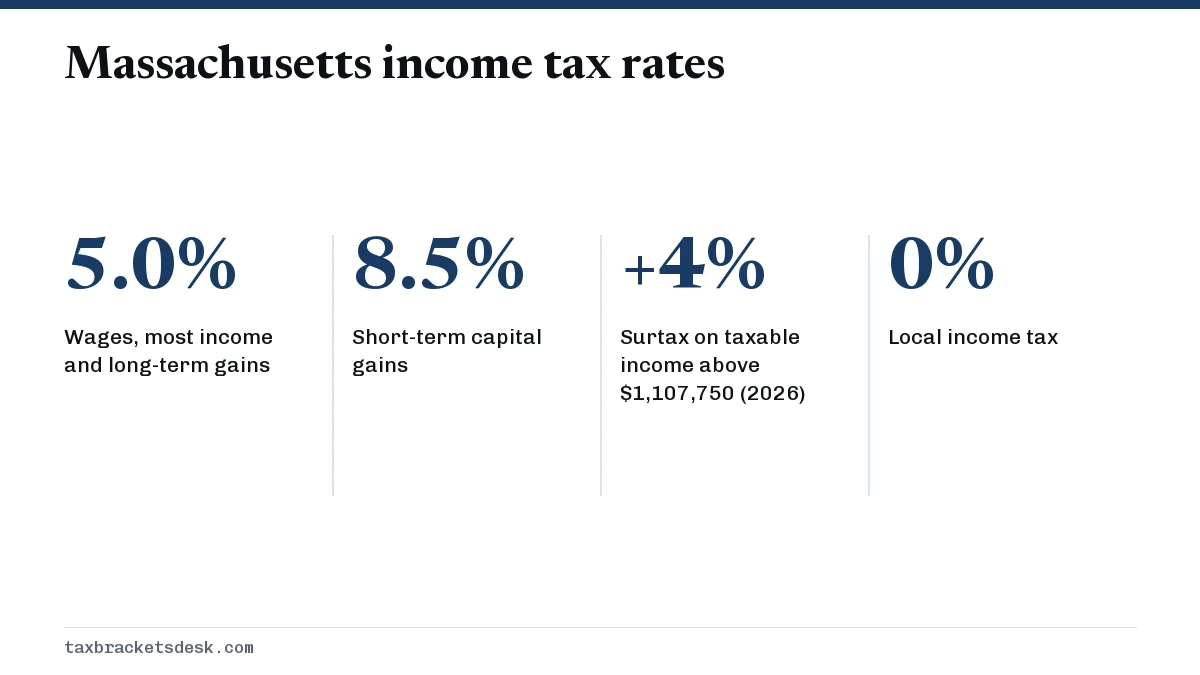
The Massachusetts income tax rate is 5.0% on wages, long-term capital gains and most other income, and 8.5% on short-term capital gains, according to the Massachusetts Department of Revenue. A 4% surtax, often called the millionaires tax, applies to taxable income above $1,107,750 for tax year 2026. Massachusetts uses personal exemptions instead of a standard deduction and has no local income tax.
- 01Rate on wages and most income (Part B)
- 5.0%
- 02Short-term capital gains (Part A)
- 8.5% since 2023
- 03Long-term capital gains (Part C)
- 5.0%
- 044% surtax threshold
- $1,083,150 (2025); $1,107,750 (2026)
- 05Personal exemption
- $4,400 single; $6,800 head of household; $8,800 joint
- 06Local income tax
- None
What is the Massachusetts income tax rate?
Massachusetts taxes most income at a flat 5.0%. That covers wages, salaries, business income, pensions, rent, interest from Massachusetts banks and long-term capital gains. Short-term capital gains are taxed at 8.5% for tax years beginning on or after January 1, 2023, and long-term gains on collectibles at 12%.
On top of those rates sits the 4% surtax on taxable income above an inflation-adjusted threshold: $1,083,150 for 2025 and $1,107,750 for 2026. Only the part of income above the threshold pays the extra 4%, so the top combined rate is 9% on regular income and 12.5% on short-term gains.
So Massachusetts income tax is flat for almost everyone and graduated only at the very top. For comparison with other large states, see the state income tax rates hub.
How are Massachusetts brackets structured? Parts A, B and C
Instead of brackets, Massachusetts sorts income into three classes on Form 1, and each class has its own rate. The class matters more than the amount.
| Class | What it includes | Rate |
|---|---|---|
| Part A | Short-term capital gains, interest and dividends (other than Massachusetts bank interest) | 8.5% on short-term gains; 5.0% on interest and dividends |
| Part B | Wages, salaries, pensions, business and rental income, Massachusetts bank interest | 5.0% |
| Part C | Long-term capital gains | 5.0%; 12% on collectibles |
| All parts combined | Taxable income above the surtax threshold | Additional 4% |
The 8.5% rate is why holding period matters more in Massachusetts than in most states. A $10,000 gain costs $850 in state tax if the asset was held a year or less, and $500 if held longer. Our pages on short-term capital gains tax and the capital gains tax guide cover the federal rules.
How the millionaires tax in Massachusetts works
The 4% surtax on taxable income over the threshold was approved by voters in November 2022 and first applied to tax year 2023, when the threshold was $1,000,000. The threshold rises with inflation each year. The Department of Revenue measures income for the surtax by adding Part A, Part B and Part C taxable income together.
| Tax year | Surtax threshold |
|---|---|
| 2023 | $1,000,000 |
| 2024 | $1,053,750 |
| 2025 | $1,083,150 |
| 2026 | $1,107,750 |
| 2027 | Not yet announced |
- One threshold per return. A married couple filing jointly gets a single threshold, not double. DOR has specific rules for spouses who would ordinarily file jointly but have income above the threshold and different residencies or tax years.
- One-time events count. A large stock sale, business sale or the taxable part of a home sale can push a household over the threshold for a single year.
- Estimated payments. If you expect to owe the surtax, include it in your Form 1-ES quarterly payments to avoid an underpayment penalty.
Massachusetts exemptions and deductions
Massachusetts has no standard deduction. You subtract personal exemptions instead, plus a short list of Massachusetts deductions.
| Exemption | Amount |
|---|---|
| Single or married filing separately | $4,400 |
| Head of household | $6,800 |
| Married filing jointly | $8,800 |
| Each qualifying dependent | $1,000 |
| Age 65 or older by year end | $700 |
Renters get a notable break: Massachusetts allows a deduction of 50% of rent paid for a principal residence in the state, capped at $4,000 a year for tax years beginning on or after January 1, 2023. Married couples filing separately share one $4,000 cap.
Does Massachusetts have local income taxes?
No. Boston, Cambridge and other Massachusetts cities and towns do not levy an income tax. The state rates and the surtax are the only income taxes a resident pays on top of federal tax. Unlike the states with no income tax, though, Massachusetts taxes both wages and investment income.
Worked example: Massachusetts income tax for a Massachusetts resident
- Single renter, $80,000 of wages, $24,000 of rent. Subtract the $4,400 exemption and the rent deduction (50% of rent is $12,000, capped at $4,000). Taxable Part B income is $71,600, and tax at 5.0% is $3,580.
- Married couple filing jointly, two children, $150,000 of wages. Exemptions are $8,800 plus $2,000 for the children, so taxable income is $139,200 and the tax is $6,960.
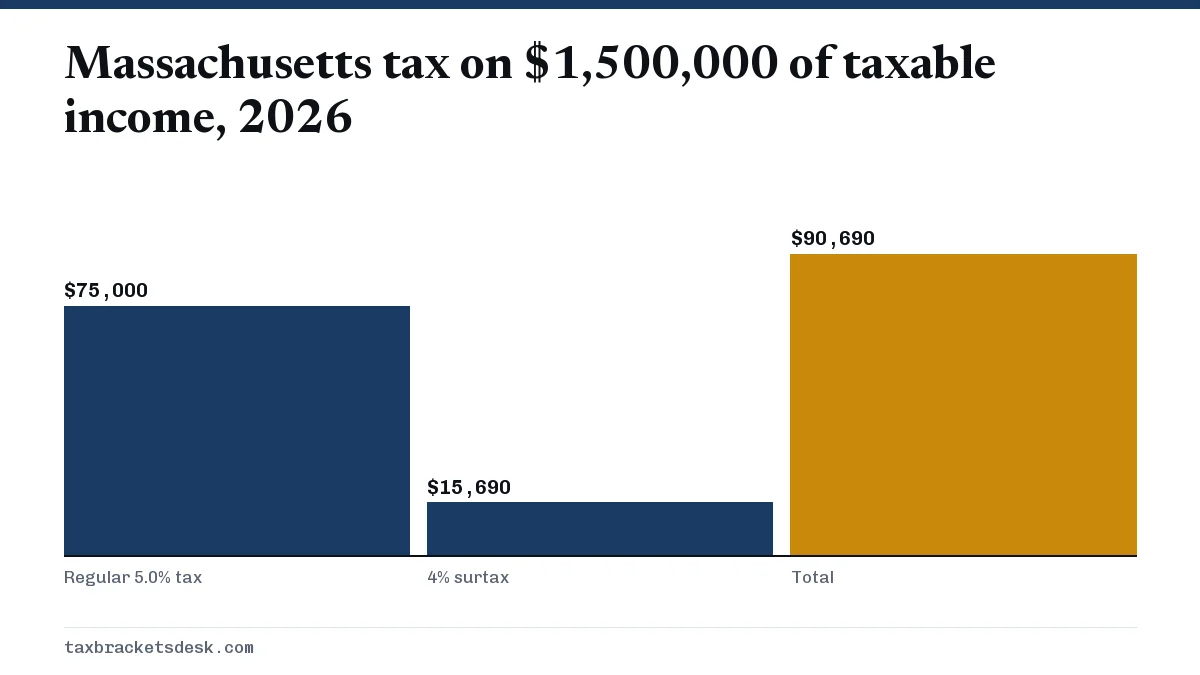
- Married couple filing jointly, $1,500,000 of taxable income in 2026. The 5.0% tax is $75,000. The surtax is 4% of the $392,250 above $1,107,750, or $15,690. Total: $90,690, about 6.05% of taxable income.
- Couple with $300,000 of taxable income who sell a rental property for a $900,000 long-term gain in 2026. Total taxable income is $1,200,000. The regular 5.0% tax is $60,000 and the surtax is 4% of $92,250, or $3,690.
The last example shows why sellers of real estate or a business sometimes spread a sale over two tax years, where the terms allow it. For the federal treatment of a home, see capital gains on a home sale.
Did Massachusetts change rates for 2026?
No rate changed for 2026: Part B stays at 5.0% and short-term gains at 8.5%. The only automatic change is the surtax threshold, which rose from $1,083,150 to $1,107,750 with inflation. The 2027 threshold is not yet announced as of September 2026; check DOR's surtax page and the 2027 Form 1-ES when they are posted.
Common questions
Is Massachusetts income tax flat?
Mostly. Wages and most income are taxed at 5.0% whatever the amount, but short-term capital gains pay 8.5% and income above $1,107,750 for 2026 pays an extra 4% surtax.
Who pays the millionaires tax in Massachusetts?
Any resident, or nonresident with Massachusetts income, whose Massachusetts taxable income exceeds the threshold, $1,107,750 for 2026. Only the income above the threshold pays the 4%.
Is the Massachusetts surtax threshold doubled for married couples?
No. A joint return gets one threshold, the same dollar amount a single filer gets.
Does Massachusetts tax Social Security benefits?
No. Social Security benefits are not included in Massachusetts gross income, even when part of them is taxable on your federal return.
Can I deduct rent on my Massachusetts tax return?
Yes, if the rent is for your principal residence in Massachusetts. The deduction is 50% of rent paid, up to $4,000 a year.
Sources
- Mass.gov, Massachusetts tax rates mass.gov
- Mass.gov, Massachusetts 4% surtax on taxable income mass.gov
- Mass.gov, Massachusetts personal income tax exemptions mass.gov
- Mass.gov, Deductions on rent paid in Massachusetts mass.gov
- Mass.gov, 2026 Form 1-ES estimated income tax mass.gov
We check figures against these official pages. Rules change; confirm anything that affects a deadline or payment with the agency before you act.
Tell us what happened
Describe your situation and our editors will use it to improve this guide. If you leave your email, we may reply with a pointer to the right page or official contact. We never share your details.