
Virginia income tax rate: four brackets that top out at 5.75% over $17,000
Short answer
The Virginia income tax rate runs from 2% to 5.75%, and the top 5.75% rate applies to all Virginia taxable income over $17,000, for every filing status. For tax year 2026 the standard deduction is $8,750 single and $17,500 married filing jointly, rising to $9,200 and $18,400 for 2027 under the 2026 budget. Virginia localities do not levy a local income tax.
- 01Virginia tax brackets
- 2%, 3%, 5% and 5.75%
- 02Top rate starts at
- $17,000 of taxable income, all filing statuses
- 03Tax on $17,000
- $720, then 5.75% of the excess
- 04Standard deduction, 2025 and 2026
- $8,750 single; $17,500 joint
- 05Standard deduction, 2027
- $9,200 single; $18,400 joint (enacted)
- 06Personal exemption
- $930 each; extra $800 if 65+ or blind
What is the Virginia income tax rate?
Virginia taxes income at four graduated rates: 2% on the first $3,000 of taxable income, 3% from $3,001 to $5,000, 5% from $5,001 to $17,000 and 5.75% on everything above $17,000. The same thresholds apply to single filers and married couples, and they are not adjusted for inflation.
Because the top bracket begins so low, almost every full-time worker in Virginia pays 5.75% on most of their income. The first $17,000 of taxable income produces exactly $720 of tax, so a quick formula for anyone above that line is $720 plus 5.75% of taxable income over $17,000.
In practice that makes Virginia close to a flat-tax state, similar to North Carolina at 3.99% or Massachusetts at 5% on wages. The state income tax rates hub ranks the largest states side by side.
No rate change was enacted for 2026. The Virginia Department of Taxation's 2026 legislative summary lists changes to the standard deduction, the earned income credit and federal conformity, but none to the Virginia tax brackets.
Virginia tax brackets for 2026
| Virginia taxable income | Tax |
|---|---|
| $0 to $3,000 | 2% of taxable income |
| $3,001 to $5,000 | $60 plus 3% of the amount over $3,000 |
| $5,001 to $17,000 | $120 plus 5% of the amount over $5,000 |
| Over $17,000 | $720 plus 5.75% of the amount over $17,000 |
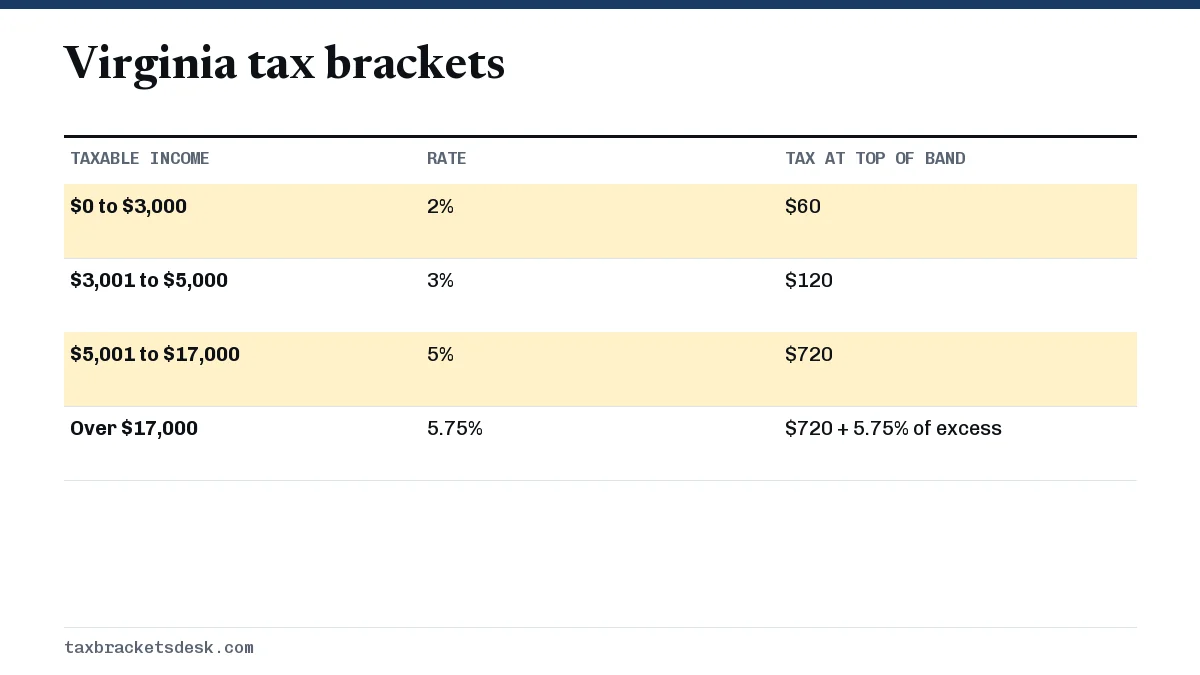
Each rate applies only to income inside its band, the same logic described in how tax brackets work. What differs from the federal system is scale: the federal 2026 brackets for a single filer stretch past $640,000, while Virginia's end at $17,000.
The spouse tax adjustment
Since married couples use the same brackets as single people, a joint return could cost more than two separate ones. The Spouse Tax Adjustment (STA) on Form 760 fixes that: couples filing jointly can reduce their tax by up to $259 if both spouses have taxable income and combined taxable income is more than $3,000. The marriage penalty page explains the federal version of the problem.
Virginia standard deduction and exemptions
Virginia taxable income starts from federal adjusted gross income, applies Virginia additions and subtractions, then subtracts either the Virginia standard deduction or itemized deductions, and finally personal exemptions.
| Tax years | Single or married filing separately | Married filing jointly |
|---|---|---|
| 2024 | $8,500 | $17,000 |
| 2025 and 2026 | $8,750 | $17,500 |
| 2027 | $9,200 | $18,400 |
| 2028 and 2029 | $9,300 | $18,600 |
| 2030 and later (current law) | $3,000 | $6,000 |
- Personal exemption: $930 for you, your spouse and each dependent.
- Age 65 or blind: an additional $800 exemption for each condition.
- Age deduction: filers born on or before January 1, 1961, may deduct up to $12,000 each for 2025. Anyone born after January 1, 1939, loses $1 of it for every $1 of adjusted federal AGI above $50,000 (single) or $75,000 (married, combined).
- Earned income credit: Virginia's refundable credit equal to 20% of the federal earned income credit now runs through 2029.
Does Virginia have local income taxes?
No. Virginia counties and cities do not tax wages or other income, so the 5.75% top state rate is the full income tax burden below the federal level. Localities raise money mainly through real estate taxes and the personal property tax on vehicles.
Commuters are a different story. If you live in Virginia but work in Washington, D.C., D.C. does not tax nonresident wages, so you pay only Virginia. If you work in a state without that rule, you file there as a nonresident and claim Virginia's credit for tax paid to another state.
Did Virginia change its income tax for 2026 and 2027?
Rates did not change, but deductions did. For 2026 the standard deduction stays at $8,750 and $17,500. For 2027, it rises to $9,200 and $18,400. Virginia also reinstated a deduction of up to $500 for eligible educator expenses starting with 2026 returns.
Virginia also moved from rolling conformity to a fixed date: it now follows the federal Internal Revenue Code as of December 31, 2025, effective February 20, 2026. Federal deductions added after that date do not automatically carry into Virginia income.
Worked example: Virginia income tax for a Virginia resident
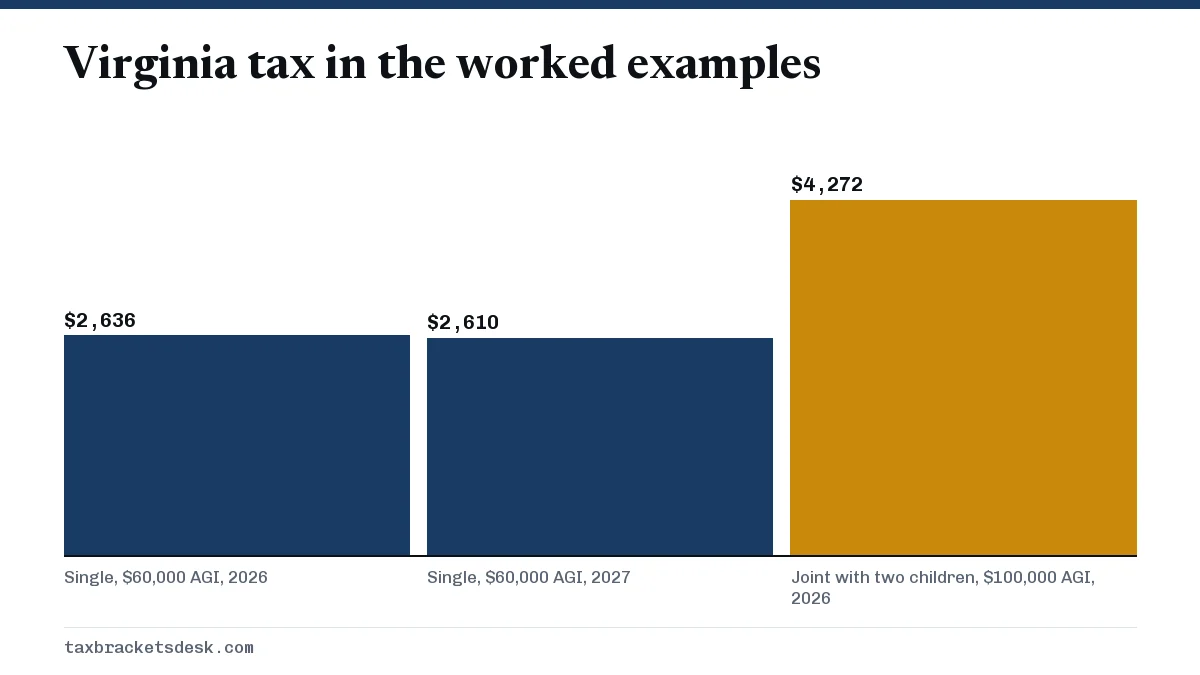
- Single, $60,000 federal AGI, 2026. Subtract the $8,750 standard deduction and one $930 exemption to reach $50,320. Tax is $720 plus 5.75% of $33,320, or $2,635.90, an effective rate of about 4.4% of AGI.
- Same filer in 2027. With the $9,200 deduction, taxable income is $49,870 and the tax is $2,610.03, about $26 less.
- Married filing jointly, two children, $100,000 federal AGI, 2026. Subtract $17,500 and four exemptions ($3,720) to reach $78,780. Tax is $720 plus 5.75% of $61,780, or $4,272.35, before a spouse tax adjustment of up to $259 if both spouses earn income.
- Single retiree age 67, $56,000 adjusted federal AGI. The $12,000 age deduction shrinks by the $6,000 above $50,000, leaving a $6,000 age deduction on top of the standard deduction and the $930 plus $800 exemptions.
For the federal side of a similar salary, see tax on a $60,000 salary.
Common questions
What is the top Virginia income tax rate?
The top rate is 5.75%, and it applies to Virginia taxable income over $17,000 for all filing statuses. There is no additional bracket for high earners.
Who has to file a Virginia income tax return?
For 2025, Virginia residents must file if Virginia adjusted gross income is $11,950 or more for single filers or married filing separately, or $23,900 or more combined for married filing jointly.
Are Virginia tax brackets adjusted for inflation?
No. The $3,000, $5,000 and $17,000 thresholds are fixed in law, which is why most workers reach the 5.75% bracket.
Does Virginia tax Social Security benefits?
No. Virginia subtracts Social Security and Tier 1 Railroad Retirement benefits that are taxable on your federal return.
How much is the Virginia standard deduction for 2027?
It is $9,200 for single filers and $18,400 for married couples filing jointly, as enacted in the 2026 budget. It then rises to $9,300 and $18,600 for 2028 and 2029.
Sources
- Virginia Tax, 2025 Form 760 resident instructions tax.virginia.gov
- Virginia Tax, Deductions tax.virginia.gov
- Virginia Tax, Legislative summary 26-82 (standard deduction and EITC) tax.virginia.gov
- Virginia Tax, New Virginia tax laws tax.virginia.gov
- Virginia Tax, 2026 legislative summary tax.virginia.gov
We check figures against these official pages. Rules change; confirm anything that affects a deadline or payment with the agency before you act.
Tell us what happened
Describe your situation and our editors will use it to improve this guide. If you leave your email, we may reply with a pointer to the right page or official contact. We never share your details.