
North Carolina income tax rate 2026: 3.99% flat, and whether it falls to 3.49% in 2027
Short answer
The North Carolina income tax rate is a flat 3.99% for tax years beginning after 2025, down from 4.25% in 2025 and 4.5% in 2024, according to the NC Department of Revenue. It applies to all NC taxable income after the standard deduction ($12,750 single, $25,500 joint). A cut to 3.49% for 2027 depends on a revenue trigger; as of October 13, 2026, NCDOR has not said whether it was met.
- 01NC rate, tax year 2026
- 3.99% flat
- 02NC rate, tax year 2025
- 4.25% flat
- 03Standard deduction
- $12,750 single; $19,125 head of household; $25,500 joint
- 04Possible 2027 rate
- 3.49% if FY 2025-26 General Fund revenue tops $33.042 billion (not confirmed)
- 05Lowest rate the triggers allow
- 2.49%
- 06Local income tax
- None
What is the North Carolina income tax rate for 2026?
The North Carolina income tax rate for 2026 is 3.99%, a single rate applied to every dollar of North Carolina taxable income. The NC Department of Revenue (NCDOR) lists 3.99% for tax years beginning after 2025, so it covers the Form D-400 you file in 2027 for the 2026 year.
The 2026 rate is the last fixed step in Session Law 2023-134, the 2023 budget law that set 4.5% for 2024, 4.25% for 2025 and 3.99% afterward. Anything below 3.99% now depends on state revenue, as explained further down.
NC income tax is a flat tax: there is no bracket to move into when you get a raise, and a person earning $40,000 and a person earning $400,000 pay the same 3.99% on their taxable income. The state income tax rates hub compares that with graduated states.
How has the NC income tax rate changed over time?
North Carolina replaced its graduated brackets with a flat rate in 2014 and has cut the flat rate almost every few years since. The NCDOR rate history shows the steps below.
| Tax year | Rate |
|---|---|
| 2015 to 2016 | 5.75% |
| 2017 to 2018 | 5.499% |
| 2019 to 2021 | 5.25% |
| 2022 | 4.99% |
| 2023 | 4.75% |
| 2024 | 4.5% |
| 2025 | 4.25% |
| 2026 and later | 3.99% (lower rates possible from 2027) |
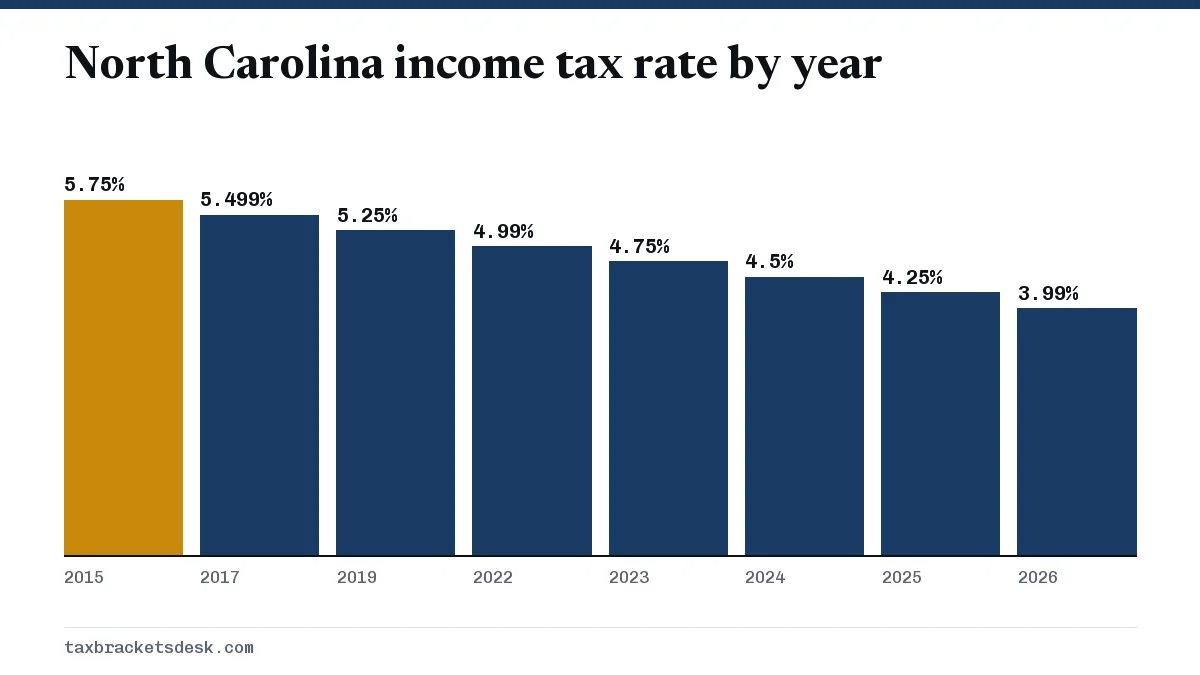
Going from 5.75% to 3.99% means the tax on $50,000 of taxable income fell from $2,875 to $1,995 over eleven years.
North Carolina standard deduction and itemized deductions
North Carolina taxable income starts from federal adjusted gross income, applies NC additions and subtractions, and then takes away either the NC standard deduction or NC itemized deductions. The NC standard deduction is much smaller than the federal one and does not rise with inflation.
| Filing status | NC standard deduction |
|---|---|
| Single | $12,750 |
| Head of household | $19,125 |
| Married filing jointly or qualifying surviving spouse | $25,500 |
| Married filing separately, spouse does not itemize | $12,750 |
| Married filing separately, spouse itemizes | $0 |
- No extra amount for age or blindness. Unlike the federal return, NC adds nothing for filers who are 65 or older or blind.
- Zero if you cannot take the federal standard deduction. NCDOR says that if you are not eligible for the federal standard deduction, your NC standard deduction is zero.
- Itemizing is narrower. NC allows only mortgage interest, real estate taxes, charitable gifts, medical and dental expenses and claim-of-right repayments. Mortgage interest and property tax together are capped at $20,000.
Because the federal standard deduction for 2026 is $16,100 for a single filer, most people use the standard deduction on both returns, but the NC amount shields less income.
Does North Carolina have local income taxes?
No. North Carolina counties and cities do not charge a local income tax, so Charlotte, Raleigh and rural residents all pay the same 3.99% state rate. Local governments rely on property and sales taxes instead.
If you live in North Carolina and commute to Virginia or another state, you file a nonresident return there and claim a credit on the D-400 for tax paid to the other state, so the same wages are not fully taxed twice.
Will the North Carolina income tax rate drop in 2027?
Possibly, but the 2027 rate is not yet confirmed. NCDOR says additional rate changes may apply to tax years beginning with 2027 based on rate reduction triggers in Session Law 2023-134. Each time General Fund revenue for a fiscal year exceeds that year's trigger, the next tax year's rate falls by half a percentage point, but never below 2.49%.
| Fiscal year revenue tested | Trigger amount | Tax year affected | Rate if met (and every earlier trigger met) |
|---|---|---|---|
| 2025-2026 | $33.042 billion | 2027 | 3.49% |
| 2026-2027 | $34.1 billion | 2028 | 2.99% |
| 2027-2028 | $34.76 billion | 2029 | 2.49% |
| 2028-2029 to 2032-2033 | $35.75 billion to $39 billion | 2030 to 2034 | Stays at 2.49% floor |
A missed trigger does not end the schedule; a later year can still trigger a cut from whatever rate is then in place. The fiscal year tested for 2027 ended June 30, 2026, but as of October 13, 2026, NCDOR's tax rate schedules page still says only that additional rate changes may apply to tax years beginning with 2027. Check that page again before you file or set your 2027 withholding.
Worked example: NC income tax for a North Carolina resident
These examples assume no NC additions, subtractions or credits other than the standard deduction.
- Single, $60,000 federal AGI. $60,000 minus $12,750 leaves $47,250 of taxable income. At 3.99% the 2026 tax is about $1,885. The same income owed $2,008 at the 2025 rate of 4.25%, a saving of about $123.
- Head of household, $45,000 federal AGI. $45,000 minus $19,125 leaves $25,875. At 3.99% the tax is about $1,032.
- Married filing jointly, $120,000 federal AGI. $120,000 minus $25,500 leaves $94,500. At 3.99% the tax is about $3,771; at 4.25% it would have been about $4,016.
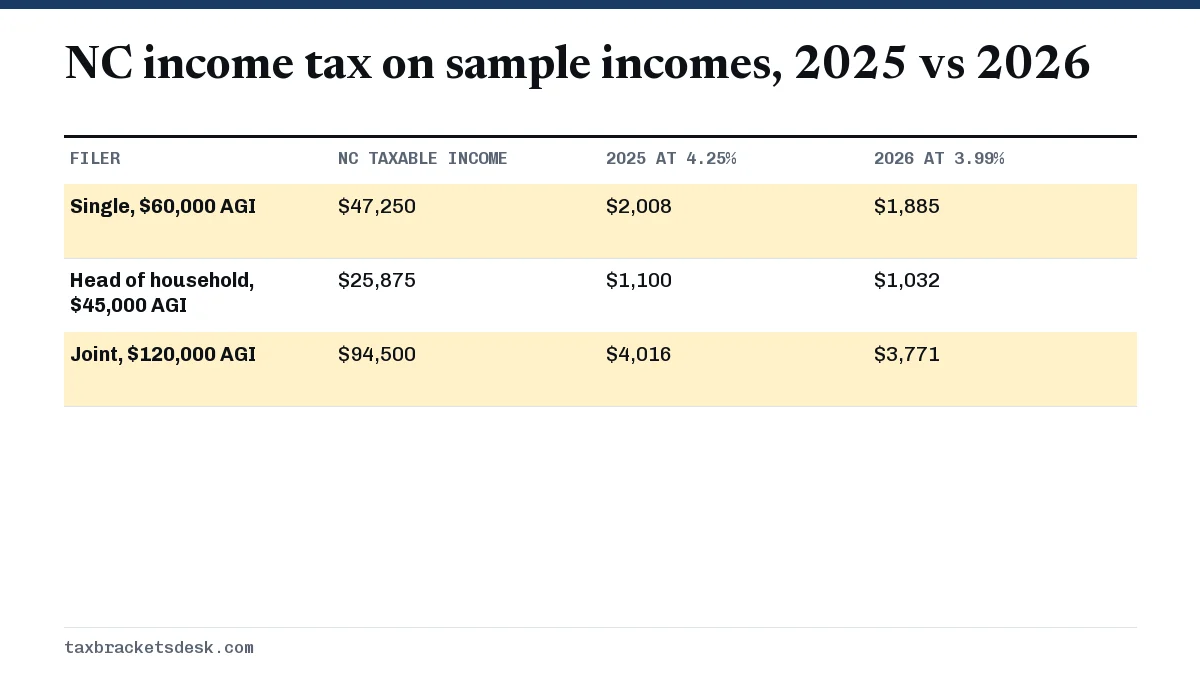
For the single filer, a 2027 rate of 3.49% would cut the bill on the same $47,250 to about $1,649. For the federal side of the same salary, see tax on a $60,000 salary.
Steps to get your NC withholding right
- Look at a recent pay stub and compare NC withholding with your expected 2026 tax from the examples above.
- If too much or too little is coming out, give your employer a new Form NC-4, Employee's Withholding Allowance Certificate.
- If you have side income, pay NC estimated tax with Form NC-40 so you are not short when you file the D-400.
- When you file in 2027, confirm your software shows 3.99% for tax year 2026; a 4.25% rate means it is using 2025 tables.
Common questions
What is the NC income tax rate for 2026?
It is 3.99% of North Carolina taxable income for every filer. The rate was 4.25% for 2025 and 4.5% for 2024.
Does North Carolina tax Social Security benefits?
No. North Carolina lets you subtract Social Security benefits that are included in federal adjusted gross income, so they are not taxed on the D-400.
Is there an extra NC standard deduction for people over 65?
No. North Carolina gives the same standard deduction regardless of age or blindness: $12,750 single, $19,125 head of household and $25,500 married filing jointly.
What is the lowest North Carolina's income tax rate can go?
Under Session Law 2023-134 the triggers can lower the rate by half a point at a time down to a floor of 2.49%. Reaching it would take three triggered cuts from 3.99%.
Why is my NC tax higher than I expected at 3.99%?
The NC standard deduction is smaller than the federal one, so more of your income is taxed. Also check NC additions, such as interest from other states' bonds, which raise NC income above federal AGI.
Sources
- NCDOR, Tax rate schedules ncdor.gov
- NCDOR, NC standard deduction or NC itemized deductions ncdor.gov
- NCDOR, 2023 personal taxes law changes (rate reduction triggers) ncdor.gov
- NCDOR, 2025 personal taxes law changes ncdor.gov
We check figures against these official pages. Rules change; confirm anything that affects a deadline or payment with the agency before you act.
Tell us what happened
Describe your situation and our editors will use it to improve this guide. If you leave your email, we may reply with a pointer to the right page or official contact. We never share your details.