
Pennsylvania income tax: the 3.07% flat rate plus local wage taxes
Short answer
Pennsylvania income tax is a flat 3.07% of taxable income, with no standard deduction and no personal exemption, according to the Pennsylvania Department of Revenue. Most residents also pay a local earned income tax, commonly 1% or more, and Philadelphia residents pay a 3.735% city Wage Tax on pay from July 1, 2026.
- 01PA income tax rate
- 3.07% flat
- 02Standard deduction or exemption
- None
- 03Philadelphia Wage Tax from July 1, 2026
- 3.735% residents; 3.425% nonresidents
- 04Local EIT cap in most places
- 1% combined for municipality and school district
- 05Working Pennsylvanians Tax Credit
- 10% of the federal EITC, refundable
- 06Full Tax Forgiveness limit, single
- $6,500 eligibility income plus $9,500 per dependent
What is the Pennsylvania income tax rate?
The PA income tax rate is 3.07%, applied to taxable income of residents and to Pennsylvania-source income of nonresidents. The Department of Revenue states that, unlike the federal system, Pennsylvania allows no standard deduction and no personal exemption, so the rate applies from the first taxable dollar. Residents file Form PA-40, Pennsylvania Personal Income Tax Return, by April 15, on paper or free through myPATH.
That makes Pennsylvania income tax one of the simplest in the country to estimate: multiply taxable income by 0.0307. It also makes it one of the lowest flat rates, below the 4.95% charged in Illinois. The harder part is working out what counts as taxable income, because Pennsylvania does not start from federal adjusted gross income.
How Pennsylvania taxes income: eight classes, one rate
Pennsylvania has no brackets. Instead, the PA-40 sorts income into eight classes and taxes the combined total at 3.07%: compensation; interest; dividends; net profits from a business, profession or farm; net gains from selling property; net income from rents, royalties, patents and copyrights; income from estates or trusts; and gambling and lottery winnings.
A loss in one class cannot reduce income in another. A $5,000 rental loss does not lower tax on your wages, and it cannot be carried to a later year either. This is the rule that most often surprises people who move to Pennsylvania from states that follow the federal return.
| Item | Federal return | Pennsylvania PA-40 |
|---|---|---|
| 401(k) and 403(b) employee contributions | Excluded from wages | Taxed when contributed |
| Retirement plan payouts after retirement age | Taxable | Not taxable |
| Social Security benefits | Up to 85% taxable | Not taxable |
| Standard deduction | Yes | None |
| Unreimbursed employee expenses | Not deductible | Direct costs allowed on PA Schedule UE |
Because employee retirement contributions are taxed going in, the PA wage figure on your W-2 is often higher than the federal wage figure in box 1. When those same dollars come out after retirement, Pennsylvania does not tax them again. Federal treatment of plan withdrawals is covered in tax on 401(k) withdrawals.
Does Pennsylvania have local income taxes?
Yes. Almost every Pennsylvania resident owes a local earned income tax (EIT) on wages and net profits, levied by the municipality and school district where they live. Under Act 32 of 2008, employers withhold it, and the Department of Community and Economic Development (DCED) publishes each area's rate and its political subdivision (PSD) code.
How the Pennsylvania local earned income tax rate is set
- Most municipalities and school districts are limited to a combined 1%, usually shared 50/50 when both levy the tax. Some school districts have voter-approved rates above that.
- Pittsburgh's school district tax is limited to 2%, and Philadelphia's tax has no statutory limit.
- School districts cannot tax nonresidents, but the municipality where you work can charge a nonresident rate, often 1% or 0.5%.
- Your employer withholds the greater of your resident rate or the nonresident rate where you work, so you pay one EIT, not two.
- Many areas also charge a Local Services Tax, a flat annual amount per worker withheld from pay.
Each resident must file an annual local earned income tax return with the tax officer for their home area by April 15, even when the employer withheld the right amount. Look up your rate with DCED's address search before assuming 1%.
Philadelphia Wage Tax
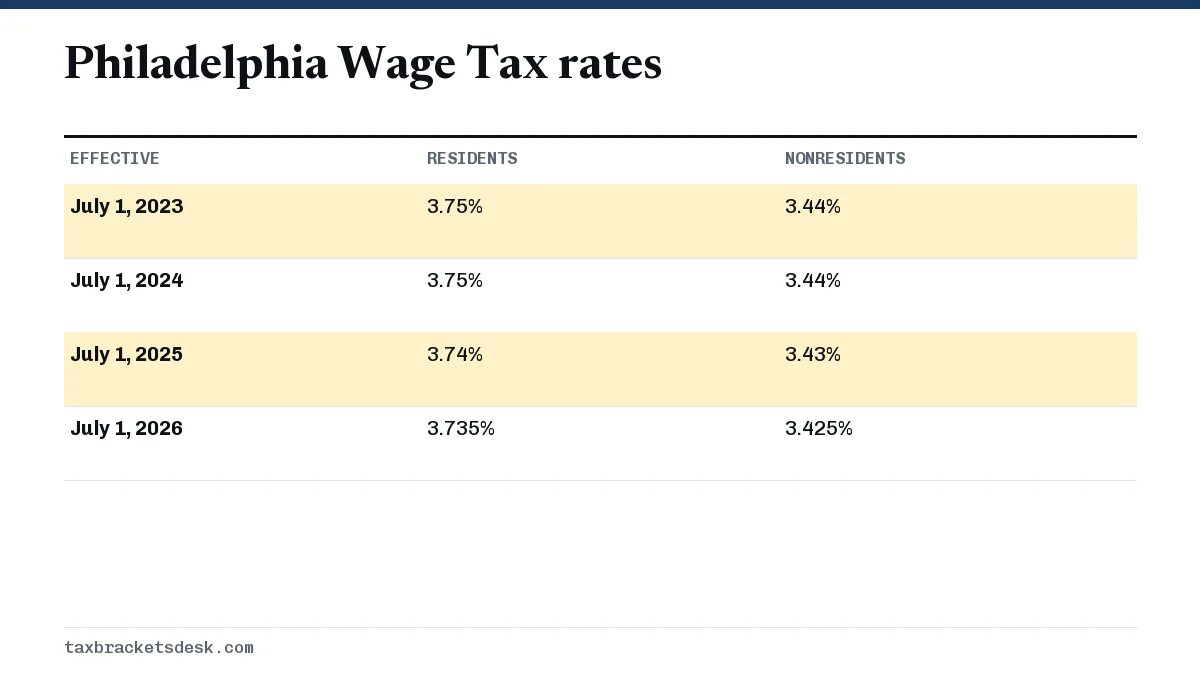
Philadelphia replaces the EIT with its own Wage Tax. The City of Philadelphia lists the rate at 3.735% for residents and 3.425% for nonresidents from July 1, 2026, down from 3.74% and 3.43% a year earlier, as part of a five-year schedule of gradual cuts.
Did Pennsylvania change its income tax rate for 2026?
No. As of September 2026, the Department of Revenue still lists the personal income tax rate at 3.07%, the rate in place since 2004. The change that matters for tax year 2025 and later is the Working Pennsylvanians Tax Credit, created in the 2025-26 budget signed on November 12, 2025.
The credit equals 10% of your federal earned income tax credit and is refundable, so you receive it even if you owe no Pennsylvania tax. The department figures it from the federal return, with a maximum of $805 for tax year 2025. Using the IRS 2026 maximum federal credit of $8,231, the 2026 maximum works out to about $823 (our calculation; the department has not yet published it). See earned income credit 2026 for the federal side.
Tax Forgiveness for lower incomes
Tax Forgiveness, claimed on PA Schedule SP, cancels part or all of the 3.07% tax for low-income households. It uses eligibility income, which adds some nontaxable items such as alimony and gifts to taxable income, but leaves out Social Security and child support.
| Household | 100% forgiveness up to | 10% forgiveness up to |
|---|---|---|
| Single, no dependents | $6,500 | $8,750 |
| Married, no dependents | $13,000 | $15,250 |
| Each dependent adds | $9,500 | $9,500 |
| Married with two dependents | $32,000 | $34,250 |
Worked example: Pennsylvania income tax on a $60,000 salary
Take a single Pennsylvania resident earning a $60,000 salary in 2026 who puts $4,000 into a 401(k) and has no other income. Federal box 1 wages would be $56,000, but Pennsylvania compensation is the full $60,000.
- Pennsylvania taxable compensation: $60,000 (the 401(k) contribution is not excluded).
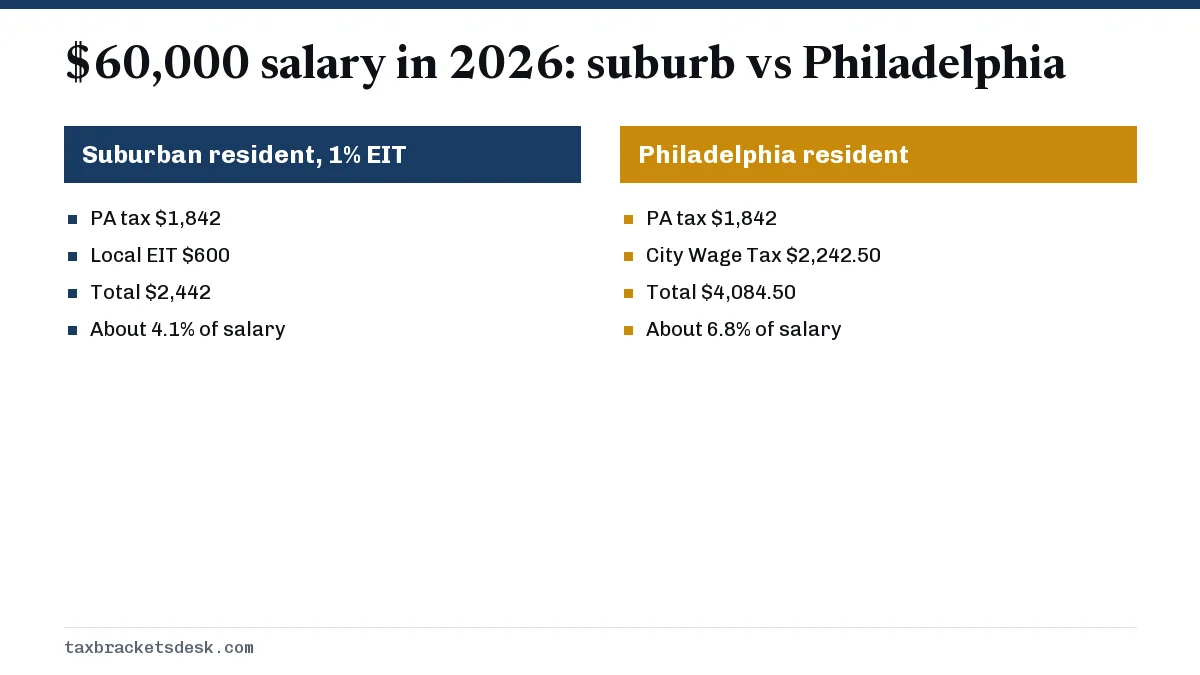
- State tax: $60,000 x 3.07% = $1,842.
- Local EIT in a township and school district with a combined 1% resident rate: $600.
- Total state and local income tax: $2,442, or about 4.1% of salary.
If the same worker lived in Philadelphia, the Wage Tax replaces the $600 EIT. With pay spread evenly over 2026, half the year is taxed at 3.74% ($1,122) and half at 3.735% ($1,120.50), for $2,242.50 of Wage Tax and $4,084.50 in total. That is roughly $1,640 more than the suburban resident pays on identical pay.
Compare these totals with graduated states on state income tax rates; a New Jersey resident at the same pay could pay more or less depending on exemptions, as shown on the New Jersey income tax rates page. Georgia, another flat-rate state, is covered in Georgia income tax rate.
Common questions
Is Pennsylvania state income tax 3.07% for everyone?
Yes. Every resident pays 3.07% on Pennsylvania taxable income regardless of amount or filing status. Low-income households may have part or all of it cancelled through Tax Forgiveness on Schedule SP.
Why are my PA wages higher than my federal wages on my W-2?
Pennsylvania taxes employee contributions to 401(k), 403(b) and similar deferred compensation plans when you make them, while federal box 1 wages exclude them. The trade-off is that qualifying retirement distributions after retirement age are not taxed by Pennsylvania.
How do I find my Pennsylvania local earned income tax rate?
Use the DCED address search for Act 32 at dced.pa.gov to find your PSD code and the resident EIT rate for your municipality and school district. Give your employer a Residency Certification Form so it withholds the correct rate.
Does Pennsylvania tax Social Security and pensions?
No. Social Security and railroad retirement benefits are never taxable in Pennsylvania, and distributions from eligible retirement plans after retirement age are excluded from compensation. Early withdrawals before retirement can be partly taxable.
Do Philadelphia residents pay both the Wage Tax and the state tax?
Yes. Philadelphia residents pay the 3.07% state tax on the PA-40 plus the city Wage Tax of 3.735% on pay from July 1, 2026. The Wage Tax takes the place of a local earned income tax, so there is no separate EIT.
Sources
- PA Department of Revenue, Personal Income Tax pa.gov
- PA Department of Revenue, Personal Income Tax Guide: Gross Compensation pa.gov
- PA Department of Revenue, Tax Forgiveness pa.gov
- PA Department of Revenue, Working Pennsylvanians Tax Credit pa.gov
- DCED, Act 32 local income tax information and Policy and Procedure Manual dced.pa.gov
- City of Philadelphia, Wage Tax (employers) phila.gov
We check figures against these official pages. Rules change; confirm anything that affects a deadline or payment with the agency before you act.
Tell us what happened
Describe your situation and our editors will use it to improve this guide. If you leave your email, we may reply with a pointer to the right page or official contact. We never share your details.