
States with no income tax: the list for 2026
Short answer
Nine states have no income tax on wages for 2026: Alaska, Florida, Nevada, New Hampshire, South Dakota, Tennessee, Texas, Washington and Wyoming. New Hampshire dropped its interest and dividends tax starting in 2025, while Washington still taxes large long-term capital gains at 7% to 9.9%. Federal income tax applies in every state.
- 01States with no wage income tax
- 9
- 02New Hampshire interest and dividends tax
- Repealed for periods beginning on or after Jan 1, 2025
- 03Tennessee Hall income tax
- Repealed for tax years beginning on or after Jan 1, 2021
- 04Washington capital gains tax
- 7%, plus 2.9% on gains over $1 million (from 2025)
- 05Washington capital gains standard deduction, 2025
- $278,000
Which states have no income tax?
The states with no income tax on wages and salaries are Alaska, Florida, Nevada, New Hampshire, South Dakota, Tennessee, Texas, Washington and Wyoming. If you live in one of them all year, you file no state income tax return on your paycheck, and your employer withholds only federal income tax, Social Security and Medicare.
A no-income-tax state is one that does not levy a broad personal income tax on earnings. That is narrower than no tax at all: these states still collect sales, property, excise and business taxes, and one of them taxes a specific kind of investment income.
| State | Tax on wages | Tax on investment income | Note |
|---|---|---|---|
| Alaska | None | None | No statewide sales tax either |
| Florida | None | None | No personal income tax in the state constitution |
| Nevada | None | None | |
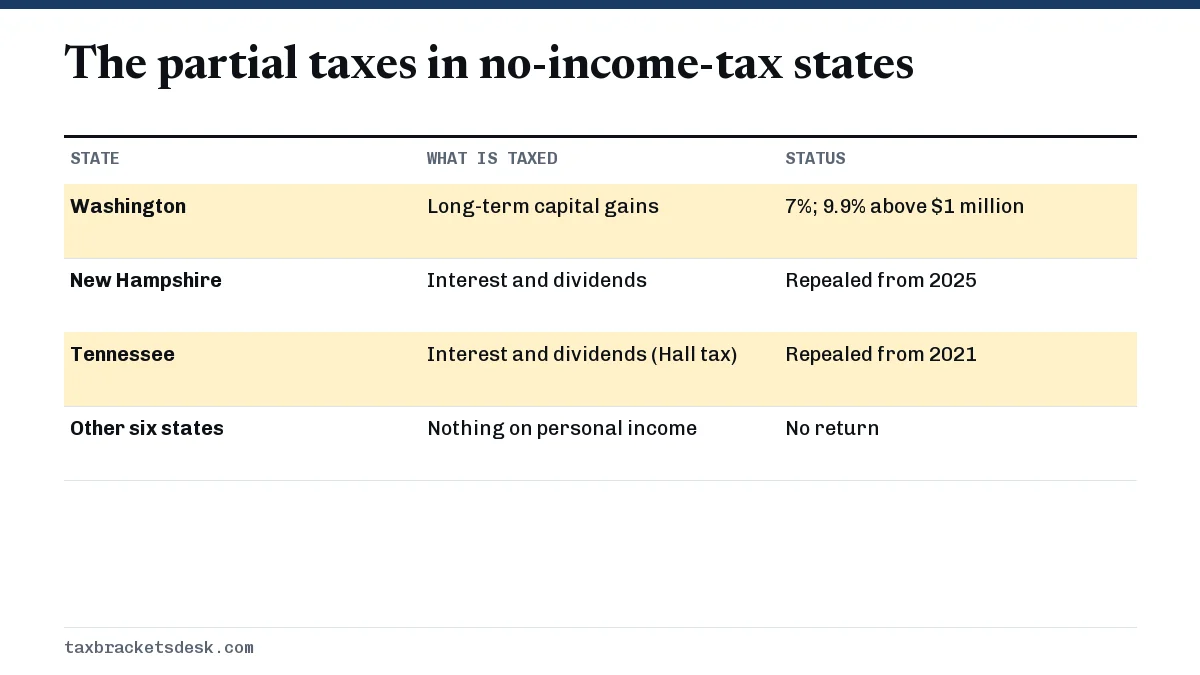
| New Hampshire | None | None from 2025 | 3% interest and dividends tax repealed |
| South Dakota | None | None | |
| Tennessee | None | None since 2021 | Hall income tax on interest and dividends repealed |
| Texas | None | None | |
| Washington | None | Long-term capital gains over $278,000 (2025) | 7%, and 9.9% on gains above $1 million |
| Wyoming | None | None |
States with no income tax in 2026: what changed recently
The list of states with no income tax 2026 filers will see is the same nine as the year before, but two of them changed what they tax at the edges.
Does New Hampshire tax income?
No, not for 2025 or later. New Hampshire never taxed wages, but it charged a tax on interest and dividends, most recently at 3% on residents with more than $2,400 of that income ($4,800 on a joint return). The New Hampshire Department of Revenue Administration says the tax is repealed for tax periods beginning on or after January 1, 2025, and no 2025 return or estimated payments are required. Earlier years can still be audited.
Washington's capital gains tax
Washington taxes individuals on the sale of long-term capital assets such as stocks, at 7% on gains above an inflation-adjusted standard deduction of $278,000 for 2025. Starting with tax year 2025, taxable gains above $1 million pay an extra 2.9%, for 9.9% on that slice, according to the Washington Department of Revenue. Real estate sales and retirement accounts are handled under separate rules on the department's site, so check before assuming a sale is taxable.
Tennessee's Hall income tax
Tennessee phased its Hall income tax on interest and dividends down one point a year and repealed it for tax years beginning January 1, 2021. There is nothing to file for 2021 onward.
Do no-income-tax states have higher other taxes?
Often, yes. A state that skips the income tax still has to pay for schools, roads and courts, so it leans harder on sales tax, property tax, business taxes, tourism or energy revenue. Whether you come out ahead depends on how you spend and what you own: a renter with a high salary usually gains more than a retiree with a large house and modest income.
Before a move, compare three numbers for your own situation: the income tax you would stop paying, the change in property tax on the home you would buy, and the sales tax on your normal spending. Our overview of state income tax rates shows what the large income-tax states charge at $75,000 of wages, a useful starting figure for that math.
No income tax states for retirees: what you actually save
In a no-income-tax state, pensions, IRA and 401(k) withdrawals, Social Security and investment income all escape state tax (apart from Washington's tax on large capital gains). Federal tax still applies: up to 85% of Social Security benefits can be federally taxable once your income passes the base amount, as explained in our guide to tax on Social Security benefits.
The gap is smaller than it looks for many retirees, because several income-tax states already exempt most retirement income. Illinois lets residents subtract federally taxed pensions, 401(k) and IRA distributions and Social Security on Form IL-1040, as covered on our Illinois income tax rate page. Pennsylvania does not tax payments from eligible retirement plans to people who have retired, as explained on the Pennsylvania income tax page.
So a retiree living on a pension and Social Security may save little by leaving Illinois or Pennsylvania, while one with large taxable investment income or a part-time salary saves more. A retiree leaving a state with high graduated rates, such as California, usually sees the biggest drop; the California tax brackets page shows how quickly its rates climb.
Moving to a no-income-tax state: residency rules
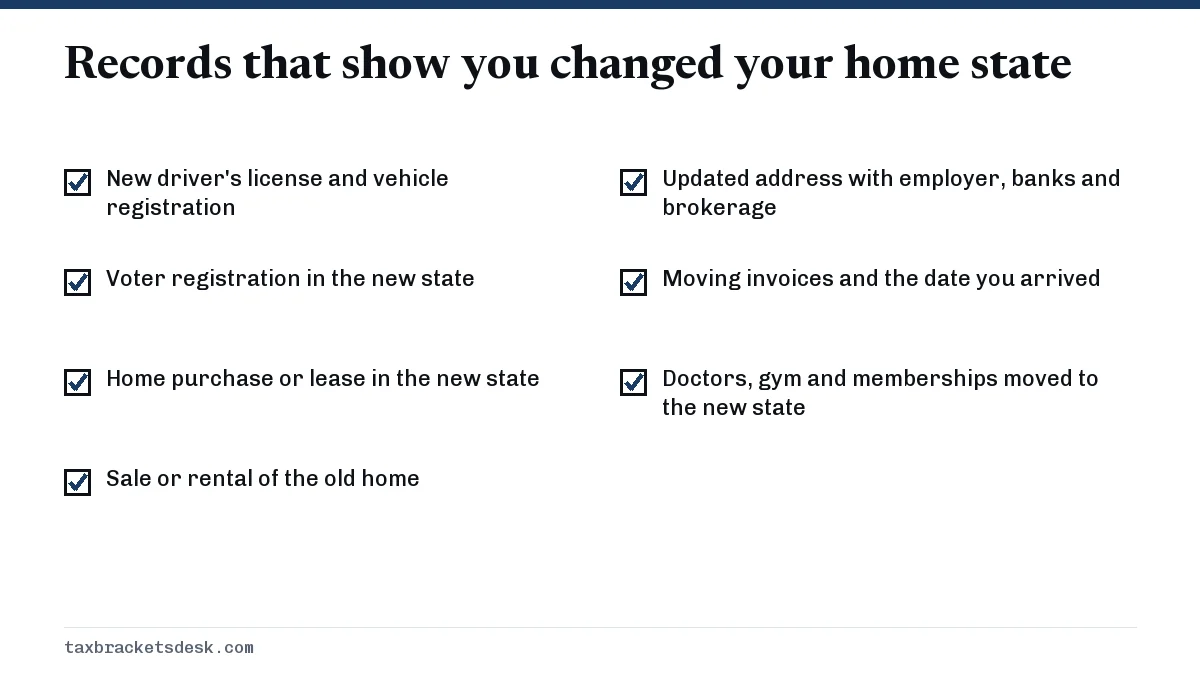
Your old state keeps taxing you as a resident until you actually change your domicile, the place you intend as your permanent home. In the year you move you normally file a part-year resident return in the old state, such as California Form 540NR, New York Form IT-203 or Illinois Form IL-1040 with Schedule NR, covering income up to the move date.
- Income sourced to the old state stays taxable there. Rent from property located in your old state, or wages for days you still work there, can be taxed on a nonresident return after you move.
- Timing of a big sale matters. A stock sale or bonus received before the move date belongs on the old state's part-year return; one received after generally does not, unless the old state sources it there.
- High-tax states may ask questions. If you had high income, expect your former state to check where you really lived. Keep the records that show the move.
If you are weighing a move away from a state that adds a surtax on very high incomes, the Massachusetts income tax rate page shows how that extra layer works, which helps you size the saving before you decide.
Common questions
How many states have no income tax in 2026?
Nine: Alaska, Florida, Nevada, New Hampshire, South Dakota, Tennessee, Texas, Washington and Wyoming. Washington does tax large long-term capital gains, and New Hampshire's interest and dividends tax ended starting with 2025.
Do I still pay federal income tax in a state with no income tax?
Yes. Federal income tax, Social Security and Medicare apply the same way in every state. Only the state layer disappears.
Which no-tax state is best for retirees?
There is no single answer, because property tax, sales tax, housing and health care costs differ far more between these states than income tax does. Compare your expected property tax and spending in each state, since all nine skip tax on pensions, IRAs and Social Security.
Do I have to file a state return the year I move to Texas or Florida?
Usually yes, in the state you left. You file a part-year resident return there for income earned before the move, plus a nonresident return for any income still sourced to that state afterward.
Is Alaska's Permanent Fund Dividend taxed?
Alaska does not tax it, because Alaska has no personal income tax. The dividend is generally taxable on your federal return.
Sources
- NH Department of Revenue Administration, Repeal of the Interest and Dividends Tax revenue.nh.gov
- Tennessee Department of Revenue, Hall Income Tax tn.gov
- Washington Department of Revenue, Capital gains tax dor.wa.gov
- Washington Department of Revenue, New tiered rates for the capital gains tax dor.wa.gov
- IRS Topic 503, Deductible taxes irs.gov
We check figures against these official pages. Rules change; confirm anything that affects a deadline or payment with the agency before you act.
Tell us what happened
Describe your situation and our editors will use it to improve this guide. If you leave your email, we may reply with a pointer to the right page or official contact. We never share your details.