
Capital Gains and Investment Tax
Capital gains tax rate 2026: income brackets for 0%, 15% and 20% by filing status
Short answer
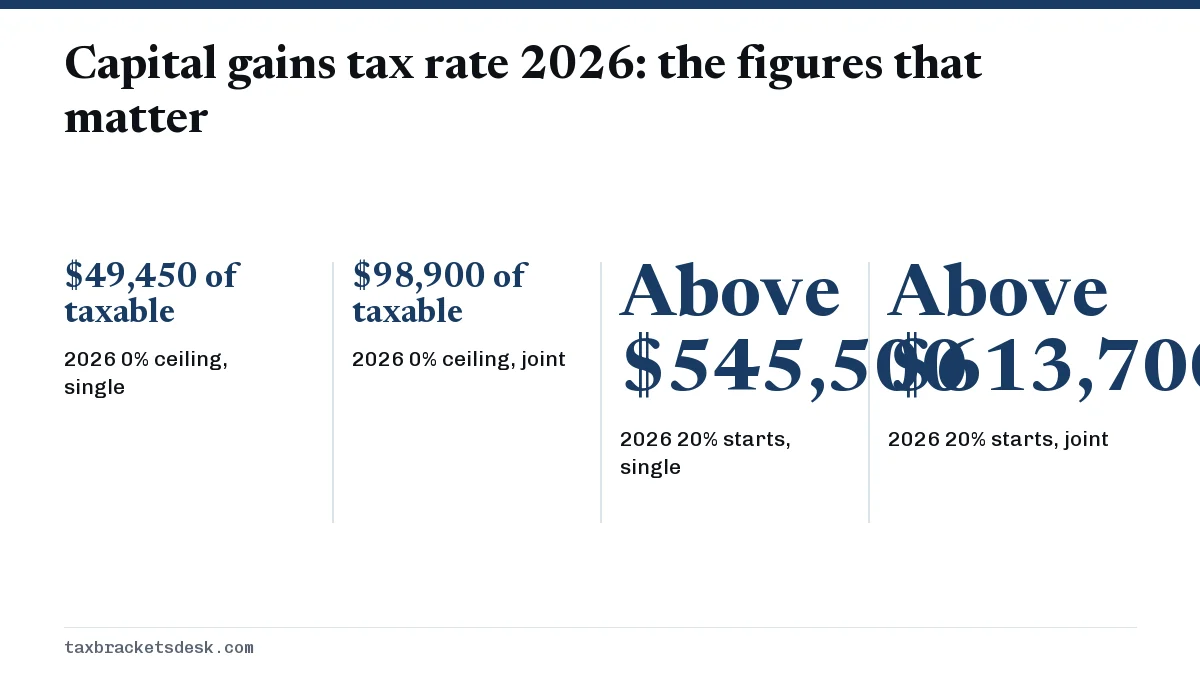
The capital gains tax rate for 2026 is 0% on long-term gains that fit under $49,450 of taxable income for single filers ($98,900 joint, $66,200 head of household), 15% up to $545,500 single ($613,700 joint), and 20% above that (Rev. Proc. 2025-32). These thresholds apply to 2026 returns filed in the 2027 season.
- 012026 0% ceiling, single
- $49,450 of taxable income
- 022026 0% ceiling, joint
- $98,900 of taxable income
- 032026 20% starts, single
- Above $545,500
- 042026 20% starts, joint
- Above $613,700
- 05Source of 2026 figures
- Rev. Proc. 2025-32, released October 9, 2025
- 062027 thresholds
- Not yet announced; expected October or November 2026
What is the capital gains tax rate for 2026?
The capital gains tax rate 2026 schedule has three long-term rates: 0%, 15% and 20%. Which one applies depends on your filing status and your total taxable income, not on the size of the gain alone. The dollar thresholds were set by the IRS in Rev. Proc. 2025-32, the tax year 2026 inflation adjustment notice announced on October 9, 2025.
These rates apply only to long-term gains, meaning assets held more than one year, and to qualified dividends. A gain on something held one year or less is taxed at the ordinary rates of 10% to 37% instead (IRS Tax Topic 409). The rules behind the holding period are covered on the long-term capital gains tax page; this page is the number reference.
Capital gains tax brackets 2026 by filing status
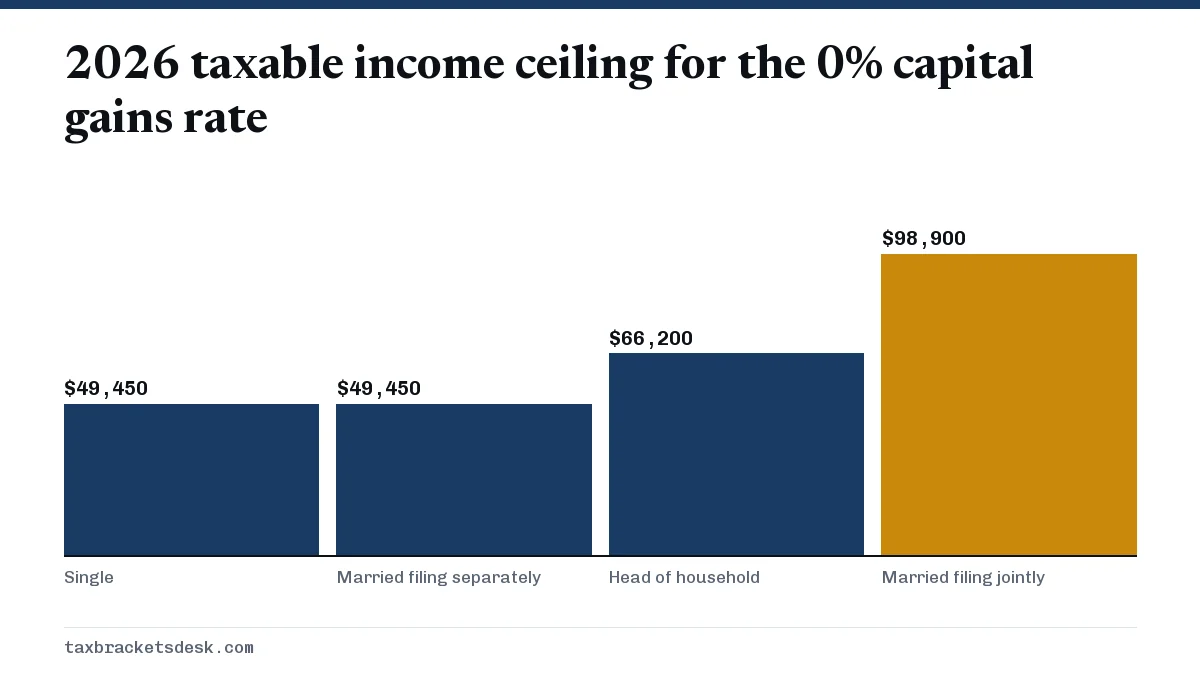
The table lists the taxable income ranges for each long-term rate in tax year 2026. Taxable income is income after the standard deduction or itemized deductions, so it is lower than your salary or gross income.
| Filing status | 0% rate applies up to | 15% rate applies up to | 20% rate applies above |
|---|---|---|---|
| Single | $49,450 | $545,500 | $545,500 |
| Married filing jointly or qualifying surviving spouse | $98,900 | $613,700 | $613,700 |
| Head of household | $66,200 | $579,600 | $579,600 |
| Married filing separately | $49,450 | $306,850 | $306,850 |
Note that the 15% band for married filing separately ends at $306,850, roughly half the joint figure, while the 0% band matches the single threshold. Two spouses filing separately with large gains can therefore reach 20% sooner than they would on a joint return.
How much did the thresholds change from 2025?
Every 2026 threshold is higher than the 2025 figure because the IRS indexes them for inflation each year. The 0% ceiling for a single filer rose by $1,100, and the joint ceiling rose by $2,200.
| Threshold | Tax year 2025 | Tax year 2026 | Change |
|---|---|---|---|
| 0% ceiling, single | $48,350 | $49,450 | +$1,100 |
| 0% ceiling, married filing jointly | $96,700 | $98,900 | +$2,200 |
| 0% ceiling, head of household | $64,750 | $66,200 | +$1,450 |
| 15% ceiling, single | $533,400 | $545,500 | +$12,100 |
| 15% ceiling, married filing jointly | $600,050 | $613,700 | +$13,650 |
| 15% ceiling, head of household | $566,700 | $579,600 | +$12,900 |
Use the 2025 column only for sales made in calendar year 2025, which you report on the return filed in 2026. Sales from January 1 through December 31, 2026 use the 2026 column. The 2025 figures come from IRS Tax Topic 409; the 2026 figures come from Rev. Proc. 2025-32.
How do capital gains stack on top of ordinary income?
Capital gains are placed on top of your ordinary taxable income, and only the part of the gain that lands in each band gets that band's rate. Wages, interest, IRA withdrawals and short-term gains fill the stack first. Long-term gains and qualified dividends sit above them.
Example: a gain that crosses the 0% line
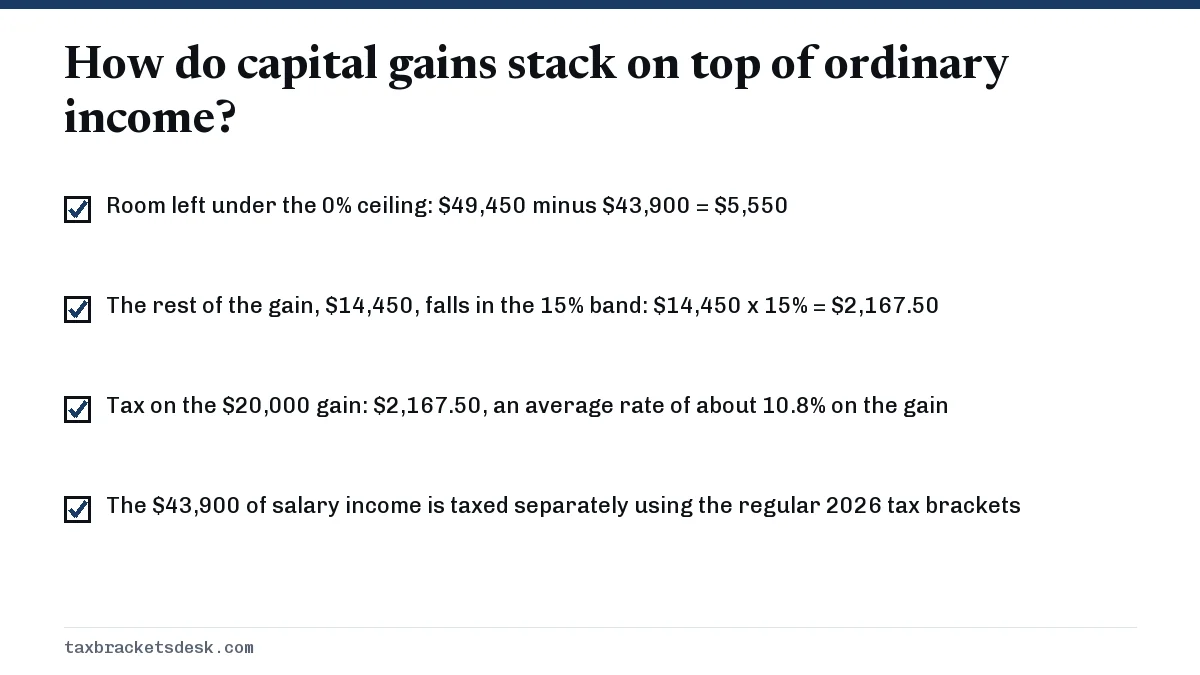
A single filer earns a $60,000 salary and takes the 2026 standard deduction of $16,100, leaving $43,900 of ordinary taxable income. She sells shares held four years for a $20,000 long-term gain, bringing taxable income to $63,900.
- Room left under the 0% ceiling: $49,450 minus $43,900 = $5,550. That slice of the gain is taxed at 0%.
- The rest of the gain, $14,450, falls in the 15% band: $14,450 x 15% = $2,167.50.
- Tax on the $20,000 gain: $2,167.50, an average rate of about 10.8% on the gain.
- The $43,900 of salary income is taxed separately using the regular 2026 tax brackets.
Example: when the 20% rate applies
A single filer has $500,000 of ordinary taxable income and a $100,000 long-term gain, for $600,000 of taxable income. The first $45,500 of gain (from $500,000 up to $545,500) is taxed at 15%, or $6,825. The remaining $54,500 is taxed at 20%, or $10,900, for $17,725 in total.
At this income the 3.8% net investment income tax also applies, because modified adjusted gross income is far above the $200,000 single threshold. On a $100,000 gain that adds up to $3,800, which makes the top federal rate on long-term gains 23.8% in practice.
What income qualifies for 0% capital gains in 2026?
You qualify for 0% on any long-term gain that fits under the ceiling after your other taxable income is counted: $49,450 single, $98,900 joint, $66,200 head of household. Because the standard deduction is subtracted first, gross income can be noticeably higher than those figures.
For example, a married couple whose only income is long-term gains and qualified dividends could receive up to $131,100 in 2026 and owe no federal income tax on it: $98,900 of taxable income plus the $32,200 joint standard deduction for 2026. For a single filer the equivalent figure is $65,550 ($49,450 plus $16,100).
Does the same rate apply to dividends and gifts?
Qualified dividends use exactly the same 0%, 15% and 20% thresholds and share the same stack, so dividends and long-term gains together decide how much room is left in each band. The qualified dividends tax rate page explains which dividends qualify.
Giving appreciated shares to a family member in a lower bracket moves the future gain to their return, where it may fall under their 0% ceiling. Gifts above $19,000 per recipient in 2026 require a gift tax return, as explained on the gift tax limit page, and gifts of investments to children can be caught by the kiddie tax.
Are the 2027 capital gains tax brackets out yet?
No. As of October 20, 2026, the IRS has not announced the 2027 capital gains thresholds. They normally arrive in a revenue procedure in late October or November; the 2026 figures were released on October 9, 2025.
The 0%, 15% and 20% rates themselves are set in the tax code and are not expected to change; only the dollar thresholds move with inflation. Track the release date on the 2027 tax brackets release page, and see the capital gains tax guide for losses, home sales and reporting.
Common questions
Is capital gains tax 15% or 20% in 2026?
Most investors pay 15%. The 20% rate starts only above $545,500 of taxable income for single filers, $613,700 for joint filers and $579,600 for heads of household in 2026.
Do capital gains push you into a higher tax bracket?
Long-term gains do not raise the rate on your wages, because they are stacked on top of ordinary income and taxed at their own rates. They can, however, push part of the gain itself from 0% into 15%, or from 15% into 20%.
What is the capital gains tax on $50,000 in 2026?
It depends on your other taxable income. A single filer with no other income pays 0% on the first $49,450 and 15% on the last $550, or $82.50. A single filer with $80,000 of other taxable income pays 15%, or $7,500.
Is the capital gains tax rate based on gross or taxable income?
Taxable income. The thresholds are measured after the standard or itemized deduction, and the gain itself counts toward the total.
Did the One Big Beautiful Bill change capital gains rates?
No. The 0%, 15% and 20% long-term rates were not changed. The 2026 thresholds rose only because of the usual inflation adjustment in Rev. Proc. 2025-32.
What is the capital gains tax rate for 2027?
Under current law the rates stay 0%, 15% and 20% for 2027; only the income thresholds change, and the IRS has not announced them as of October 20, 2026. Until it does, the 2026 thresholds ($49,450 and $545,500 single, $98,900 and $613,700 joint) are the latest official figures.
Sources
- Rev. Proc. 2025-32 (tax year 2026 inflation adjustments) irs.gov
- Tax Topic 409, Capital gains and losses irs.gov
- IRS releases tax inflation adjustments for tax year 2026 irs.gov
- Publication 505, Tax Withholding and Estimated Tax irs.gov
We check figures against these official pages. Rules change; confirm anything that affects a deadline or payment with the agency before you act.
Tell us what happened
Describe your situation and our editors will use it to improve this guide. If you leave your email, we may reply with a pointer to the right page or official contact. We never share your details.
Related guides
 Capital Gains Tax: Rates, Rules and Worked Examples
Capital gains tax is the federal tax on profit from selling an asset such as stock, a fund, crypto or real estate. For 2026, gain…
Long-Term Capital Gains Tax: Rates and How It Is Figured
Long term capital gains tax is the lower federal tax on profit from assets held more than one year: 0%, 15% or 20% depending on t…
Qualified Dividends Tax Rate 2026 vs Ordinary Dividends
The qualified dividends tax rate for 2026 is 0%, 15% or 20%, the same rates that apply to long-term capital gains. A single filer…
Net Investment Income Tax 2026: 3.8% Rate and Thresholds
For 2026, the net investment income tax (NIIT) is 3.8% of the smaller of your net investment income or the amount your modified a…
Gift Tax Limit 2026: $19,000 Annual Exclusion Explained
The gift tax limit for 2026 is $19,000 per recipient, the same annual gift exclusion as 2025. You can give that much to any numbe…