
Capital Gains and Investment Tax
Estate tax exemption 2026: the $15 million limit, portability and Form 706
Short answer
The federal estate tax exemption for 2026 is $15,000,000 per person, up from $13,990,000 for 2025, under the One Big Beautiful Bill Act and Rev. Proc. 2025-32. Only the part of an estate above that amount, after deductions and lifetime taxable gifts, is taxed, at a top rate of 40%. A married couple can shelter up to $30,000,000 using portability.
- 01Basic exclusion amount, 2026 deaths
- $15,000,000 per person
- 02Basic exclusion amount, 2025 deaths
- $13,990,000
- 03Top estate tax rate
- 40%
- 042027 exemption
- Inflation adjusted; not yet announced (usually October or November)
- 05Form 706 due date
- 9 months after death; 6-month extension on Form 4768
- 06Late portability election
- Up to the 5th anniversary of death under Rev. Proc. 2022-32
What is the estate tax exemption for 2026?
The estate tax exemption for 2026 is $15,000,000 for a person who dies during calendar year 2026. The IRS calls this figure the basic exclusion amount: the value of property you can pass on at death, combined with taxable gifts made during life, before any federal estate tax is due (IRS Estate Tax).
The estate tax is a tax on the right to transfer property at death, measured on the fair market value of everything the person owned. That includes cash, securities, real estate, life insurance they controlled, business interests, annuities and certain trust assets. It is paid by the estate before heirs receive their shares, not by the heirs on their income tax returns.
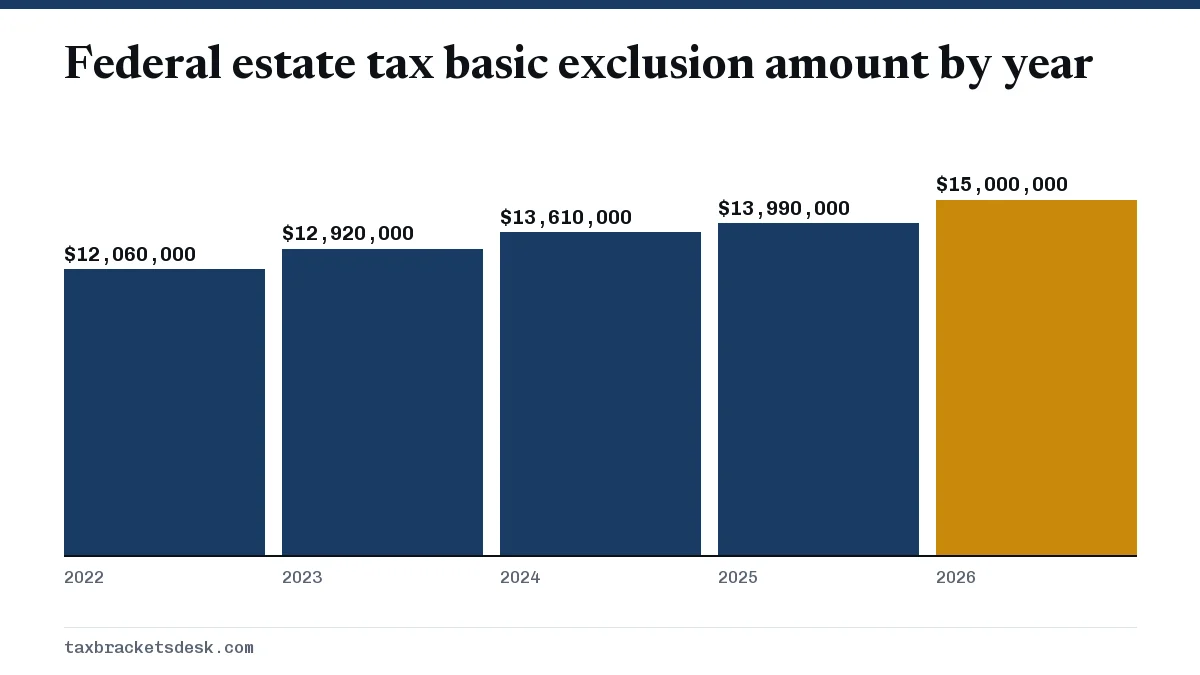
Estate tax exemption by year: 2025, 2026 and 2027
Section 70106 of the One Big Beautiful Bill Act raised the basic exclusion amount to $15,000,000 for 2026 and set it to be adjusted for inflation for 2027 and later years (Rev. Proc. 2025-32, section 2.14). The generation-skipping transfer tax exemption is also $15,000,000 for 2026.
| Year of death | Basic exclusion amount | Status |
|---|---|---|
| 2023 | $12,920,000 | Final |
| 2024 | $13,610,000 | Final |
| 2025 | $13,990,000 | Final |
| 2026 | $15,000,000 | Final (set by law) |
| 2027 | Not yet announced | Inflation adjusted; IRS usually publishes in October or November |
The estate tax exemption 2027 figure will be the $15,000,000 base adjusted for inflation, a number that the IRS will publish in the revenue procedure that also sets the 2027 income tax brackets. Track that release on the 2027 tax changes page. Do not rely on any 2027 number you see before the IRS publishes it.
Is the estate tax exemption per person?
Yes. Each individual has a separate $15,000,000 federal estate tax limit for 2026. Married couples do not share one exemption, but they can move unused exemption from the first spouse to die to the survivor through a portability election.
How portability works
When a married person dies after 2010 without using all of their exclusion, the unused part is called the deceased spousal unused exclusion (DSUE) amount. The executor can transfer it to the surviving spouse by filing a timely Form 706 and making the election, even if the estate owes no tax (Form 706 instructions).
Example: Tom dies in 2026 with a $6,000,000 estate that passes entirely to his wife. The unlimited marital deduction means no tax is due and none of his $15,000,000 exclusion is used. If his executor elects portability, his wife can later use her own exclusion plus Tom's $15,000,000 DSUE amount.
How much is the estate tax rate?
The federal estate tax rate schedule runs from 18% to 40%, and the 40% rate applies to taxable amounts above $1,000,000 (Form 706 instructions, Table A). Because the exclusion is applied as a credit against the tentative tax, every dollar of taxable estate above the exemption is effectively taxed at 40%.
- Start with the gross estate at fair market value on the date of death.
- Subtract debts, mortgages, funeral and administration expenses, property passing to a surviving spouse, and bequests to qualified charities. The result is the taxable estate.
- Add adjusted taxable gifts made after 1976, meaning lifetime gifts above the annual exclusion.
- Figure the tentative tax, then subtract the credit for the $15,000,000 basic exclusion (plus any DSUE amount).
- Whatever remains is the estate tax due.
Worked number: a single person dies in 2026 with a $17,500,000 taxable estate and no prior taxable gifts. The amount above the exemption is $2,500,000, so the federal estate tax is $1,000,000 (40% of $2,500,000). A single person with a gross estate of $14,000,000 and no prior taxable gifts owes nothing and does not have to file.
Who needs to file Form 706?
The executor must file Form 706, United States Estate (and Generation-Skipping Transfer) Tax Return, if the gross estate plus adjusted taxable gifts and specific exemption is more than $15,000,000 for a 2026 death. Filing is also needed to elect portability, whatever the estate's size.
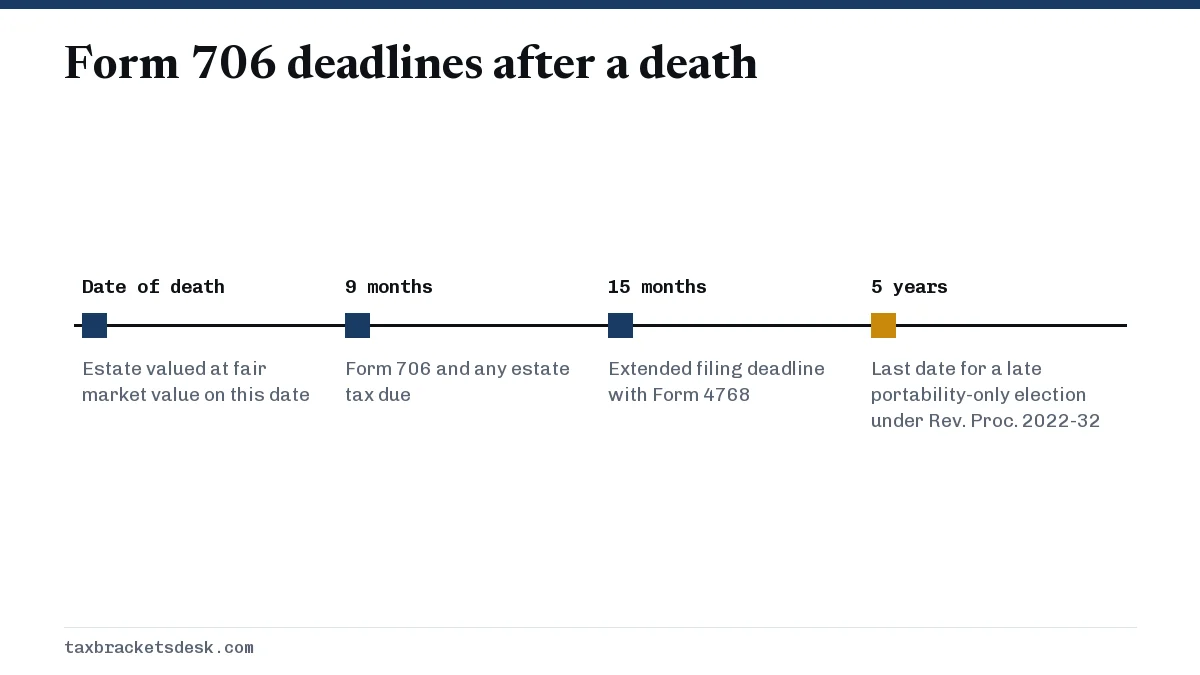
- Due date: 9 months after the date of death.
- Extension: Form 4768 gives an automatic 6-month extension to file. It is a separate request if the estate also needs more time to pay.
- Gross value, not net: the test uses the gross estate, so an estate with large debts or a big marital bequest may still have to file even though it owes no tax.
- Lifetime gifts count: taxable gifts reported on Form 709 are added back, which is why the gift tax limit and the estate exemption are linked.
What the estate tax does not cover
Heirs do not pay federal income tax simply for inheriting. Property received from an estate is treated as held long-term, so a later sale is taxed at the long-term rates explained in the capital gains tax guide. Income the estate earns while it is being settled, such as dividends, is reported on Form 1041 and can be subject to the net investment income tax.
Some states charge their own estate or inheritance tax with exemptions far lower than the federal $15,000,000. Check your state revenue department before assuming no tax is owed. For the other major 2025 law changes, see the One Big Beautiful Bill tax changes.
Common questions
What is the estate tax exemption for a married couple in 2026?
Each spouse has a $15,000,000 exclusion for 2026, so a couple can shelter up to $30,000,000 if the first spouse's executor files Form 706 and elects portability. Without the election, the first spouse's unused exclusion is lost.
Did the estate tax exemption get cut in half in 2026?
No. The One Big Beautiful Bill Act, signed July 4, 2025, amended the law to set the basic exclusion amount at $15,000,000 for 2026, up from $13,990,000 for 2025, with inflation adjustments starting in 2027 (Rev. Proc. 2025-32).
Do heirs pay tax on an inheritance?
Not federal estate tax; that is owed by the estate. Heirs pay income tax later only on income the inherited assets earn or on gain when they sell. A few states do impose an inheritance tax on heirs.
When will the 2027 estate tax exemption be announced?
The IRS usually publishes next-year inflation adjustments in October or November. The 2026 figures came out on October 9, 2025, in Rev. Proc. 2025-32. Until the 2027 revenue procedure is released, the 2027 exemption is not yet announced.
Does life insurance count toward the estate tax limit?
Yes, if the person who died owned the policy or held rights over it. Insurance proceeds are listed by the IRS as part of the gross estate, which is why some families hold large policies in an irrevocable trust.
Sources
- Estate Tax irs.gov
- Instructions for Form 706 irs.gov
- Rev. Proc. 2025-32 irs.gov
- IRS releases tax inflation adjustments for tax year 2026 irs.gov
We check figures against these official pages. Rules change; confirm anything that affects a deadline or payment with the agency before you act.
Tell us what happened
Describe your situation and our editors will use it to improve this guide. If you leave your email, we may reply with a pointer to the right page or official contact. We never share your details.
Related guides
 Capital Gains Tax: Rates, Rules and Worked Examples
Capital gains tax is the federal tax on profit from selling an asset such as stock, a fund, crypto or real estate. For 2026, gain…
Net Investment Income Tax 2026: 3.8% Rate and Thresholds
For 2026, the net investment income tax (NIIT) is 3.8% of the smaller of your net investment income or the amount your modified a…
Tax Changes 2027: What Is New for Your Next Return
The main tax changes in 2027 land on the tax year 2026 return you file that season: a $1,000 ($2,000 joint) charity deduction wit…
One Big Beautiful Bill Tax Changes for Individuals
The One Big Beautiful Bill (Public Law 119-21, signed July 4, 2025) made the seven tax rates and the larger standard deduction pe…