
Capital Gains and Investment Tax
Net investment income tax 2026: who owes the 3.8% NIIT, the thresholds and how it is figured
Short answer
For 2026, the net investment income tax (NIIT) is 3.8% of the smaller of your net investment income or the amount your modified adjusted gross income exceeds $200,000 (single or head of household), $250,000 (married filing jointly) or $125,000 (married filing separately). The thresholds are fixed in law and not indexed for inflation, so they are the same as in every year since 2013. It is figured on Form 8960.
- 01NIIT rate
- 3.8%
- 02MAGI threshold, single or head of household
- $200,000
- 03MAGI threshold, married filing jointly or qualifying surviving spouse
- $250,000
- 04MAGI threshold, married filing separately
- $125,000
- 05Threshold for estates and trusts, 2026
- $16,000 of AGI (start of the top trust bracket)
- 06Form used
- Form 8960, Net Investment Income Tax
What is the net investment income tax?
The net investment income tax is a 3.8% surtax that applies to individuals, estates and trusts with investment income and income above a set threshold. It is charged on top of regular income tax and on top of the 0%, 15% or 20% long-term capital gains rates, according to the IRS NIIT page.
Net investment income means interest, dividends, capital gains, rents, royalties, non-qualified annuities and passive business income, minus the expenses allocable to that income. The tax only reaches the slice of that income that sits above your threshold, so many investors with large portfolios but moderate total income never pay it.
What are the NIIT thresholds for 2026?
For 2026 returns filed in 2027, the NIIT thresholds are $200,000 of modified adjusted gross income (MAGI) for single and head of household filers, $250,000 for joint filers and qualifying surviving spouses, and $125,000 for married filing separately. These are the same dollar amounts that have applied since the tax began in 2013.
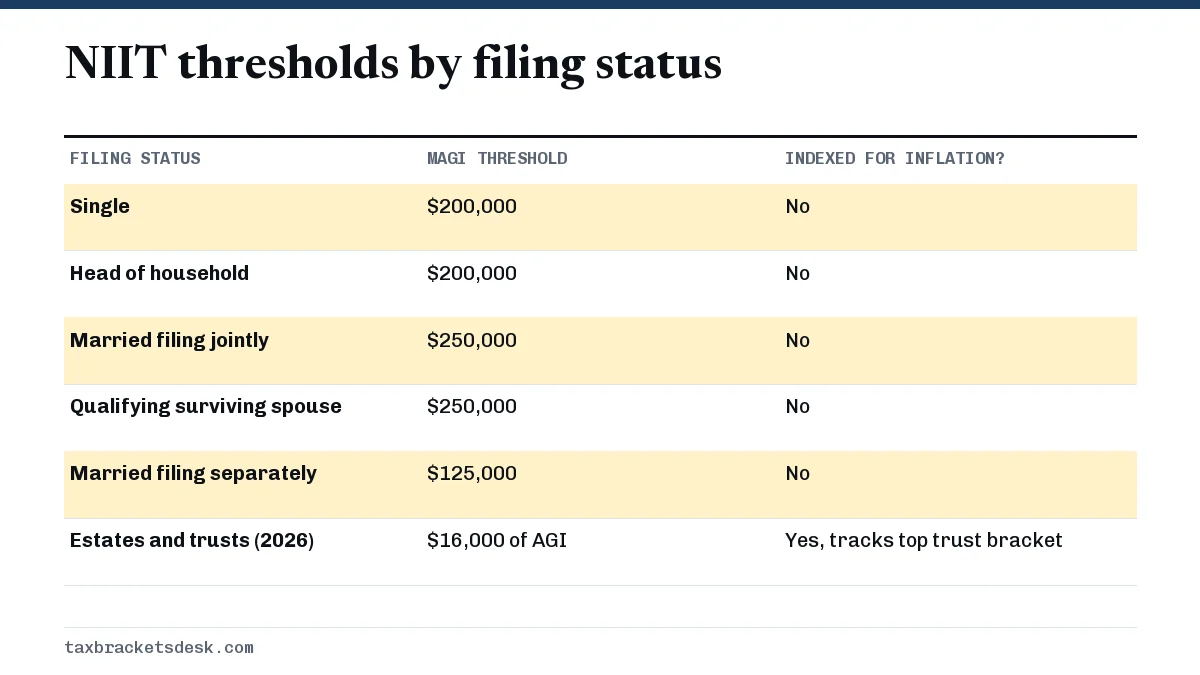
Because the net investment income tax threshold is not indexed, it catches more households every year as wages and asset values rise, while the regular 2026 capital gain rate thresholds move up with inflation. The same three dollar figures are used by the separate 0.9% Additional Medicare Tax on wages, which is a different tax reported on a different form (Form 8959).
What counts as MAGI for the NIIT?
For most people, MAGI for this purpose is simply adjusted gross income from Form 1040. If you live abroad and exclude foreign earned income, you add that excluded amount back, according to the Form 8960 instructions.
What income is subject to the 3.8 percent tax?
| Included in NII | Not included in NII |
|---|---|
| Taxable interest | Wages and salaries |
| Ordinary and qualified dividends | Self-employment income subject to SE tax |
| Capital gains on stocks, funds, crypto, second homes | Social Security benefits |
| Rental and royalty income | Distributions from 401(k)s, IRAs and pensions |
| Non-qualified annuity payouts | Tax-exempt municipal bond interest |
| Passive business income (K-1) | Home sale gain covered by the exclusion |
Two items on the right side still matter. Retirement plan withdrawals are not investment income, but a large 401(k) withdrawal raises your MAGI and can push other investment income over the line. Likewise, gain on a main home above the $250,000 or $500,000 exclusion described on the home sale capital gains page is net investment income.
Dividends are included whether or not they get the lower qualified dividends tax rate. A high-income investor can therefore pay 20% plus 3.8%, or 23.8%, on qualified dividends and long-term gains.
How is the NIIT calculated on Form 8960?
Form 8960 compares two numbers and taxes the smaller one at 3.8%. Individuals complete Parts I, II and lines 13 to 17 of Part III; estates and trusts use lines 18a to 21 instead.
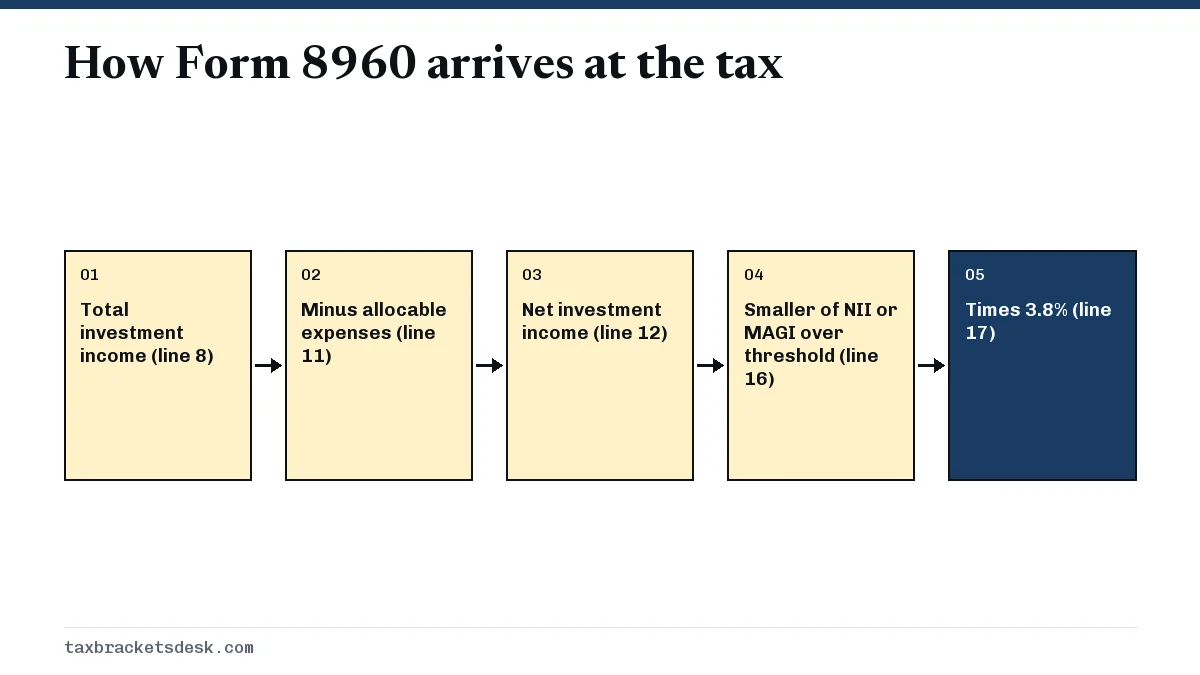
- Lines 1 to 8: add taxable interest, ordinary dividends, annuities, rental and passive income (line 4a), and net gains (line 5a). Line 8 is total investment income.
- Lines 9a to 11: subtract allocable expenses such as investment interest, the share of state and local income tax that relates to investment income, and other investment expenses.
- Line 12: net investment income (not below zero).
- Lines 13 and 14: enter MAGI and your threshold ($200,000, $250,000 or $125,000).
- Lines 15 and 16: take MAGI minus the threshold, then the smaller of that result or line 12.
- Line 17: multiply by 3.8%. This amount flows to Schedule 2, Additional Taxes, and then to Form 1040.
Net investment income tax examples
Single filer just over the threshold
Maria is single with $180,000 of wages and $50,000 of dividends and long-term gains, so her MAGI is $230,000. MAGI exceeds $200,000 by $30,000, which is smaller than her $50,000 of net investment income. Her NIIT is 3.8% of $30,000, or $1,140.
Married couple with a big stock sale
A couple filing jointly has $210,000 of salaries and sells shares for a $120,000 long-term gain, giving MAGI of $330,000. The excess over $250,000 is $80,000, smaller than the $120,000 gain. NIIT is 3.8% of $80,000, or $3,040. Had the gain been $30,000, MAGI would have been $240,000 and they would owe nothing.
Trust that keeps its income
Estates and trusts hit the NIIT far sooner. Their threshold is the income level where the top trust bracket starts, which is $16,000 for 2026 under Rev. Proc. 2025-32. A trust that retains $40,000 of undistributed dividends and has $40,000 of AGI owes 3.8% on $24,000, or $912. Income distributed to beneficiaries is generally taxed on their returns instead. Estates that are large enough to owe estate tax face a separate set of rules, covered on the estate tax exemption page.
How can you reduce or plan for the NIIT?
- Spread large sales across tax years so MAGI stays under the threshold in each year, or offset gains with realized capital losses.
- Hold growth assets inside retirement accounts, where gains and dividends are not net investment income.
- Consider municipal bonds for part of a taxable bond allocation, since tax-exempt interest is excluded.
- Give appreciated shares instead of cash to charity or family; the gain is not realized by you. See the gift tax limit for the $19,000 per-recipient exclusion.
- Check material participation if you own a business or rentals through a partnership or S corporation, because nonpassive business income is excluded.
For how this surtax fits with capital gain rates, loss limits and reporting, see the capital gains tax guide.
Common questions
Does the net investment income tax apply to the sale of my home?
Only on gain above the home sale exclusion. If you qualify for the $250,000 or $500,000 exclusion, the excluded gain is not net investment income. Any taxable gain beyond it counts, as does gain on a second home or rental.
Is the NIIT threshold adjusted for inflation?
No. The $200,000, $250,000 and $125,000 MAGI thresholds are written into the law as fixed dollar amounts and have not changed since 2013. The trust threshold is different because it tracks the top trust bracket, which is indexed.
Do IRA and 401(k) withdrawals count as net investment income?
No. Distributions from qualified retirement plans and IRAs are excluded from net investment income. They do increase MAGI, though, which can cause other investment income to be taxed.
Do nonresident aliens pay the net investment income tax?
No. The Form 8960 instructions state that the NIIT does not apply to nonresident alien individuals. A nonresident married to a U.S. citizen or resident who elects to be treated as a resident may become subject to it.
Is rental income subject to the 3.8% tax?
Usually yes, because most rental activity is passive. It can be excluded when the rentals are part of a trade or business in which you materially participate, which Form 8960 handles as an adjustment on line 4b.
Sources
- Net Investment Income Tax irs.gov
- Instructions for Form 8960 irs.gov
- Form 8960, Net Investment Income Tax irs.gov
- Publication 505, Tax Withholding and Estimated Tax irs.gov
- Rev. Proc. 2025-32 (2026 trust brackets) irs.gov
We check figures against these official pages. Rules change; confirm anything that affects a deadline or payment with the agency before you act.
Tell us what happened
Describe your situation and our editors will use it to improve this guide. If you leave your email, we may reply with a pointer to the right page or official contact. We never share your details.
Related guides
 Capital Gains Tax: Rates, Rules and Worked Examples
Capital gains tax is the federal tax on profit from selling an asset such as stock, a fund, crypto or real estate. For 2026, gain…
Qualified Dividends Tax Rate 2026 vs Ordinary Dividends
The qualified dividends tax rate for 2026 is 0%, 15% or 20%, the same rates that apply to long-term capital gains. A single filer…
Estate Tax Exemption 2026: $15 Million Per Person Explained
The federal estate tax exemption for 2026 is $15,000,000 per person, up from $13,990,000 for 2025, under the One Big Beautiful Bi…
Additional Medicare Tax: 0.9% Over $200,000 Explained
Additional Medicare Tax is a 0.9% tax on Medicare wages and self-employment income above $200,000 for single and head of househol…
Capital Gains on Home Sale: $250,000 Exclusion Rules
Most people owe no capital gains on a home sale: if you owned and lived in the home as your main home for at least 24 months of t…