
Capital Gains and Investment Tax
Long-term capital gains tax: the holding period, the math and the rates
Short answer
Long term capital gains tax is the lower federal tax on profit from assets held more than one year: 0%, 15% or 20% depending on taxable income, with special maximums of 25% and 28% for some real estate, collectibles and small business stock (IRS Tax Topic 409). The holding period is counted from the day after purchase through the day of sale.
- 01Holding period needed
- More than one year
- 02Counting rule
- Day after purchase through the sale date
- 03Standard long-term rates
- 0%, 15% or 20%
- 04Collectibles and section 1202 stock
- 28% maximum
- 05Unrecaptured section 1250 gain
- 25% maximum
- 06Inherited property
- Always treated as long-term
What is long-term capital gains tax?
Long term capital gains tax is the tax on a profit from selling a capital asset you held for more than one year. Instead of your ordinary income tax rate, the gain gets a rate of 0%, 15% or 20%, set by your taxable income and filing status (IRS Tax Topic 409).
The lower rate is the whole reason the holding period matters. A single filer in the 24% bracket who sells after 13 months typically pays 15% on the gain; the same sale after 11 months would be taxed at 24%. This page explains how the clock works, how the gain is measured and how the rates are applied. For the full list of dollar thresholds, see the 2026 capital gains tax rate page.
How long do I need to hold an asset for long-term capital gains?
You must hold the asset more than one year. The IRS counts the holding period from the day after you acquired the asset up to and including the day you sold it (IRS Tax Topic 409). Holding for exactly one year is not enough.
| Bought (trade date) | Sold | Result |
|---|---|---|
| June 3, 2025 | June 3, 2026 | Short-term: exactly one year |
| June 3, 2025 | June 4, 2026 | Long-term: more than one year |
| February 28, 2025 | March 1, 2026 | Long-term |
| Inherited any date | Any date | Long-term regardless of time held |
For stocks and funds, use the trade date, not the settlement date, for both the purchase and the sale. Your Form 1099-B shows the date acquired and date sold for each lot, and brokers split the lots into short-term and long-term sections.
Holding period exceptions
- Inherited property is treated as long-term even if you sell it days after receiving it (IRS Publication 550).
- Gifts generally keep the donor's holding period, so shares a parent held for five years are long-term for you from day one.
- Reinvested dividends buy new shares with their own purchase dates, so a fund you have owned for years can contain some short-term lots.
How is a long-term capital gain calculated?
Your gain equals the amount realized minus your adjusted basis. The amount realized is the sale price minus selling costs such as commissions. Basis is usually what you paid plus purchase costs, adjusted for items like reinvested dividends and return-of-capital distributions.
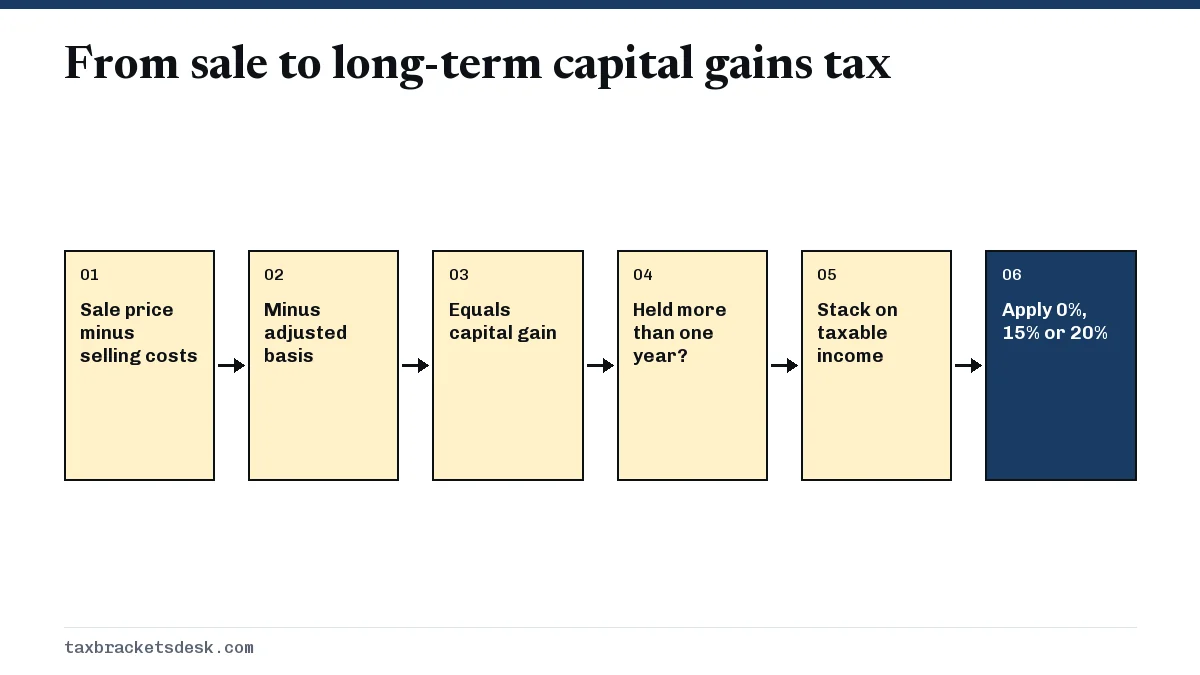
Worked example
- Purchase: 100 shares at $40 plus a $5 fee, for a basis of $4,005.
- Sale: 100 shares at $100 minus a $5 fee, for an amount realized of $9,995.
- Gain: $9,995 minus $4,005 = $5,990.
- Holding period: bought April 7, 2023, sold May 12, 2026, so the gain is long-term.
- Rate: taken from the long term capital gains tax brackets for the year of sale based on total taxable income.
Long-term gains and losses are netted against each other first, then combined with short-term results on Schedule D (Form 1040). Only a net long-term gain that exceeds any net short-term loss gets the preferential rates.
Long term capital gains tax brackets: how the rate is applied
The rate is applied in layers. Ordinary income fills the bottom of your taxable income, and long-term gains sit on top. Each part of the gain is taxed at the rate for the band it lands in, which is why one sale can be taxed partly at 0% and partly at 15%.
| Filing status | 0% | 15% | 20% |
|---|---|---|---|
| Single | $0 to $49,450 | $49,451 to $545,500 | Over $545,500 |
| Married filing jointly | $0 to $98,900 | $98,901 to $613,700 | Over $613,700 |
| Head of household | $0 to $66,200 | $66,201 to $579,600 | Over $579,600 |
Tax software does this layering with the Qualified Dividends and Capital Gain Tax Worksheet in the Form 1040 instructions. If you have 28% or 25% gain, the longer Schedule D Tax Worksheet is used instead.
Is the 0% long-term capital gains rate real?
Yes. Any long-term gain that fits under the 0% ceiling is taxed at zero federal income tax, and it is common among retirees and people between jobs. In 2026 the ceiling is $98,900 of taxable income for a married couple filing jointly.
Example: a retired couple has $50,000 of taxable income from a pension and IRA withdrawals after their deductions. They sell a fund held ten years for a $40,000 long-term gain. Total taxable income is $90,000, below $98,900, so the whole $40,000 gain is taxed at 0%.
When do the special 25% and 28% rates apply?
Two kinds of long-term gain have their own maximum rates, set out in IRS Tax Topic 409. They are maximums: if your ordinary bracket is lower, the lower rate applies.
- 28% maximum: gains on collectibles such as art, antiques, stamps, coins and precious metals, and the taxable part of gain on qualified small business stock under section 1202.
- 25% maximum: unrecaptured section 1250 gain, which is the part of a gain on depreciable real estate, such as a rental house, that reflects depreciation you claimed or could have claimed.
Example: you sell a rental property held eight years for a $90,000 gain, and you claimed $30,000 of depreciation. Up to $30,000 of the gain is unrecaptured section 1250 gain taxed at no more than 25%, and the other $60,000 uses the normal 0%, 15% or 20% bands.
How to plan the sale date
The sale date decides both the holding period and the tax year. A few days or a few weeks can change the rate on the whole gain.
- Check the acquisition date for each lot in your brokerage account before selling; different lots of the same fund can have different dates.
- If a lot is a few weeks short of the one-year mark, compare the tax saved by waiting with the market risk of holding longer.
- If you expect lower income next year, such as the first year of retirement, a sale on January 2 instead of December 31 moves the gain into that lower-income year.
- Pair gains with losses from the same year to reduce the net gain; the rules for losses and the $3,000 limit are in the capital gains tax guide.
- If the gain is large, plan estimated payments; the IRS generally expects them when you will owe $1,000 or more at filing (IRS Publication 505).
Sales held one year or less follow the ordinary-rate rules explained on the short-term capital gains tax page. Qualified dividends share the same brackets, as the qualified dividends tax rate page shows.
Common questions
How long is long-term capital gains?
More than one year. Count from the day after you bought the asset through the day you sold it; a sale exactly one year later is still short-term.
Is long-term capital gains tax 15%?
For most investors, yes. The 15% rate covers 2026 taxable income from $49,451 to $545,500 for single filers and from $98,901 to $613,700 for joint filers. Lower incomes can pay 0% and the highest pay 20%.
Do long-term capital gains count toward my tax bracket?
They count toward taxable income and fill the top of your stack, but they are taxed at their own 0%, 15% or 20% rates. They do not raise the rate on your wages.
Is a house sale a long-term capital gain?
If you owned it more than one year, any taxable gain is long-term. Many homeowners owe nothing because of the $250,000 or $500,000 exclusion for a main home.
Do I pay long-term capital gains tax if I sell and buy another stock?
Yes. Selling in a taxable account is a taxable event even if you reinvest the proceeds immediately. The new purchase starts a new holding period.
Sources
- Tax Topic 409, Capital gains and losses irs.gov
- Rev. Proc. 2025-32 (tax year 2026 inflation adjustments) irs.gov
- Publication 550, Investment Income and Expenses irs.gov
- Publication 505, Tax Withholding and Estimated Tax irs.gov
- Publication 915, Social Security and Equivalent Railroad Retirement Benefits irs.gov
We check figures against these official pages. Rules change; confirm anything that affects a deadline or payment with the agency before you act.
Tell us what happened
Describe your situation and our editors will use it to improve this guide. If you leave your email, we may reply with a pointer to the right page or official contact. We never share your details.
Related guides
 Capital Gains Tax: Rates, Rules and Worked Examples
Capital gains tax is the federal tax on profit from selling an asset such as stock, a fund, crypto or real estate. For 2026, gain…
Form 1099-DA: What Crypto Brokers Report for 2025 and 2026
Form 1099-DA is the information return crypto brokers send for sales and exchanges of digital assets. Forms for 2025 sales show g…
Short-Term Capital Gains Tax: Taxed as Ordinary Income
Short term capital gains tax applies to profit on assets held one year or less, and the gain is taxed as ordinary income at your…
Capital Gains Tax Rate 2026: 0%, 15%, 20% Income Brackets
The capital gains tax rate for 2026 is 0% on long-term gains that fit under $49,450 of taxable income for single filers ($98,900…
Qualified Dividends Tax Rate 2026 vs Ordinary Dividends
The qualified dividends tax rate for 2026 is 0%, 15% or 20%, the same rates that apply to long-term capital gains. A single filer…
Tax on Social Security Benefits: 50% and 85% Rules
Federal tax on Social Security benefits applies only when your other income plus half of your benefits is more than $25,000 (sing…