
Capital Gains and Investment Tax
Gift tax limit 2026: how much you can give without filing or paying tax
Short answer
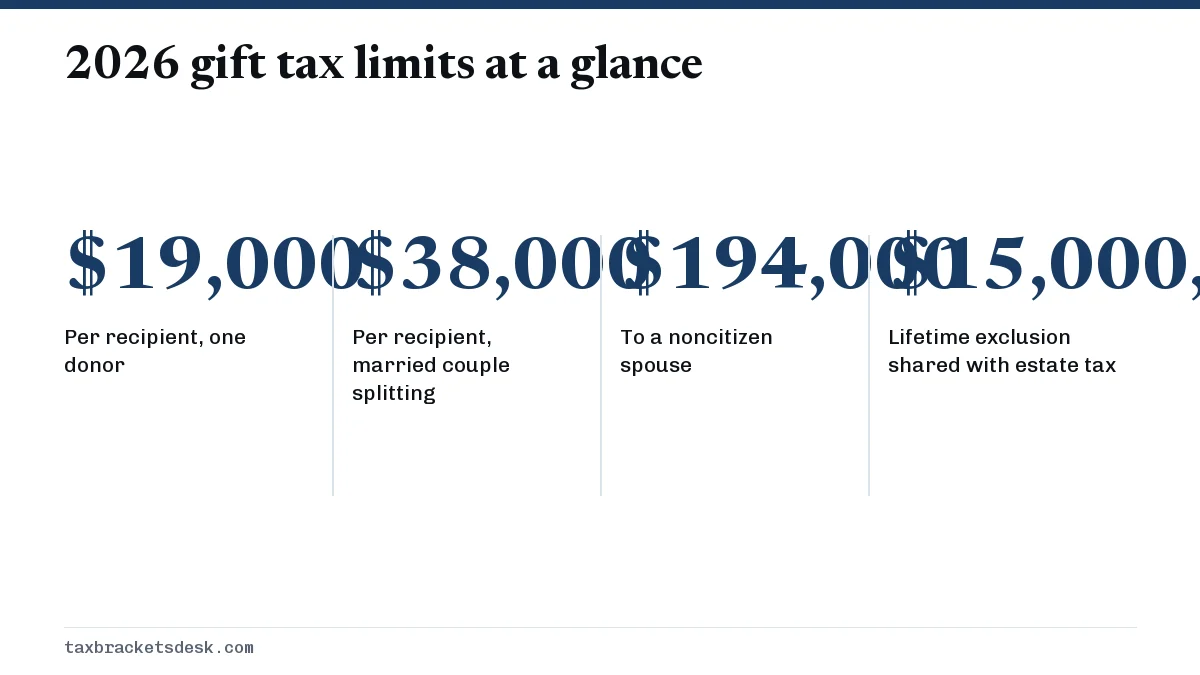
The gift tax limit for 2026 is $19,000 per recipient, the same annual gift exclusion as 2025. You can give that much to any number of people without filing a gift tax return; a married couple who elects gift splitting can give $38,000 per recipient. Larger gifts require Form 709 but rarely cost tax, because they draw on a $15,000,000 lifetime exclusion.
- 01Annual exclusion per recipient, 2026
- $19,000
- 02Annual exclusion per recipient, 2025
- $19,000
- 03Married couple splitting gifts, 2026
- $38,000 per recipient
- 04Gifts to a noncitizen spouse, 2026
- $194,000 ($190,000 in 2025)
- 05Lifetime basic exclusion, 2026
- $15,000,000
- 06Form 709 for 2026 gifts due
- April 15, 2027 (extended with your income tax extension)
What is the gift tax limit for 2026?
The gift tax limit for 2026 is $19,000 per recipient per calendar year. This annual gift exclusion is the amount you can give one person in cash or property without reporting it to the IRS, and it resets every January 1 (IRS gift tax FAQs).
The limit applies per recipient, not in total. A grandmother can give $19,000 to each of five grandchildren in 2026, $95,000 in all, with no return and no tax. The giver, called the donor, is the one responsible for any gift tax; the recipient does not report a gift as income.
Gift tax limit 2025 vs 2026
| Item | 2024 | 2025 | 2026 |
|---|---|---|---|
| Annual exclusion per recipient | $18,000 | $19,000 | $19,000 |
| Couple splitting gifts | $36,000 | $38,000 | $38,000 |
| Lifetime basic exclusion | $13,610,000 | $13,990,000 | $15,000,000 |
The per-recipient amount did not change between 2025 and 2026, while the lifetime exclusion rose by more than $1 million under Rev. Proc. 2025-32. The 2027 annual gift exclusion is not yet announced. The IRS normally publishes it with the other inflation adjustments in October or November; the 2027 tax changes page will list it once released.
Which gifts do not count toward the limit?
Several transfers are excluded entirely and do not use up the $19,000 annual gift exclusion:
- Tuition paid directly to a school. Only tuition counts, and the check must go to the educational institution, not the student.
- Medical bills paid directly to the doctor, hospital or other provider.
- Gifts to your spouse who is a U.S. citizen, through the unlimited marital deduction. For a spouse who is not a citizen, the 2026 limit is $194,000.
- Gifts to political organizations for their use.
- Qualifying charitable gifts. These may also be deductible on your income tax return; see charitable deduction limits.
Can spouses combine gifts? How gift splitting works
Yes. Married couples can elect gift splitting, which treats a gift made by one spouse as made half by each, so together they can give $38,000 per recipient in 2026 (Form 709 instructions). The election is made on Form 709 and the other spouse signs a notice of consent.
Splitting always requires a return, even when no tax is owed. In most cases both spouses file their own Form 709. Only the donor spouse files when that spouse gave no more than $38,000 of present-interest gifts to each recipient, or in the second narrow exception described in the instructions.
Example: helping with a down payment
Parents give their daughter $50,000 in 2026 from the father's account and elect to split it. Each parent is treated as giving $25,000, which is $6,000 over each person's $19,000 exclusion. Because the father's gift exceeded $38,000, both parents file Form 709. Neither owes tax: each simply reports $6,000 of taxable gift that reduces their $15,000,000 lifetime exclusion.
Do I have to file a gift tax return?
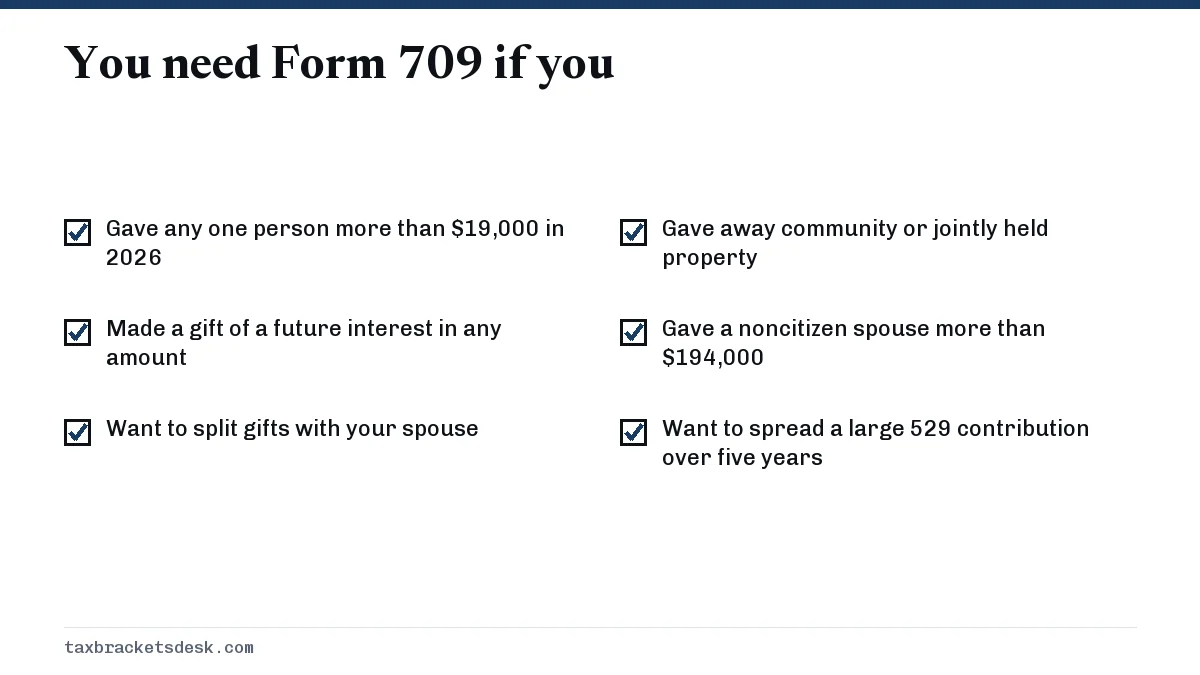
You must file Form 709, United States Gift (and Generation-Skipping Transfer) Tax Return, if any of these apply for the year:
- You gave one person (other than your spouse) more than the annual exclusion: over $19,000 for 2026.
- You gave a gift of a future interest, such as property placed in a trust that the recipient cannot use until later, in any amount. Future interests do not qualify for the annual exclusion.
- You and your spouse want to split gifts.
- You gave community property or jointly held property to someone.
- You gave a noncitizen spouse more than $194,000 in 2026.
Form 709 for 2026 gifts is due April 15, 2027. Filing Form 4868 to extend your income tax return also extends the gift tax return. If you do not extend your income tax return, Form 8892 gives a separate six-month extension for Form 709. An extension to file is not an extension to pay any gift tax due.
How the lifetime gift tax limit connects to estate tax
Gift and estate taxes share one lifetime exclusion: $15,000,000 per person for 2026. Taxable gifts above the annual exclusion are subtracted from it, and whatever remains at death shelters the estate. Actual gift tax, at rates up to 40%, is due only after lifetime taxable gifts exceed that amount. The estate tax exemption page explains how the remainder is applied at death and how portability works for couples.
Gifts of stock and capital gains
Gifts are not deductible to the giver (except charitable gifts), and the recipient takes over your cost basis. If you give shares you bought for $4,000 that are now worth $19,000, the recipient who sells pays tax on $15,000 of gain, using the rates in 2026 capital gains tax rates. Giving appreciated shares to a child can also trigger the kiddie tax when the child sells. The capital gains tax guide covers holding periods for gifted property.
Common questions
How much can I gift in 2026 without paying taxes?
You can give up to $19,000 to each person in 2026 without filing a return. Above that you file Form 709, but you pay no gift tax until your lifetime taxable gifts pass $15,000,000.
Does the person receiving a gift have to pay tax on it?
No. The donor is responsible for gift tax, and gifts are not taxable income to the recipient. The recipient may owe capital gains tax later if they sell gifted property for more than the donor's basis.
Can I give $19,000 to my son and $19,000 to his wife?
Yes. The exclusion is per recipient, so gifts of $19,000 each to two people, $38,000 in total, stay within the limit. With your spouse also giving $19,000 to each, a couple can move $76,000 to the pair in 2026 without using lifetime exclusion.
What happens if I forgot to file Form 709?
File the missing return as soon as you notice, using the form for the year of the gift. If no tax was owed because the gift was covered by your lifetime exclusion, the return is still needed to record how much of that exclusion you used, which your executor will need for Form 706.
Is paying my grandchild's college tuition a taxable gift?
Not if you pay the school directly. Tuition paid straight to an eligible educational institution is excluded without limit and does not count against the $19,000 annual exclusion. Money given to the grandchild to pay tuition does count.
What is the gift tax limit for 2027?
The 2027 annual exclusion has not been announced as of October 20, 2026; the IRS normally publishes it with the other inflation adjustments in October or November. Until then the latest official figure is $19,000 per recipient for 2026. The lifetime exclusion of $15,000,000 for 2026 is also adjusted for inflation from 2027.
Sources
- Frequently asked questions on gift taxes irs.gov
- Instructions for Form 709 irs.gov
- Rev. Proc. 2025-32 (2026 gift exclusion amounts) irs.gov
- IRS releases tax inflation adjustments for tax year 2026 irs.gov
We check figures against these official pages. Rules change; confirm anything that affects a deadline or payment with the agency before you act.
Tell us what happened
Describe your situation and our editors will use it to improve this guide. If you leave your email, we may reply with a pointer to the right page or official contact. We never share your details.
Related guides
 Capital Gains Tax: Rates, Rules and Worked Examples
Capital gains tax is the federal tax on profit from selling an asset such as stock, a fund, crypto or real estate. For 2026, gain…
Capital Gains Tax Rate 2026: 0%, 15%, 20% Income Brackets
The capital gains tax rate for 2026 is 0% on long-term gains that fit under $49,450 of taxable income for single filers ($98,900…
Kiddie Tax 2026: Thresholds, Rules and How It Is Figured
The kiddie tax makes a child's unearned income above $2,700 taxable at the parent's marginal rate instead of the child's lower ra…
Charitable Deduction Limits 2026: The New 0.5% Floor
For 2026, itemizers can deduct charitable gifts only to the extent they exceed 0.5% of AGI, a new floor, and cash gifts to public…