
American Opportunity Credit: up to $2,500 per student, $1,000 refundable
Short answer
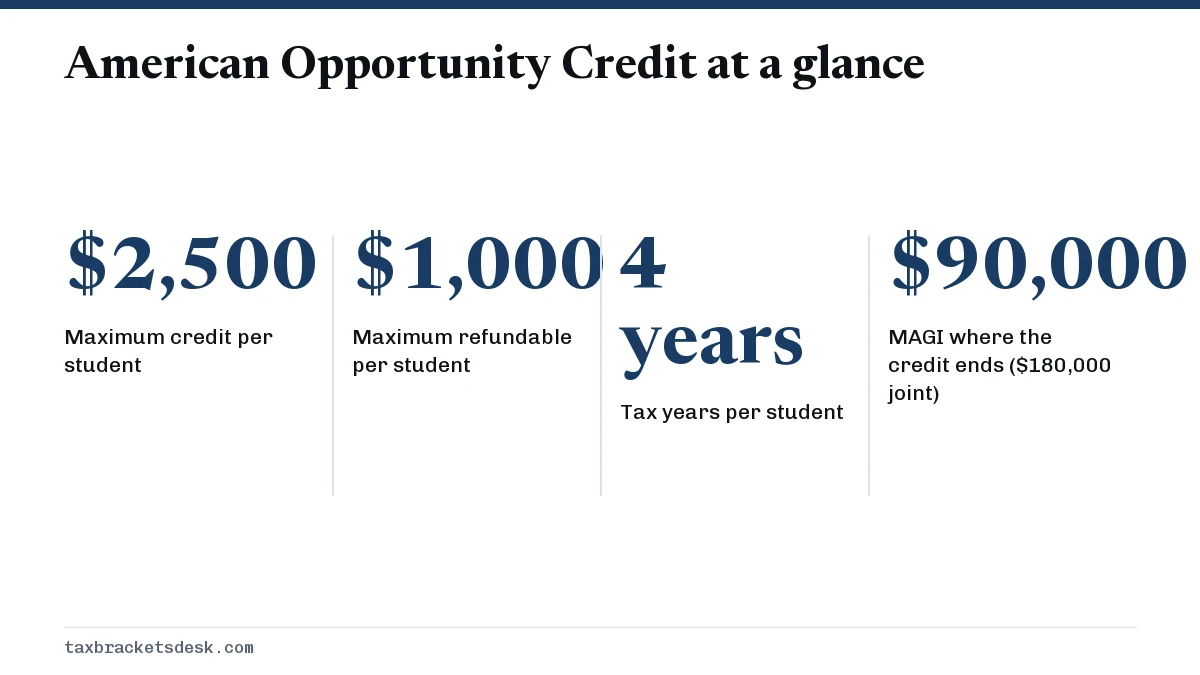
The American Opportunity Credit (AOTC) is worth up to $2,500 per eligible student each year: 100% of the first $2,000 of tuition, fees and course materials plus 25% of the next $2,000. Up to 40%, or $1,000, is refundable. It covers only the first four years of college and phases out between $80,000 and $90,000 of MAGI ($160,000 to $180,000 joint).
- 01Maximum credit per student
- $2,500
- 02Refundable portion
- 40%, up to $1,000
- 03Phaseout (single, HoH)
- MAGI $80,000 to $90,000
- 04Phaseout (married filing jointly)
- MAGI $160,000 to $180,000
- 05Years available per student
- 4 tax years
- 06New for 2026
- Valid SSN by the due date and the school's EIN on Form 8863
How much is the American Opportunity Credit?
The American Opportunity Credit pays up to $2,500 per eligible student per year. It is figured as 100% of the first $2,000 of adjusted qualified education expenses plus 25% of the next $2,000, so a family needs $4,000 of qualifying costs to reach the maximum (IRS Publication 970).
The AOTC is a per-student credit, which sets it apart from the lifetime learning credit's per-return cap. Parents paying for two undergraduates who both qualify can claim up to $5,000.
| Qualified expenses | 100% part | 25% part | Credit |
|---|---|---|---|
| $1,500 | $1,500 | $0 | $1,500 |
| $2,000 | $2,000 | $0 | $2,000 |
| $3,000 | $2,000 | $250 | $2,250 |
| $4,000 or more | $2,000 | $500 | $2,500 |
How much of the AOTC is refundable?
Forty percent of the credit is refundable, which caps the refundable part at $1,000 per student. The other 60% can only reduce income tax you owe. A refundable credit is paid to you even when your tax is zero, so a student or parent with little tax can still receive up to $1,000 per student.
Worked example: a single parent has $4,000 of qualified expenses and a full $2,500 credit. Income tax before credits is $600. The refundable $1,000 is paid regardless; the nonrefundable $1,500 is limited to the $600 of tax. Total benefit: $1,600, and the remaining $900 of the nonrefundable part is lost, not carried forward.
What is the American Opportunity Credit income limit?
The credit phases out between $80,000 and $90,000 of modified adjusted gross income (MAGI) for single, head of household and qualifying surviving spouse filers, and between $160,000 and $180,000 for married couples filing jointly. At $90,000 or more ($180,000 joint) no credit is allowed. Married filing separately filers cannot claim it at all.
Inside the range, the credit shrinks in proportion to how far MAGI is from the top. For most people MAGI is the AGI on Form 1040; people excluding foreign income add that back.
| Filing status | MAGI | Share kept | Credit |
|---|---|---|---|
| Single | $80,000 | 100% | $2,500 |
| Single | $84,000 | 60% | $1,500 |
| Married filing jointly | $170,000 | 50% | $1,250 |
| Married filing jointly | $180,000 | 0% | $0 |
The share kept is (upper limit minus MAGI) divided by $10,000, or by $20,000 on a joint return. Because the thresholds are low compared with the 22% and 24% brackets, it helps to know what tax bracket you are in before assuming the credit applies.
American Opportunity Credit eligibility: who and what qualifies
You can claim the credit for yourself, your spouse or a dependent you list on your return. Each student must meet all of these tests for the year, per Publication 970, Table 2-1:
- Had not completed the first four years of postsecondary education at the start of the year, as determined by the school.
- Enrolled at least half-time for at least one academic period beginning in the year.
- Pursuing a degree or other recognized education credential.
- No federal or state felony drug conviction as of the end of the year.
- The AOTC has not already been claimed for this student for four earlier tax years.
Qualified expenses
Tuition, required enrollment fees and course materials the student needs, such as books, supplies and equipment, count whether or not they are bought from the school. Room and board, insurance, medical costs and transportation do not. Expenses paid with tax-free scholarships, Pell grants or employer aid must be subtracted first.
Four-year limit and the half-time rule
A student who started college with dual-enrollment credits may reach the four-year mark early because the school, not the calendar, decides the year level. A graduate student never qualifies for the AOTC but may use the lifetime learning credit instead.
New 2026 rules: valid SSN and the school's EIN
Starting with 2026 returns, filed in the 2027 season, the person claiming the AOTC needs a Social Security number valid for work and issued before the return's due date, including extensions. When a parent claims the credit for a child, the student also needs a valid SSN (Pub. 970; Pub. 505). An ITIN no longer works for this credit.
You must also enter the school's employer identification number (EIN) on Form 8863. It usually appears on Form 1098-T, Tuition Statement. If a claim is rejected because the EIN is missing, correct Form 8863 and resubmit rather than dropping the credit.
How to claim the AOTC on Form 8863
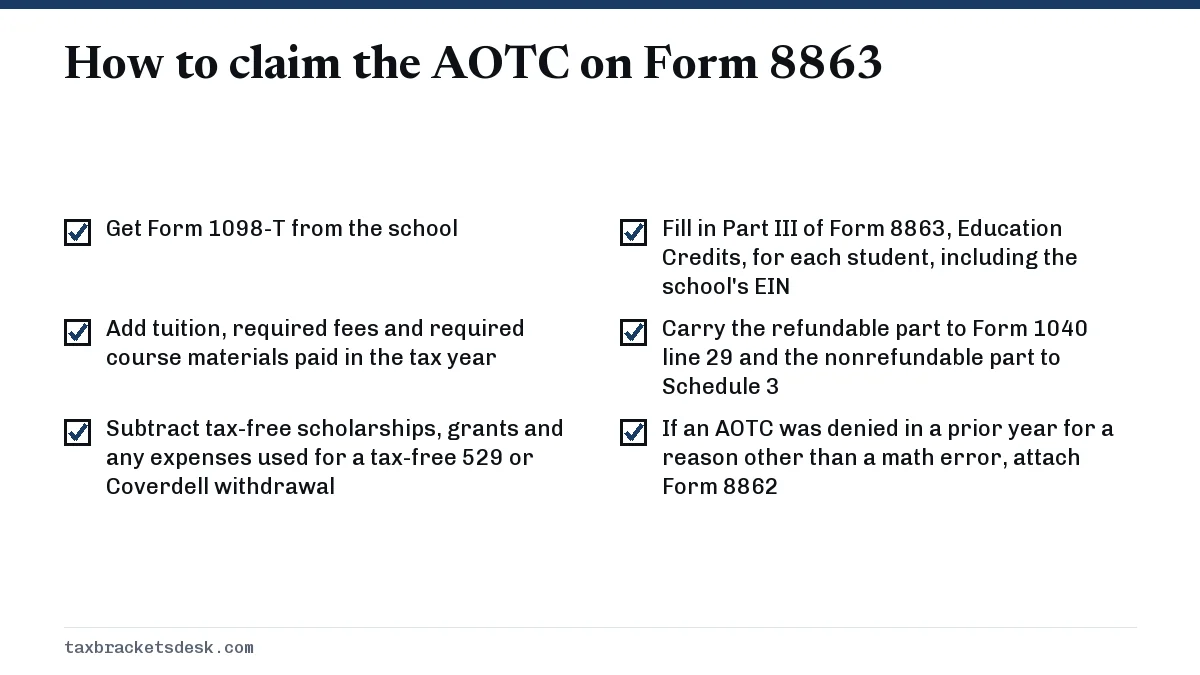
- Get Form 1098-T from the school. Schools generally must send it by January 31; compare it with your own payment records, since Box 1 may not match what you paid in the calendar year.
- Add tuition, required fees and required course materials paid in the tax year, including payments for an academic period starting in the first three months of the next year.
- Subtract tax-free scholarships, grants and any expenses used for a tax-free 529 or Coverdell withdrawal.
- Fill in Part III of Form 8863, Education Credits, for each student, including the school's EIN.
- Carry the refundable part to Form 1040 line 29 and the nonrefundable part to Schedule 3.
- If an AOTC was denied in a prior year for a reason other than a math error, attach Form 8862, Information To Claim Certain Credits After Disallowance.
Compare the AOTC with other credits you may claim in the same year in our education tax credits overview. Families claiming several credits can check the combined effect with the tax refund calculator.
Step by step
Collect Form 1098-T
Get the Tuition Statement from the school and your own payment records.
Total qualified expenses
Add tuition, required fees and required course materials paid during the year.
Subtract tax-free aid
Remove scholarships, grants and amounts used for tax-free 529 or Coverdell withdrawals.
Complete Form 8863
Fill in Part III for each student with the school's EIN, then Parts I and II.
Transfer the totals
Put the refundable part on Form 1040 and the nonrefundable part on Schedule 3.
Common questions
Can I claim the American Opportunity Credit for a fifth year of college?
No. The AOTC is limited to four tax years per student and to students who had not finished four years of postsecondary education by the start of the year. A fifth-year student can use the lifetime learning credit instead.
Can a student claim the AOTC if the parents claim them as a dependent?
No. If the student is listed as a dependent on the parents' return, only the parents can claim the credit, even when the student paid the tuition. Expenses the student pays are treated as paid by the parents.
Is the AOTC income limit based on AGI or MAGI?
MAGI. For most filers it equals AGI; people who exclude foreign earned income or certain territory income add those amounts back.
Why did I get only $1,000 from the American Opportunity Credit?
Most often because your tax before credits was zero, so only the refundable 40% was paid. The nonrefundable part cannot exceed the tax you owe.
Do books count for the AOTC if I bought them on Amazon?
Yes, if the course requires them. Course materials count for the AOTC whether or not they are bought from the school, unlike the lifetime learning credit rule.
Can I claim the AOTC and the lifetime learning credit for the same student?
Not in the same year. You pick one credit per student per year, though you can use the AOTC for one child and the lifetime learning credit for another.
Sources
- Publication 970 (2025), Tax Benefits for Education irs.gov
- Publication 505 (2026), Tax Withholding and Estimated Tax irs.gov
We check figures against these official pages. Rules change; confirm anything that affects a deadline or payment with the agency before you act.
Tell us what happened
Describe your situation and our editors will use it to improve this guide. If you leave your email, we may reply with a pointer to the right page or official contact. We never share your details.
Related guides
 Education Tax Credits and Other Credits: 2026 Amounts
There are two federal education tax credits for 2026: the American Opportunity Credit, worth up to $2,500 per student with $1,000…
Lifetime Learning Credit: Amount, Income Limit and Rules
The lifetime learning credit (LLC) equals 20% of the first $10,000 of qualified tuition and required fees, for a maximum of $2,00…
EV Tax Credit 2026: What Changed After September 30, 2025
There is no EV tax credit for a vehicle acquired in 2026: the new ($7,500), used ($4,000) and commercial clean vehicle credits en…
Saver's Credit 2026: Income Limits and Credit Rates
The saver's credit for 2026 equals 50%, 20% or 10% of up to $2,000 you put into an IRA, 401(k) or similar plan ($4,000 for a marr…