
Energy tax credits 2026: the home energy credits ended on December 31, 2025
Short answer
There are no new home energy tax credits for 2026: the Residential Clean Energy Credit (solar, batteries, geothermal) and the Energy Efficient Home Improvement Credit (heat pumps, windows, insulation) do not apply to property placed in service after December 31, 2025. Work finished in 2025 is still claimed on Form 5695 with your 2025 return, and unused solar credit can carry forward to 2026.
- 01Last day to place property in service
- December 31, 2025
- 02Residential clean energy credit rate (2022 to 2025)
- 30% of cost, no annual cap
- 03Home improvement credit cap (2025)
- $3,200 per year
- 04Form to claim 2025 work
- Form 5695, Residential Energy Credits
- 05Home EV charger credit
- Placed in service before July 1, 2026
Are there energy tax credits in 2026?
No. For the 2026 tax year there is no federal credit for new solar panels, heat pumps, insulation, windows or home batteries. The One Big Beautiful Bill Act (Public Law 119-21, signed July 4, 2025) moved the end date for both household energy credits to December 31, 2025, and IRS Publication 505 (2026) lists them under credits that "have expired" for 2026 (Pub. 505).
The two credits that ended are the Residential Clean Energy Credit (section 25D), which covered 30% of the cost of solar, wind, geothermal, fuel cell and battery storage property, and the Energy Efficient Home Improvement Credit (section 25C), which covered 30% of qualifying upgrades such as heat pumps, exterior doors and home energy audits, up to $3,200 a year.
The test is the date the property was placed in service, meaning installed and ready to use. A deposit or a signed contract in 2025 does not count if the installer finished in 2026. The IRS says the clean energy credit is claimed "for the tax year when the property is installed, not merely purchased" (IRS, Residential Clean Energy Credit).
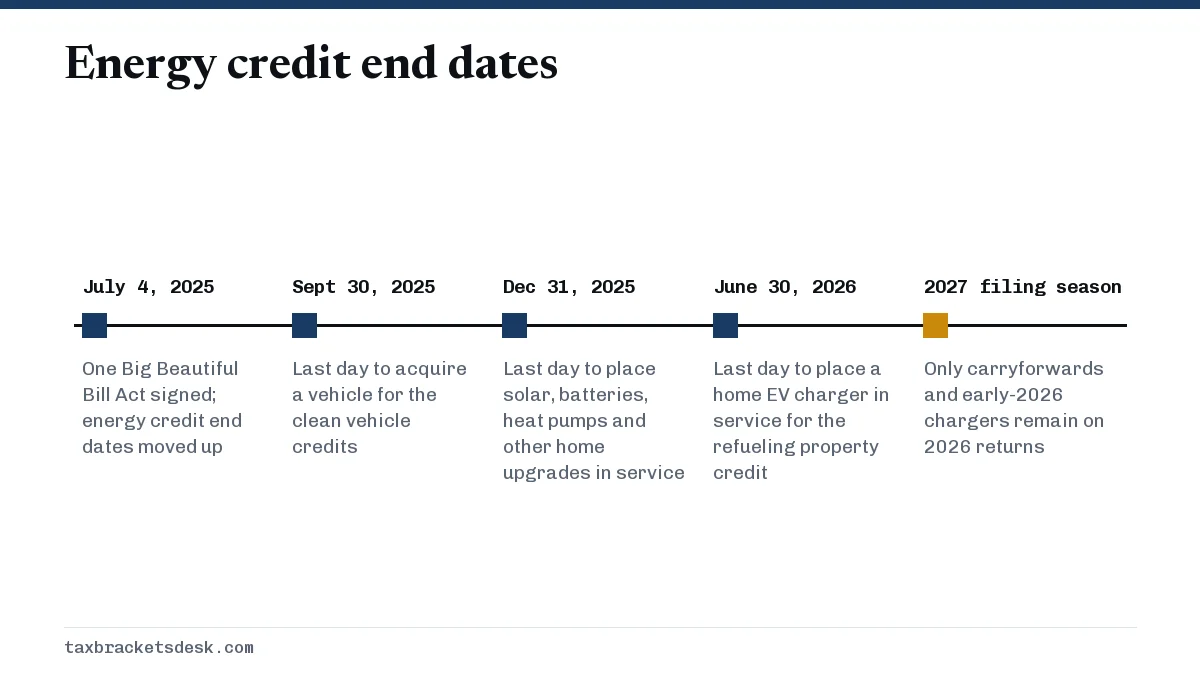
When did the home energy credits end, credit by credit?
Each energy-related credit has its own cutoff. The table below shows the date that controls eligibility and the form used for the last eligible year. Vehicle credits are covered in detail on our EV tax credit page.
| Credit | What it covered | Cutoff | Form |
|---|---|---|---|
| Residential Clean Energy Credit (25D) | Solar panels, solar water heaters, wind, geothermal heat pumps, fuel cells, batteries | Placed in service by Dec 31, 2025 | Form 5695 |
| Energy Efficient Home Improvement Credit (25C) | Heat pumps, water heaters, insulation, windows, doors, energy audits | Placed in service by Dec 31, 2025 | Form 5695 |
| New, used and commercial clean vehicle credits | Electric and fuel cell vehicles | Acquired by Sept 30, 2025 | Form 8936 |
| Alternative Fuel Vehicle Refueling Property Credit | Home EV chargers in eligible census tracts | Placed in service by June 30, 2026 | Form 8911 |
How to claim the residential clean energy credit for a 2025 install
If your system was finished in 2025, the credit is still yours on the 2025 return. The residential clean energy credit equals 30% of qualified costs, including labor for onsite preparation and installation, with no annual or lifetime dollar limit except for fuel cells, which are capped at $500 per half kilowatt of capacity (IRS).
- Collect the final invoice showing the installation completion date and the total cost, including permits and labor.
- Keep the manufacturer certification or product specification sheet for each component in your tax records.
- Complete Part I of Form 5695, Residential Energy Credits, and carry the result to Schedule 3 (Form 1040).
- If the credit is larger than your tax, Form 5695 figures the unused amount to carry forward to your 2026 return.
- If you already filed a 2025 return without the credit, file Form 1040-X with Form 5695 attached.
Worked example: a $24,000 solar system finished in November 2025
A household pays $24,000 for rooftop solar plus a battery, completed on November 12, 2025. The credit is 30% x $24,000 = $7,200. Their 2025 federal income tax before credits is $4,000, so the credit wipes out that $4,000 and the remaining $3,200 carries forward to the 2026 return filed in 2027.
Claiming the energy efficient home improvement credit for 2025 work
The home improvement credit follows tighter limits and has no carryforward, so any amount above your tax is lost. For 2025 it was 30% of qualified costs, capped as follows (IRS, Energy Efficient Home Improvement Credit):
- $2,000 per year for qualified heat pumps, heat pump water heaters, biomass stoves and biomass boilers.
- $1,200 per year combined for other items, within which exterior doors are limited to $250 each and $500 total, windows and skylights to $600, and a home energy audit to $150.
- $3,200 overall maximum per year.
For property placed in service in 2025, each item also needs the manufacturer's Qualified Manufacturer Identification Number (QMID) reported on Form 5695. Ask your installer for it before you file; without it the IRS says no credit is allowed for that item.
Worked example: heat pump plus windows
A homeowner installed a $9,000 air-source heat pump and $2,500 of qualifying windows in October 2025. The heat pump credit is 30% x $9,000 = $2,700, capped at $2,000. The window credit is 30% x $2,500 = $750, capped at $600. Total credit: $2,600, usable only against 2025 tax.
What energy credits remain for 2026?
Very little remains for individuals. The Alternative Fuel Vehicle Refueling Property Credit is the last household energy credit still open in 2026: 30% of the cost of a home EV charger, up to $1,000 per item, if placed in service before July 1, 2026 in a low-income or non-urban census tract, claimed on Form 8911 (IRS).
- Unused residential clean energy credit from 2025 or earlier can still reduce 2026 tax.
- A charger installed from January 1 through June 30, 2026 in an eligible tract can still qualify.
- State programs and utility rebates are separate from federal law and are not affected by the federal end dates; check your state energy office.
Because the energy credits are gone, a 2026 tax estimate that assumed a solar or heat pump credit needs to be redone. Our education and other credits overview lists the credits that are still available for 2026, and the 2025 tax law changes page covers the rest of the law that ended these credits.
Common questions about solar panels in 2026
Solar owners ask the most questions because systems are large and installation schedules slip. The rules above answer most cases: the completion date decides the year, and 2026 completions get no federal credit.
What if the installer finished in January 2026?
Then no federal credit applies, even if you paid in full in 2025. Keep your contract and completion paperwork in case the installer disputes the date, and review the price you agreed to if the sales pitch relied on a 30% credit.
Does the credit change what I owe in tax brackets?
A credit reduces tax dollar for dollar after your bracket math is done; it does not move you into a lower bracket. See how tax brackets work for the order in which rates and credits apply.
Common questions
Can I still claim solar panels in 2026?
Only if the system was installed and ready to use by December 31, 2025. Systems placed in service in 2026 get no federal credit. Unused credit from a 2025 or earlier system can still carry forward to your 2026 return.
Did the 30% solar tax credit end early?
Yes. Under the earlier law the IRS described the 30% rate as lasting until a phase-out that began in 2033. The One Big Beautiful Bill Act ended it for property placed in service after December 31, 2025.
I paid a deposit in 2025 but the heat pump went in during 2026. Do I get the credit?
No. Both home energy credits use the placed-in-service date, not the payment date. A 2026 installation does not qualify under either credit.
Is there a tax credit for a new furnace or AC in 2026?
No federal credit applies to furnaces, air conditioners, boilers or water heaters installed in 2026. The energy efficient home improvement credit that covered them ended after 2025.
Can I amend my 2025 return to add a missed energy credit?
Yes. File Form 1040-X with Form 5695 attached. Include the QMID for any home improvement items and keep the invoice showing the 2025 completion date.
Is the home EV charger credit still available in 2026?
Yes, until June 30, 2026. The charger must be placed in service by then at your main home in an eligible low-income or non-urban census tract. The credit is 30% of the cost, up to $1,000 per item, on Form 8911.
Sources
- Publication 505 (2026), Tax Withholding and Estimated Tax irs.gov
- Residential Clean Energy Credit irs.gov
- Energy Efficient Home Improvement Credit irs.gov
- Alternative Fuel Vehicle Refueling Property Credit irs.gov
- Clean Vehicle Tax Credits irs.gov
We check figures against these official pages. Rules change; confirm anything that affects a deadline or payment with the agency before you act.
Tell us what happened
Describe your situation and our editors will use it to improve this guide. If you leave your email, we may reply with a pointer to the right page or official contact. We never share your details.
Related guides
 Education Tax Credits and Other Credits: 2026 Amounts
There are two federal education tax credits for 2026: the American Opportunity Credit, worth up to $2,500 per student with $1,000…
Premium Tax Credit 2026: 400% Income Cap and Full Repayment
The premium tax credit for 2026 is back to its original limits: a household with income above 400% of the federal poverty line, $…
EV Tax Credit 2026: What Changed After September 30, 2025
There is no EV tax credit for a vehicle acquired in 2026: the new ($7,500), used ($4,000) and commercial clean vehicle credits en…
Saver's Credit 2026: Income Limits and Credit Rates
The saver's credit for 2026 equals 50%, 20% or 10% of up to $2,000 you put into an IRA, 401(k) or similar plan ($4,000 for a marr…
One Big Beautiful Bill Tax Changes for Individuals
The One Big Beautiful Bill (Public Law 119-21, signed July 4, 2025) made the seven tax rates and the larger standard deduction pe…