
EV tax credit 2026: no credit for vehicles acquired after September 30, 2025
Short answer
There is no EV tax credit for a vehicle acquired in 2026: the new ($7,500), used ($4,000) and commercial clean vehicle credits end for vehicles acquired after September 30, 2025. A buyer who signed a binding written contract and made a payment by that date can still claim the credit on Form 8936 for the year the car was delivered, including 2026.
- 01Acquisition cutoff
- September 30, 2025
- 02New clean vehicle credit maximum
- $7,500
- 03Used clean vehicle credit maximum
- $4,000 (30% of a price up to $25,000)
- 04Form
- Form 8936 and Schedule A (Form 8936)
- 05Year to claim
- The tax year you take delivery
Is there an EV tax credit in 2026?
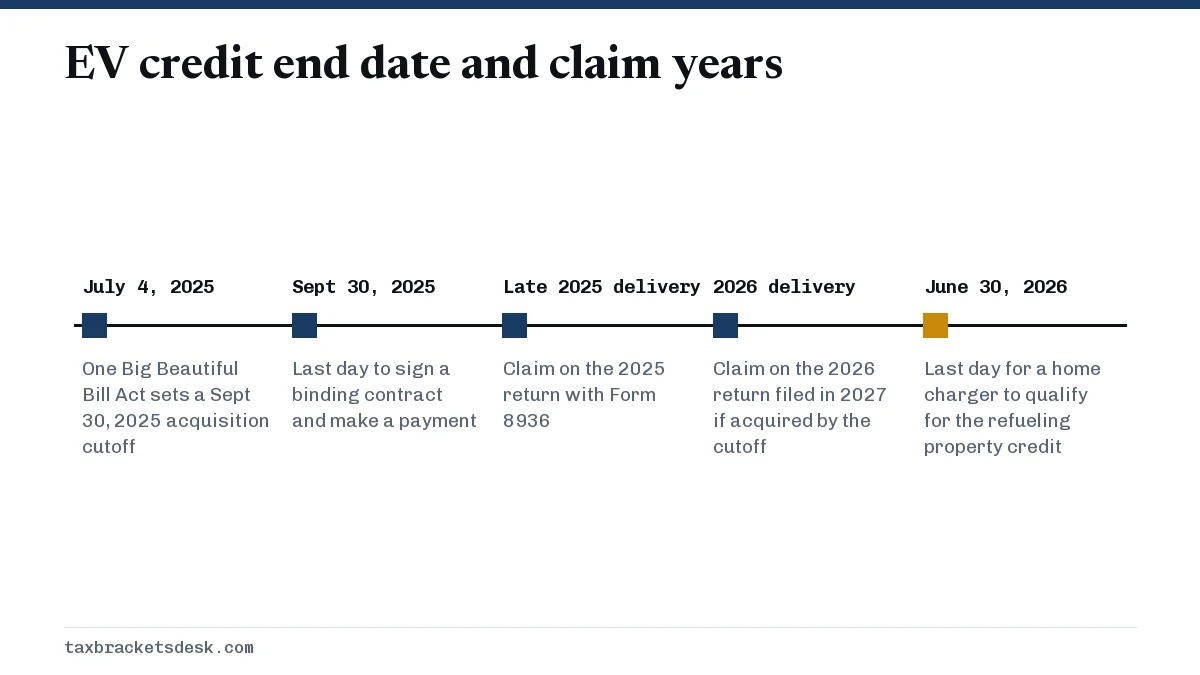
Not for a car you contract for in 2026. The IRS states that the new, previously owned and qualified commercial clean vehicle credits are "not available for vehicles acquired after Sept. 30, 2025" (IRS, Clean Vehicle Tax Credits). The cutoff came from the One Big Beautiful Bill Act, signed July 4, 2025, which ended the credits years ahead of their prior schedule.
A clean vehicle credit is a federal income tax credit for buying a qualifying electric or fuel cell vehicle. There were three versions: the new clean vehicle credit (section 30D), the previously owned or used clean vehicle credit (section 25E), and the commercial clean vehicle credit for business buyers (section 45W). All three share the September 30, 2025 acquisition date.
When did the EV tax credit end, and what counts as acquired?
The credit ended for vehicles acquired after September 30, 2025, which is a different test from delivery. Under the 2025 Instructions for Form 8936, a vehicle is acquired on the date a written binding contract is entered into and a payment has been made, and a payment includes a nominal down payment or a vehicle trade-in (Instructions for Form 8936).
- Signed contract and a $500 deposit on September 28, 2025, delivery in December 2025: acquired in time; claim on the 2025 return.
- Signed contract and trade-in on September 30, 2025, delivery in February 2026: acquired in time; claim on the 2026 return filed in 2027.
- Reservation fee paid in August 2025 but no binding contract until October 2025: not acquired in time; no credit.
- Contract signed September 29, 2025 with no payment until October 3, 2025: both conditions were not met by the cutoff; no credit.
New, used and commercial clean vehicle credits compared
The three credits had different amounts and income limits. These still matter for anyone claiming a vehicle acquired on or before the cutoff.
| Credit | Maximum | Price or MSRP limit | Income limit or buyer |
|---|---|---|---|
| New clean vehicle (30D) | $7,500 | $80,000 vans, SUVs, pickups; $55,000 other vehicles | $300,000 joint; $225,000 head of household; $150,000 others |
| Used clean vehicle (25E) | 30% of price, up to $4,000 | Sale price $25,000 or less | $150,000 joint; $112,500 head of household; $75,000 others |
| Commercial clean vehicle (45W) | $7,500 under 14,000 lbs; $40,000 at 14,000 lbs or more | Credit is the smallest of the cap, 30% of basis (15% for plug-in hybrids) or incremental cost | Business buyers; claimed on Form 3800 or Form 8936 |
Extra rules for the used EV tax credit
The used credit required a purchase from a dealer, a model year at least two years earlier than the calendar year of purchase, and no other used clean vehicle credit claimed in the three years before the purchase (IRS, Used Clean Vehicle Credit). A private-party sale never qualified.
For the new vehicle credit, the IRS lets you use the lower of your modified AGI for the delivery year or the year before. A buyer who took delivery in 2026 can therefore test against 2025 or 2026 MAGI, whichever helps.
How do I claim a clean vehicle credit for a car acquired before the deadline?
You claim the credit on the return for the year you took delivery, using Form 8936, Clean Vehicle Credits, and Schedule A (Form 8936), with the vehicle identification number (VIN). The dealer must have filed a time-of-sale report through the IRS Energy Credits Online portal; without it the vehicle is not eligible.
- Get the time-of-sale report from the dealer. It lists your name and taxpayer ID, the VIN, battery capacity and the maximum credit for the vehicle.
- Check your modified AGI against the limit for your filing status, using the lower of the delivery year or the prior year for a new vehicle.
- Complete Schedule A (Form 8936) for the vehicle, then Form 8936.
- Attach both to Form 1040 for the delivery year. A February 2026 delivery goes on the 2026 return filed in the 2027 season.
- If the credit exceeds your tax, the unused personal portion is lost; the new and used credits are nonrefundable when claimed on the return.
What if I transferred the credit to the dealer?
Buyers who took the credit as a price reduction at the dealership still must file Form 8936 and Schedule A (Form 8936) for the year the vehicle was placed in service. If your income turns out to be over the limit, the Form 8936 instructions say you must repay the amount transferred to the dealer, which increases your tax for that year.
Worked example: a single filer took a $7,500 point-of-sale credit on a car delivered in November 2025. Her MAGI was $142,000 in 2024 and $158,000 in 2025. Because the new vehicle test uses the lower of the two years, $142,000 is under the $150,000 limit and nothing is repaid. If both years had been above $150,000, she would add $7,500 to her 2025 tax.
What remains for EV owners in 2026?
Two federal tax breaks still touch EV buyers in 2026. Neither is a vehicle credit.
- Home charger credit: the Alternative Fuel Vehicle Refueling Property Credit pays 30% of a home charger's cost, up to $1,000, if placed in service before July 1, 2026 in an eligible census tract. Details are on our energy tax credits page.
- Car loan interest deduction: from 2025 through 2028, you can deduct up to $10,000 a year of interest on a loan originated after December 31, 2024 for a new personal-use vehicle with final assembly in the United States, phasing out above $100,000 MAGI ($200,000 joint). An EV can qualify if it meets those tests. See the car loan interest deduction guide.
For how the car loan deduction interacts with your bracket, see what tax bracket am I in. A $2,000 interest deduction saves $440 for someone in the 22% bracket, far less than the old $7,500 credit.
Common questions
Can I get the $7,500 EV tax credit in 2026?
Only if you acquired the vehicle by September 30, 2025, meaning a binding written contract and a payment by that date, and took delivery later. Any vehicle contracted for after that date gets no federal credit.
Is there a used EV tax credit in 2026?
No. The used clean vehicle credit also ended for vehicles acquired after September 30, 2025. A used EV bought from a dealer in 2026 does not qualify.
Does a reservation fee count as acquiring the car?
Only if it was paid under a written binding contract. A refundable reservation without a binding purchase contract does not meet the acquisition test described in the Form 8936 instructions.
Can I still claim the EV credit on my 2025 tax return?
Yes, for a vehicle acquired and delivered by the end of 2025 that met the price, income and dealer reporting rules. Use Form 8936 and Schedule A (Form 8936), or file Form 1040-X if you left it off.
Will the EV tax credit come back in 2027?
Nothing in current IRS guidance points that way. The IRS clean vehicle page, last updated July 13, 2026, still shows no credit for any vehicle acquired after September 30, 2025, and a new credit would require new legislation.
Do I have to repay a point-of-sale EV credit if my income was too high?
Yes. If you transferred the credit to the dealer and do not qualify when you file, you repay the transferred amount on that year's return through Form 8936.
Sources
- Clean Vehicle Tax Credits irs.gov
- Credits for new clean vehicles purchased in 2023 or after irs.gov
- Used Clean Vehicle Credit irs.gov
- Commercial Clean Vehicle Credit irs.gov
- Instructions for Form 8936 (2025) irs.gov
We check figures against these official pages. Rules change; confirm anything that affects a deadline or payment with the agency before you act.
Tell us what happened
Describe your situation and our editors will use it to improve this guide. If you leave your email, we may reply with a pointer to the right page or official contact. We never share your details.
Related guides
 Education Tax Credits and Other Credits: 2026 Amounts
There are two federal education tax credits for 2026: the American Opportunity Credit, worth up to $2,500 per student with $1,000…
Energy Tax Credits 2026: Home Energy Credits Have Ended
There are no new home energy tax credits for 2026: the Residential Clean Energy Credit (solar, batteries, geothermal) and the Ene…
American Opportunity Credit: $2,500 Per Student Rules
The American Opportunity Credit (AOTC) is worth up to $2,500 per eligible student each year: 100% of the first $2,000 of tuition,…
Car Loan Interest Deduction: Up to $10,000 for New Cars
The car loan interest deduction lets you deduct up to $10,000 a year of interest on a loan taken out after December 31, 2024 to b…