
Saver's credit 2026: income limits, rates and how much you get
Short answer
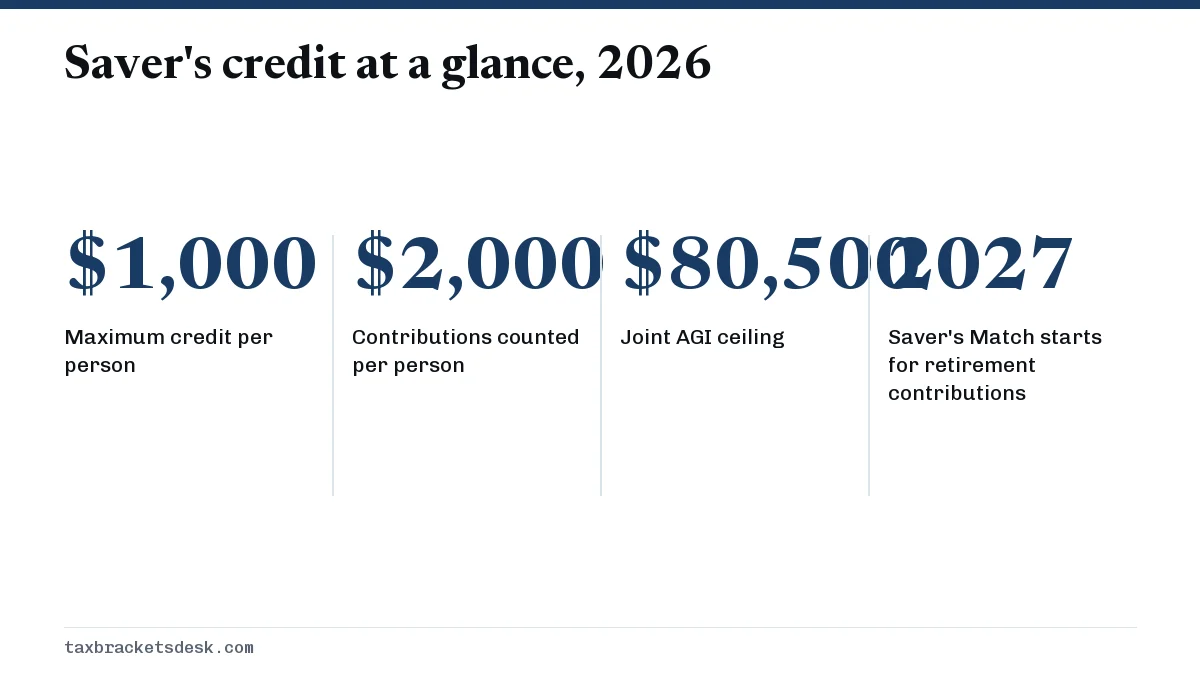
The saver's credit for 2026 equals 50%, 20% or 10% of up to $2,000 you put into an IRA, 401(k) or similar plan ($4,000 for a married couple), so the most it can pay is $1,000 per person. It disappears once adjusted gross income passes $40,250 single, $60,375 head of household or $80,500 married filing jointly. It is nonrefundable and claimed on Form 8880.
- 01Credit rates
- 50%, 20% or 10% of contributions
- 02Contributions counted
- Up to $2,000 per person ($4,000 joint)
- 03Maximum credit
- $1,000 ($2,000 married filing jointly)
- 042026 AGI ceiling
- $40,250 single, $60,375 HoH, $80,500 joint
- 05Form
- Form 8880, Credit for Qualified Retirement Savings Contributions
- 06From 2027 returns
- Saver's Match deposit replaces the credit for retirement contributions
What is the saver's credit?
The saver's credit, officially the retirement savings contributions credit, is a federal tax credit for low- and moderate-income workers who put money into a retirement account or an ABLE account. For the 2026 tax year it is worth 50%, 20% or 10% of up to $2,000 of contributions per person, depending on adjusted gross income (AGI) and filing status (IRS, Saver's Credit).
It sits on top of any tax break the contribution already gets. A $1,000 deductible traditional IRA contribution can lower taxable income by $1,000 and also earn a saver's credit, and Form 8880 says plainly that you can take the credit in addition to an IRA deduction.
The credit is nonrefundable: it can cut your 2026 income tax to zero, but any excess is not paid out. That makes the real value depend on how much tax you owe, which is covered in the worked examples below.
What are the 2026 saver's credit income limits?
The 2026 saver's credit income limits top out at AGI of $40,250 for single and married filing separately filers, $60,375 for heads of household and $80,500 for married couples filing jointly. The IRS set these figures in Notice 2025-67 and announced them on November 13, 2025 (IR-2025-111). Each ceiling rose from 2025, when it was $39,500, $59,250 and $79,000.
| Credit rate | Married filing jointly | Head of household | Single, MFS, surviving spouse |
|---|---|---|---|
| 50% | $48,500 or less | $36,375 or less | $24,250 or less |
| 20% | $48,501 to $52,500 | $36,376 to $39,375 | $24,251 to $26,250 |
| 10% | $52,501 to $80,500 | $39,376 to $60,375 | $26,251 to $40,250 |
| No credit | Over $80,500 | Over $60,375 | Over $40,250 |
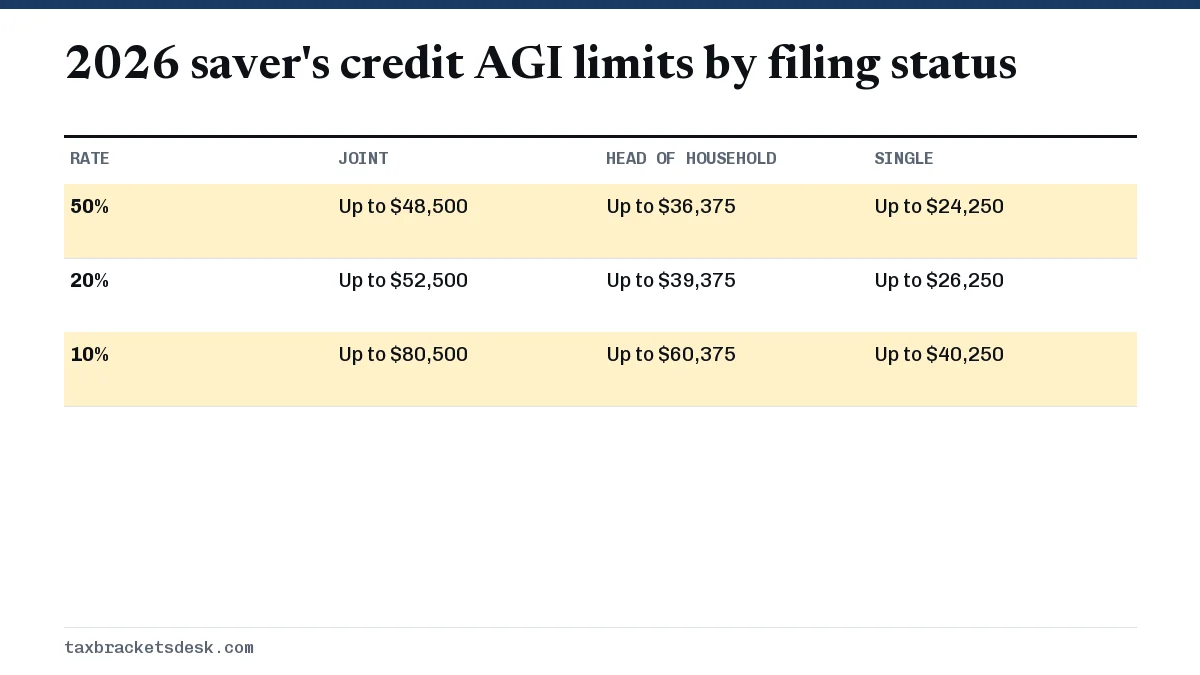
The AGI used is the figure on Form 1040 line 11a. Pre-tax 401(k) deferrals are already left out of W-2 box 1 wages, so they lower that AGI automatically. A deductible traditional IRA contribution, taken on Schedule 1, lowers it too. Our guide to how taxable income is calculated shows where AGI falls in the order of the return.
How much is the saver's credit? The 50%, 20% and 10% rates
The credit is your eligible contributions, capped at $2,000 per person, multiplied by the rate for your AGI band. The table shows the credit before the tax-liability limit is applied.
| Contribution | 50% rate | 20% rate | 10% rate |
|---|---|---|---|
| $500 | $250 | $100 | $50 |
| $1,000 | $500 | $200 | $100 |
| $2,000 | $1,000 | $400 | $200 |
| $5,000 | $1,000 | $400 | $200 |
A married couple filing jointly counts each spouse's contributions separately, up to $2,000 each. If only one spouse saves $4,000, the return still counts just $2,000, because the cap applies per person, not per couple.
Worked example: single worker in the 50% band
A single filer has 2026 AGI of $24,000 and puts $1,500 into a Roth IRA. Her rate is 50%, so the starting credit is $750. Taxable income is $24,000 minus the $16,100 standard deduction, or $7,900, and tax at the 10% bracket rate is $790. The $750 credit fits under that, so her federal income tax falls to $40.
Worked example: married couple near the 20% edge
A couple filing jointly reports AGI of $53,000 and each spouse deferred $2,000 into a workplace 401(k). At $53,000 they are $500 over the 20% band, so the rate is 10% and the credit is $400. If one spouse had deferred another $500 pre-tax, AGI would drop to $52,500, the rate would double to 20%, and the credit would be $800. The bands work like cliffs, so small contributions near a boundary can be worth far more than their face value.
Who can claim the retirement savings contributions credit?
You qualify for the retirement savings contributions credit if your AGI is under the limit and you meet three personal tests for 2026. The person who made the contribution must pass all three.
- Age 18 or older by the end of 2026. The 2025 form excluded anyone born after January 1, 2008, and the cutoff moves forward one year each year.
- Not claimed as a dependent on someone else's 2026 return.
- Not a student. The IRS counts you as a student if you were enrolled full time at a school, or took a full-time on-farm training course, during any part of five calendar months of the year.
The student test catches many young workers. A 22-year-old who finished a full-time spring semester in May was a student in January through May, which is five months, and cannot claim the credit for that year even with a full-time job from June on. Part-time and evening students are not excluded.
Which accounts count for the saver's credit?
Most personal and workplace retirement contributions count, but rollovers and employer money do not. According to Form 8880 and the IRS saver's credit page, eligible contributions include:
- Traditional and Roth IRA contributions, excluding rollover contributions.
- Elective deferrals to a 401(k), 403(b), governmental 457(b), SARSEP, SIMPLE plan or the federal Thrift Savings Plan.
- Voluntary after-tax employee contributions to a qualified plan or 403(b).
- Contributions to a 501(c)(18)(D) plan.
- Contributions by the designated beneficiary to his or her own ABLE account.
Employer matching and profit-sharing contributions do not count, because you did not make them. Only your own deferrals shown on Form W-2, usually box 12 with codes D, E, G or AA, go on line 2 of Form 8880.
How distributions reduce your contributions
Withdrawals can cancel out contributions. Form 8880 line 4 subtracts certain distributions from retirement plans, IRAs and ABLE accounts received in a testing period: the two years before the tax year, the tax year itself, and the time up to the return's due date including extensions. For 2025 returns that meant distributions after 2022; for 2026 returns it covers 2024 onward. Rollovers and some other amounts are excepted, and married couples filing jointly include both spouses' distributions. If you took an early 401(k) withdrawal, see tax on a 401(k) withdrawal for the tax side.
How do I claim the saver's credit on Form 8880?
- Confirm your Form 1040 line 11a AGI is at or below $40,250, $60,375 or $80,500 for your filing status.
- Enter IRA and ABLE contributions on line 1 and workplace deferrals on line 2, in separate columns for you and your spouse.
- Enter distributions from the testing period on line 4 and subtract them.
- Cap each person's net amount at $2,000, add the columns, and multiply by the decimal (0.5, 0.2 or 0.1) from the AGI table on the form.
- Complete the Credit Limit Worksheet in the Form 8880 instructions, which limits the credit to your remaining income tax.
- Enter the smaller amount on Schedule 3 (Form 1040), line 4, and attach Form 8880 to your return.
Because the credit is nonrefundable and shares your tax bill with other credits such as the lifetime learning credit, families with children sometimes find little tax left for it. Our education and other credits overview lists which 2026 credits are refundable.
What happens to the saver's credit in 2027?
Starting with 2027 tax returns filed in 2028, the SECURE 2.0 Act of 2022 replaces the saver's credit for retirement contributions with the Saver's Match, a federal deposit of up to 50% of contributions, capped at $1,000 per person, paid straight into a designated retirement account. The IRS says it will be claimed on a new Form 8880-A. Form 8880 will then be used only for the saver's credit on ABLE account contributions, which the One Big Beautiful Bill Act made permanent.
| Filing status | Full 50% match up to | No match at or above |
|---|---|---|
| Single or married filing separately | $20,500 | $35,500 |
| Head of household | $30,750 | $53,250 |
| Married filing jointly | $41,000 | $71,000 |
These match limits are lower than the 2026 saver's credit ceilings, so some people who get a 10% credit on their 2026 return will not qualify for the match. Eligible plans for the match are 401(k), 403(b), governmental 457(b) and traditional or Roth IRAs (IRS, Saver's Match). We track other 2027 changes on the 2027 tax changes page. The saver's credit is unrelated to the home energy credits that ended after 2025; see energy tax credits for those.
Step by step
Check AGI
Compare Form 1040 line 11a with the 2026 ceiling for your filing status: $40,250, $60,375 or $80,500.
List contributions
Enter IRA, ABLE and workplace plan contributions for each spouse on Form 8880 lines 1 and 2.
Subtract distributions
Subtract distributions received in the testing period on line 4 and cap each person at $2,000.
Apply the rate
Multiply by 0.5, 0.2 or 0.1 from the AGI table on Form 8880.
Limit and report
Limit the credit to your tax with the Credit Limit Worksheet and enter it on Schedule 3, line 4.
Common questions
What is the income limit for the saver's credit in 2026?
For 2026, no saver's credit is allowed once AGI exceeds $40,250 for single and married filing separately filers, $60,375 for heads of household, or $80,500 for married couples filing jointly. The 50% rate applies only up to $24,250, $36,375 and $48,500 respectively.
Is the saver's credit refundable?
No. It can reduce your income tax to zero but cannot increase a refund beyond the tax you owe. The Credit Limit Worksheet in the Form 8880 instructions sets the cap.
Does my employer's 401(k) match count toward the saver's credit?
No. Only contributions you make yourself count, such as elective deferrals from your paycheck and IRA contributions. Employer matching and profit-sharing money is excluded.
Can a college student get the saver's credit?
Not if the student was enrolled full time during any part of five calendar months of the year, or is claimed as someone's dependent. A part-time student who is 18 or older and not a dependent can qualify.
Can I get the saver's credit and deduct my IRA contribution?
Yes. Form 8880 states the credit can be claimed in addition to an IRA deduction on Schedule 1. The same traditional IRA contribution can lower your AGI and earn the credit.
Is the saver's credit going away?
For retirement contributions, yes, after 2026. Beginning with 2027 returns it is replaced by the Saver's Match, claimed on Form 8880-A. The credit continues for contributions to your own ABLE account.
Sources
- Retirement Savings Contributions Credit (Saver's Credit) irs.gov
- Notice 2025-67, 2026 amounts relating to retirement plans and IRAs irs.gov
- IR-2025-111, 401(k) limit increases to $24,500 for 2026 irs.gov
- Form 8880 (2025), Credit for Qualified Retirement Savings Contributions irs.gov
- Saver's Match irs.gov
- Publication 505 (2026), Tax Withholding and Estimated Tax irs.gov
We check figures against these official pages. Rules change; confirm anything that affects a deadline or payment with the agency before you act.
Tell us what happened
Describe your situation and our editors will use it to improve this guide. If you leave your email, we may reply with a pointer to the right page or official contact. We never share your details.
Related guides
 Education Tax Credits and Other Credits: 2026 Amounts
There are two federal education tax credits for 2026: the American Opportunity Credit, worth up to $2,500 per student with $1,000…
Lifetime Learning Credit: Amount, Income Limit and Rules
The lifetime learning credit (LLC) equals 20% of the first $10,000 of qualified tuition and required fees, for a maximum of $2,00…
Tax on 401(k) Withdrawal: How Much You Will Owe and Why
The tax on a 401(k) withdrawal is ordinary federal income tax at your normal bracket rates, because pre-tax money was never taxed…
Tax Changes 2027: What Is New for Your Next Return
The main tax changes in 2027 land on the tax year 2026 return you file that season: a $1,000 ($2,000 joint) charity deduction wit…
Energy Tax Credits 2026: Home Energy Credits Have Ended
There are no new home energy tax credits for 2026: the Residential Clean Energy Credit (solar, batteries, geothermal) and the Ene…