
Lifetime learning credit: 20% of up to $10,000, capped at $2,000 per return
Short answer
The lifetime learning credit (LLC) equals 20% of the first $10,000 of qualified tuition and required fees, for a maximum of $2,000 per tax return, not per student. It is nonrefundable, has no limit on the number of years, and covers graduate school and single job-skills courses. It phases out between $80,000 and $90,000 of MAGI ($160,000 to $180,000 joint).
- 01Credit rate
- 20% of up to $10,000 of expenses
- 02Maximum credit
- $2,000 per return
- 03Refundable
- No
- 04Phaseout (single, HoH)
- MAGI $80,000 to $90,000
- 05Phaseout (married filing jointly)
- MAGI $160,000 to $180,000
- 06Years available
- Unlimited
How much is the lifetime learning credit?
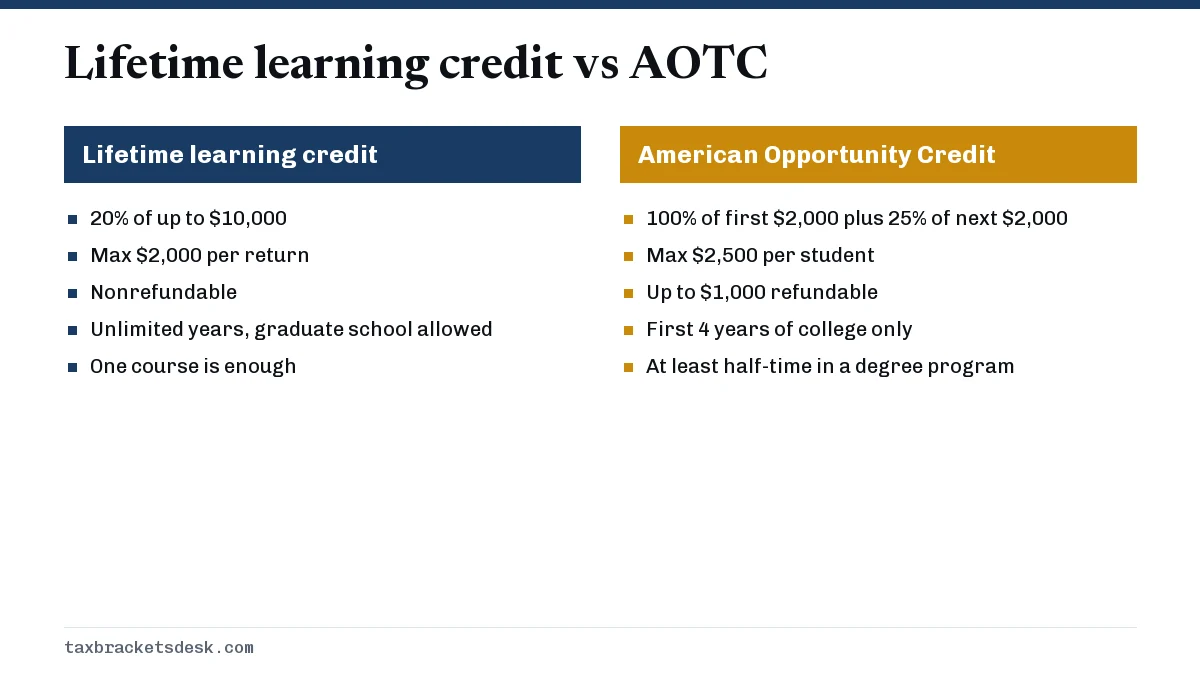
The lifetime learning credit is 20% of up to $10,000 of qualified education expenses, so the most any household can get is $2,000 a year. The cap applies to the whole return: a couple paying for their own master's degree and a child's community college classes still shares one $2,000 limit (IRS Publication 970, Table 3-1).
| Qualified expenses | 20% of expenses | Credit allowed |
|---|---|---|
| $1,200 (one certificate course) | $240 | $240 |
| $6,000 | $1,200 | $1,200 |
| $10,000 | $2,000 | $2,000 |
| $15,000 (graduate tuition) | $3,000 | $2,000 |
For 2026 the rate and the $10,000 base are unchanged from 2025. Rev. Proc. 2025-32, which lists the inflation-adjusted amounts for 2026, does not include the education credits because their dollar limits are not indexed. No 2027 change has been announced; the IRS usually publishes its 2027 inflation figures in October or November 2026.
Is the lifetime learning credit refundable?
No. The LLC can reduce your income tax to zero but cannot produce a refund by itself. If your tax before credits is $700 and your LLC figures to $1,200, you save $700 and the remaining $500 is not paid out.
That makes timing matter. A part-time graduate student with a low income may get little or nothing from the LLC, while the same tuition paid by a working spouse on a joint return can use the full credit. Other nonrefundable credits, such as the saver's credit, draw on the same tax liability, so a large combination may not all fit.
What is the lifetime learning credit income limit for 2026?
The credit starts shrinking once modified AGI passes $80,000 ($160,000 on a joint return) and is gone at $90,000 ($180,000 joint). Married filing separately filers cannot claim it. These are the same ranges that apply to the American Opportunity Credit.
Worked example: a single nurse earning MAGI of $85,000 pays $7,500 for a nurse practitioner program. The starting credit is 20% x $7,500 = $1,500. She is halfway through the $10,000 range, so she keeps 50%: ($90,000 minus $85,000) / $10,000 = 0.5, and the credit is $750.
Who and what qualifies for the LLC tax credit?
You can claim the credit for yourself, your spouse or a dependent enrolled at an eligible educational institution, which includes most accredited colleges, universities and vocational schools that take part in federal student aid programs. The LLC has fewer student tests than the AOTC:
- No degree requirement: one course taken to acquire or improve job skills qualifies.
- No half-time enrollment requirement.
- No limit on the number of years claimed.
- A felony drug conviction does not disqualify the student.
- Graduate, professional and doctoral programs qualify.
Qualified expenses are narrower
Only tuition and fees required for enrollment or attendance count. Books, supplies and equipment count only if they must be paid to the school as a condition of enrollment. A textbook bought separately from a bookstore counts for the AOTC but not for the LLC.
New 2026 SSN requirement
Beginning with 2026 returns, the person claiming the LLC must have a Social Security number valid for work, issued before the return's due date including extensions, and the student needs one too when someone else claims the credit (Pub. 505 (2026)). The school EIN requirement on Form 8863 applies to the AOTC.
Can I claim the lifetime learning credit for graduate school?
Yes. Graduate students turn to the lifetime learning credit because the American Opportunity Credit stops after four years of undergraduate study. Law, medical, MBA and doctoral tuition all count if paid to an eligible institution.
Employer tuition help changes the math. Tax-free educational assistance paid by your employer must be subtracted from your expenses before you figure the credit, so only the part you paid yourself counts.
Choosing between the AOTC and the LLC
For each student you choose one credit per year. Publication 970 says that when a student qualifies for both, the AOTC will always be the larger credit, because it pays 100% on the first $2,000 and part of it is refundable. See the American Opportunity Credit rules for the four-year and half-time tests.
- Undergraduate in years one to four, at least half-time, in a degree program: use the AOTC.
- Fifth-year undergraduate, graduate student or part-time student below half-time: use the LLC.
- Adult taking a single course for work: use the LLC.
- Two children in college: you can use the AOTC for one and the LLC for the other in the same year.
Our education credits hub shows both credits side by side with the other 2026 credits. The credit is claimed on Form 8863, Education Credits, Part III for each student, with the total carried to Schedule 3 (Form 1040).
Common questions
Is the lifetime learning credit per student or per return?
Per return. However many students you pay for, the combined credit cannot exceed $2,000 in a year.
Can I get the lifetime learning credit for an online course?
Yes, if the provider is an eligible educational institution and you pay required tuition or fees. Courses from providers that are not eligible for federal student aid programs do not qualify.
Does the lifetime learning credit phase out?
Yes. It is reduced for MAGI between $80,000 and $90,000, or $160,000 and $180,000 on a joint return, and no credit is allowed above the top of the range.
Can I claim the LLC if I am married filing separately?
No. Married filing separately filers cannot claim either education credit.
How many years can I claim the lifetime learning credit?
There is no limit. You can claim it every year you pay qualified expenses and meet the other rules, including years of graduate school and later job training.
Sources
- Publication 970 (2025), Tax Benefits for Education irs.gov
- Publication 505 (2026), Tax Withholding and Estimated Tax irs.gov
- Rev. Proc. 2025-32, 2026 inflation adjustments irs.gov
We check figures against these official pages. Rules change; confirm anything that affects a deadline or payment with the agency before you act.
Tell us what happened
Describe your situation and our editors will use it to improve this guide. If you leave your email, we may reply with a pointer to the right page or official contact. We never share your details.
Related guides
 Education Tax Credits and Other Credits: 2026 Amounts
There are two federal education tax credits for 2026: the American Opportunity Credit, worth up to $2,500 per student with $1,000…
American Opportunity Credit: $2,500 Per Student Rules
The American Opportunity Credit (AOTC) is worth up to $2,500 per eligible student each year: 100% of the first $2,000 of tuition,…
Saver's Credit 2026: Income Limits and Credit Rates
The saver's credit for 2026 equals 50%, 20% or 10% of up to $2,000 you put into an IRA, 401(k) or similar plan ($4,000 for a marr…
Energy Tax Credits 2026: Home Energy Credits Have Ended
There are no new home energy tax credits for 2026: the Residential Clean Energy Credit (solar, batteries, geothermal) and the Ene…