
Payroll and Self-Employment Tax
Medicare tax rate for 2026: 1.45% of every dollar of wages
Short answer
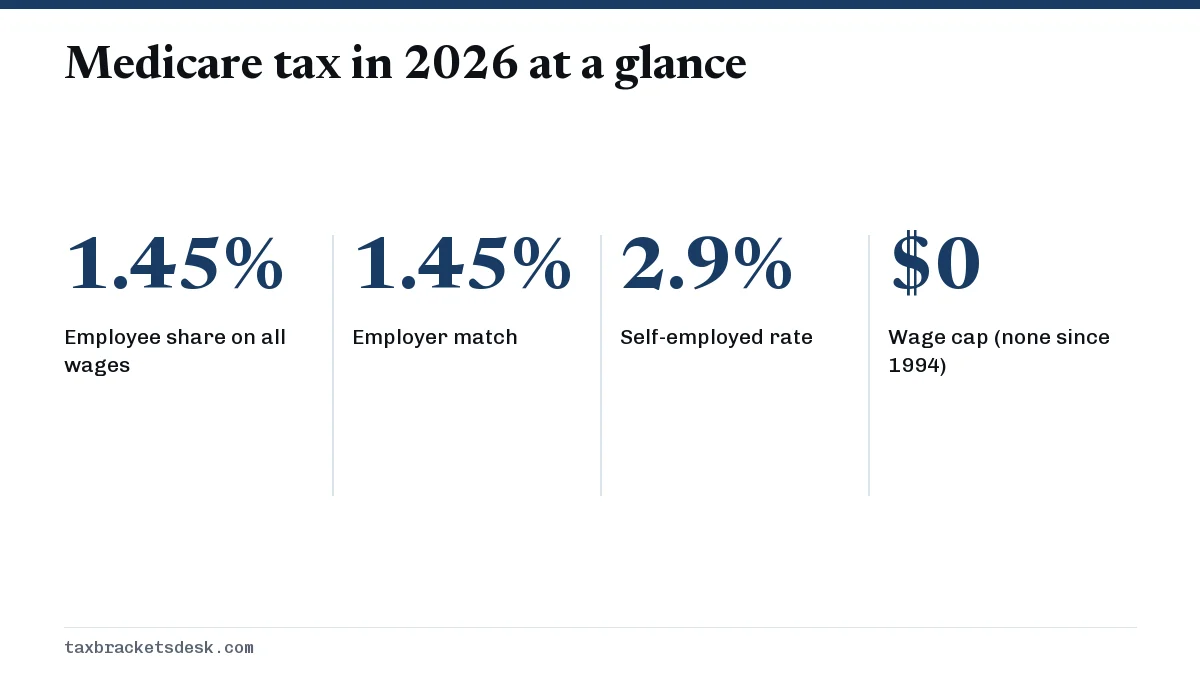
The Medicare tax rate for 2026 is 1.45% of all wages for the employee, matched by another 1.45% from the employer, for 2.9% in total. Self-employed people pay the full 2.9% themselves. Unlike Social Security tax, Medicare tax has no wage cap, and pay above $200,000 adds a 0.9% Additional Medicare Tax that employers do not match.
- 01Employee Medicare tax rate
- 1.45% of all Medicare wages
- 02Employer match
- 1.45% (2.9% combined)
- 03Self-employed rate
- 2.9% on 92.35% of net earnings
- 04Wage cap
- None since 1994
- 05Additional Medicare Tax
- 0.9% above $200,000 of wages (employee only)
What is the Medicare tax rate in 2026?
The Medicare tax rate in 2026 is 1.45% of an employee's Medicare wages, and the employer pays a matching 1.45%, according to IRS Topic 751. Medicare tax is the hospital insurance (HI) part of FICA, the payroll tax that also funds Social Security. The rate is set in law, so it did not change for 2026 and is not adjusted for inflation.
Medicare tax is a flat percentage, not a bracketed tax. A cashier earning $30,000 and an executive earning $3 million pay the same 1.45% on each dollar, with one exception: wages above $200,000 in a calendar year carry an extra 0.9% employee-only charge, covered on our Additional Medicare Tax page.
| Who pays | Rate | Applies to | Cap |
|---|---|---|---|
| Employee | 1.45% | All Medicare wages (Form W-2 box 5) | None |
| Employer | 1.45% | Same wages, paid on top of salary | None |
| Employee, extra | 0.9% | Wages over $200,000 from one employer | None; no employer match |
| Self-employed person | 2.9% | 92.35% of net self-employment earnings | None |
Is there a limit on Medicare tax?
No. There is no maximum wage for Medicare tax, so every dollar of pay is taxed for as long as you work. That is the key difference from Social Security tax, which stops once wages reach the 2026 Social Security wage base of $184,500.
A Medicare cap did exist once. The Social Security Administration's history of taxable maximums shows that hospital insurance used the same cap as Social Security from 1966 through 1990, then separate caps of $125,000 in 1991, $130,200 in 1992 and $135,000 in 1993. Since 1994, all covered earnings have been subject to Medicare tax.
How much Medicare tax comes out of a paycheck?
Multiply the gross Medicare wages for the pay period by 1.45%. On a biweekly check of $3,000, Medicare withholding is $43.50. On a monthly salary of $9,500, it is $137.75. Payroll systems show this line as "Medicare" or "FICA-Med" on the pay stub.
The yearly totals below apply the 1.45% rate to the full salary and add the 0.9% Additional Medicare Tax only where wages from a single employer pass $200,000. For the Social Security half of the picture at the same salaries, see FICA tax explained.
| Annual wages | Employee Medicare tax | Employer Medicare tax | Combined |
|---|---|---|---|
| $35,000 | $507.50 | $507.50 | $1,015.00 |
| $85,000 | $1,232.50 | $1,232.50 | $2,465.00 |
| $300,000 | $4,350 + $900 extra = $5,250 | $4,350 | $9,600 |
| $1,000,000 | $14,500 + $7,200 extra = $21,700 | $14,500 | $36,200 |
The $300,000 row shows how the extra 0.9% works: it applies only to the $100,000 above $200,000, which adds $900. The employer's share stays at a flat 1.45% because employers never pay the additional tax.
Do employers match Medicare tax?
Yes. Employers pay 1.45% of each employee's Medicare wages from their own funds, on top of the 1.45% they withhold from the employee's pay. IRS Publication 15, the Employer's Tax Guide, requires the employer to deposit both halves and report them on Form 941 each quarter.
The match covers the regular 1.45% only. Employers withhold the 0.9% Additional Medicare Tax from the employee once wages pass $200,000 but add nothing of their own. The employer share is not shown on your W-2, but it is a real cost of employing you, which is one reason the self-employed rate is double.
What Medicare tax rate do self-employed people pay?
Self-employed people pay 2.9% Medicare tax, both halves, as part of the 15.3% self-employment tax figured on Schedule SE (IRS Topic 554). The tax applies to 92.35% of net self-employment earnings, and it is owed once those net earnings reach $400 for the year.
Worked example: a freelancer with $80,000 of net profit multiplies by 92.35% to get $73,880 of net earnings from self-employment. Medicare tax is 2.9% of that, or $2,142.52. Half of the total self-employment tax is deductible on Schedule 1. The full calculation, including the Social Security part, is on our self-employment tax rate page.
Do retirees pay Medicare tax?
Retirees pay Medicare tax only on wages or self-employment income, not on retirement income. Social Security benefits, pensions, 401(k) and IRA withdrawals are not wages, so no Medicare tax is withheld from them. Those amounts can still be subject to federal income tax; see tax on Social Security benefits.
A retiree who takes a job does pay Medicare tax on that paycheck. IRS Publication 15 states that wages are generally subject to Social Security and Medicare tax regardless of the employee's age or whether the employee already receives Social Security benefits. Enrolling in Medicare does not stop the withholding either.
What to do if Medicare withholding looks wrong
- Divide the Medicare line on your pay stub by the gross pay for that period. The result should be 1.45%, or 2.35% on the portion of pay above $200,000 for the year.
- At year end, compare Form W-2 box 6 (Medicare tax withheld) with 1.45% of box 5 (Medicare wages), plus 0.9% of box 5 above $200,000.
- If the math is off, ask your payroll department to correct it. Over- or under-withheld FICA is fixed by the employer, usually on Form W-2c and Form 941-X, not on your own tax return.
- If you had two jobs, remember that each employer withholds the regular 1.45% on all your pay there. Because Medicare has no cap, there is no excess Medicare tax to claim back, unlike excess Social Security tax.
Common questions
Is Medicare tax 1.45% or 2.9%?
Both numbers are correct for different people. Employees pay 1.45% and their employer pays another 1.45%, for 2.9% in total. Self-employed people pay the whole 2.9% themselves through self-employment tax.
At what income do you stop paying Medicare tax?
You never stop. Medicare tax has had no wage cap since 1994, so it applies to every dollar of wages and self-employment earnings. Only Social Security tax stops at a yearly limit, which is $184,500 for 2026.
Did the Medicare tax rate change for 2026?
No. The 1.45% employee rate and 1.45% employer rate are set by statute and were the same in 2025 and 2026. The 0.9% Additional Medicare Tax thresholds are also fixed in law and are not indexed for inflation.
Is Medicare tax withheld from tips?
Yes. Tips you report to your employer are Medicare wages, so 1.45% Medicare tax applies to them. The no tax on tips deduction for 2025 through 2028 is claimed on Schedule 1-A of your income tax return, so it does not change the Medicare wages your employer reports in W-2 box 5.
Can I get a refund of Medicare tax?
Only if an employer withheld it by mistake, such as on pay that was exempt. The employer corrects the error and refunds you. Medicare tax paid correctly on wages is not refundable, even if you never enroll in Medicare.
What is the Medicare tax rate for 2027?
The same as 2026: 1.45% for employees plus 1.45% from employers, or 2.9% for the self-employed, because the rates are set by statute and not indexed. Medicare tax still has no wage cap in 2027. The $192,300 taxable maximum the Social Security Administration announced on October 14, 2026 applies only to Social Security tax, and the 0.9% Additional Medicare Tax still starts at $200,000 of wages.
Sources
- Topic 751, Social Security and Medicare withholding rates irs.gov
- Topic 554, Self-employment tax irs.gov
- Publication 15 (2026), Employer's Tax Guide irs.gov
- SSA, Contribution and benefit base ssa.gov
We check figures against these official pages. Rules change; confirm anything that affects a deadline or payment with the agency before you act.
Tell us what happened
Describe your situation and our editors will use it to improve this guide. If you leave your email, we may reply with a pointer to the right page or official contact. We never share your details.
Related guides
 FICA Tax: Social Security and Medicare Rates for 2026
FICA tax is the 7.65% payroll tax taken from an employee's wages in 2026: 6.2% for Social Security on the first $184,500 of pay a…
Additional Medicare Tax: 0.9% Over $200,000 Explained
Additional Medicare Tax is a 0.9% tax on Medicare wages and self-employment income above $200,000 for single and head of househol…
Social Security Tax 2026: 6.2% Rate Up to the $184,500 Cap
Social Security tax is 6.2% of an employee's wages up to the 2026 wage base of $184,500, which makes the maximum employee tax $11…
Self-Employment Tax: 15.3% Rate and How to Figure It
Self-employment tax is 15.3% (12.4% Social Security plus 2.9% Medicare) charged on 92.35% of your net earnings from self-employme…
Social Security Wage Base 2027: $192,300 Official Limit
The Social Security wage base for 2027 is $192,300, up from $184,500 in 2026. The Social Security Administration announced it on…