
Payroll and Self-Employment Tax
Additional Medicare Tax: the 0.9% surcharge on high wages
Short answer
Additional Medicare Tax is a 0.9% tax on Medicare wages and self-employment income above $200,000 for single and head of household filers, $250,000 for married couples filing jointly and $125,000 for married filing separately. Employers must withhold it on wages over $200,000 regardless of filing status and do not match it. You settle the exact amount on Form 8959.
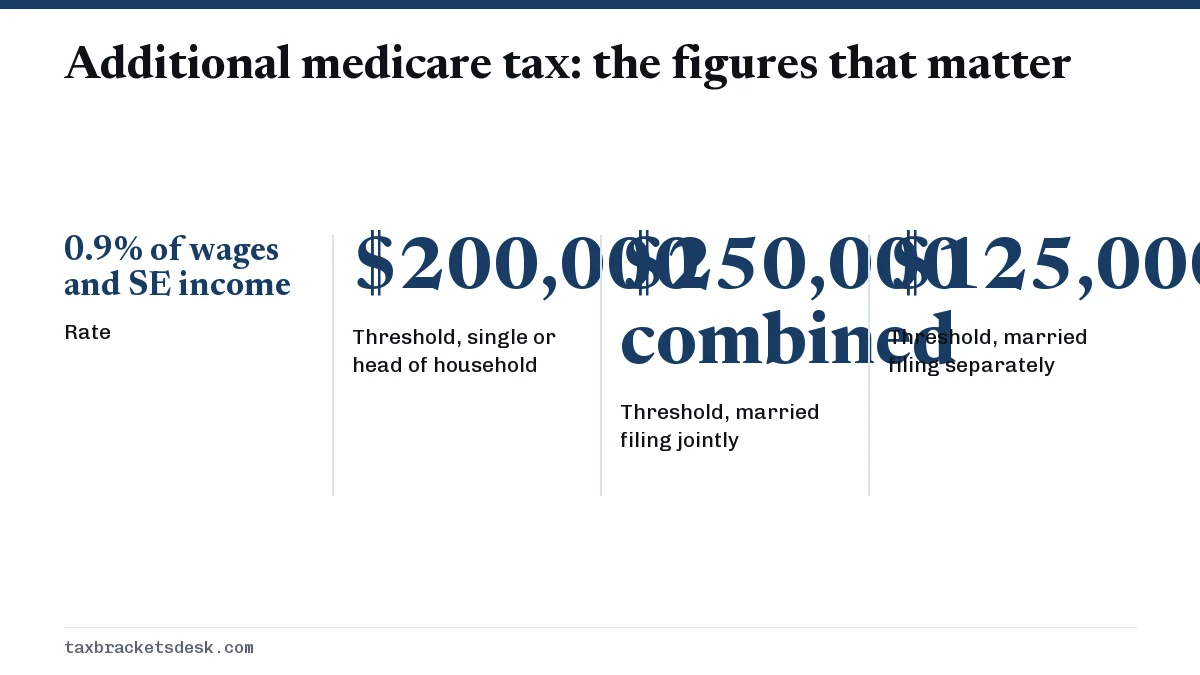
- 01Rate
- 0.9% of wages and SE income above the threshold
- 02Threshold, single or head of household
- $200,000
- 03Threshold, married filing jointly
- $250,000 combined
- 04Threshold, married filing separately
- $125,000
- 05Employer withholding trigger
- Wages over $200,000 from that employer, any filing status
- 06Form used
- Form 8959, total to Schedule 2 line 11
What is the Additional Medicare Tax?
The Additional Medicare Tax is a 0.9% tax that high earners pay on top of the regular 1.45% Medicare tax rate. It applies only to the part of Medicare wages, Railroad Retirement Tax Act (RRTA) compensation and self-employment income that exceeds a threshold set by filing status (IRS Topic 751 and Publication 505).
Three features make it different from ordinary FICA tax. The employee pays it alone, with no employer match. The employer's withholding rule ignores your filing status. And the final amount is worked out on your individual return, which is why many two-income households owe it, or get some of it back, at filing time.
What is the additional Medicare tax threshold for each filing status?
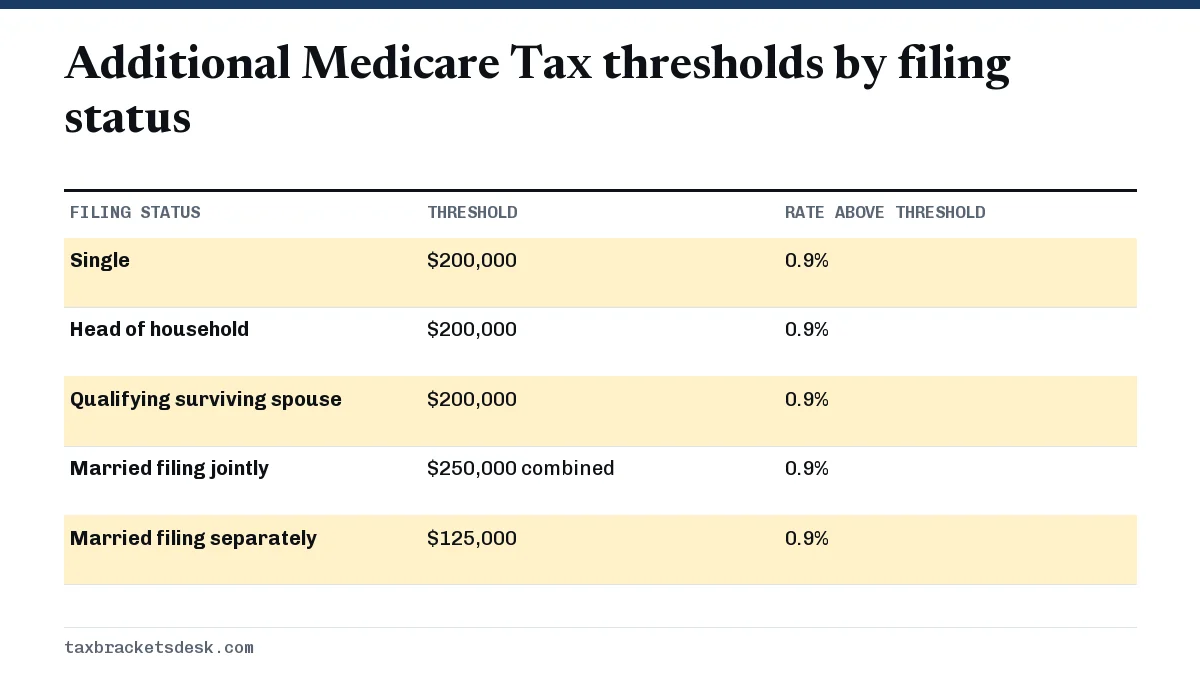
The additional Medicare tax threshold is $200,000 for single, head of household and qualifying surviving spouse filers, $250,000 for married filing jointly and $125,000 for married filing separately. These amounts are written into the law and, unlike income tax brackets, are not adjusted for inflation, so they are the same for 2026 as they were when the tax began in 2013.
For a joint return, the $250,000 test uses the couple's combined wages and self-employment income, not each spouse separately. The same fixed dollar amounts are used by the 3.8% net investment income tax, but that is a separate tax on investment income figured on Form 8960.
How does employer withholding of the 0.9% Medicare tax work?
Your employer must start withholding the 0.9% Medicare tax in the pay period in which your wages from that employer pass $200,000 for the calendar year, and continue through December. The employer does not know or consider your filing status, your spouse's pay or your other jobs, so the $200,000 trigger applies to everyone.
The Form 8959 instructions add that you cannot ask your employer to stop this withholding when it is required. You also cannot ask an employer to begin withholding it early. What you can do, according to the IRS Additional Medicare Tax questions and answers, is request extra federal income tax withholding in Step 4(c) of Form W-4, which is credited against everything you owe, including this tax. Our W-4 withholding guide shows where that goes.
Why was Additional Medicare Tax withheld when we are under $250,000 married?
Because the employer must withhold on wages above $200,000 even when your joint income is below $250,000. The withholding is not wasted: Form 8959 compares the tax you actually owe with what was withheld, and any excess is credited on Form 1040 line 25c together with your income tax withholding, which raises your refund or cuts your balance due.
Example: one spouse earns $230,000 and the other has no earned income. The employer withholds 0.9% of $30,000, which is $270. The couple's combined wages of $230,000 are under the $250,000 joint threshold, so their actual Additional Medicare Tax is $0 and the full $270 flows back through Form 8959 Part V.
Example: a two-earner couple filing jointly
This is the case the withholding rules miss most often. Here are three households worked through with the 2026 rules.
| Household | Tax owed on the return | Withheld by employers | Settled on Form 8959 |
|---|---|---|---|
| Married, wages $180,000 + $120,000 = $300,000 | 0.9% x $50,000 = $450 | $0 (neither job over $200,000) | $450 more owed |
| Married, wages $230,000 + $0 = $230,000 | $0 (under $250,000) | 0.9% x $30,000 = $270 | $270 credited back |
| Single, wages $260,000 from one job | 0.9% x $60,000 = $540 | 0.9% x $60,000 = $540 | Balanced |
| Single, wages $130,000 + net SE income $145,000 | 0.9% x $75,000 = $675 | $0 | $675 more owed |
The last row follows the IRS method for mixing wages and self-employment income. The $200,000 threshold is first reduced by the $130,000 of wages, leaving $70,000. The 0.9% then applies to the $75,000 of self-employment income above that reduced threshold. The wages themselves are below $200,000, so no tax is due on them.
Self-employment losses do not reduce wages for this test, according to the IRS questions and answers. If you expect to owe, cover the gap with extra W-4 withholding or with quarterly estimated payments.
How do I report it on Form 8959?
Form 8959, Additional Medicare Tax, is required if any single W-2 shows more than $200,000 in box 5 (Medicare wages) or if your combined wages, tips and self-employment income exceed your filing status threshold. Tax software fills it in from your W-2 and Schedule SE, but knowing the parts helps you check the result.
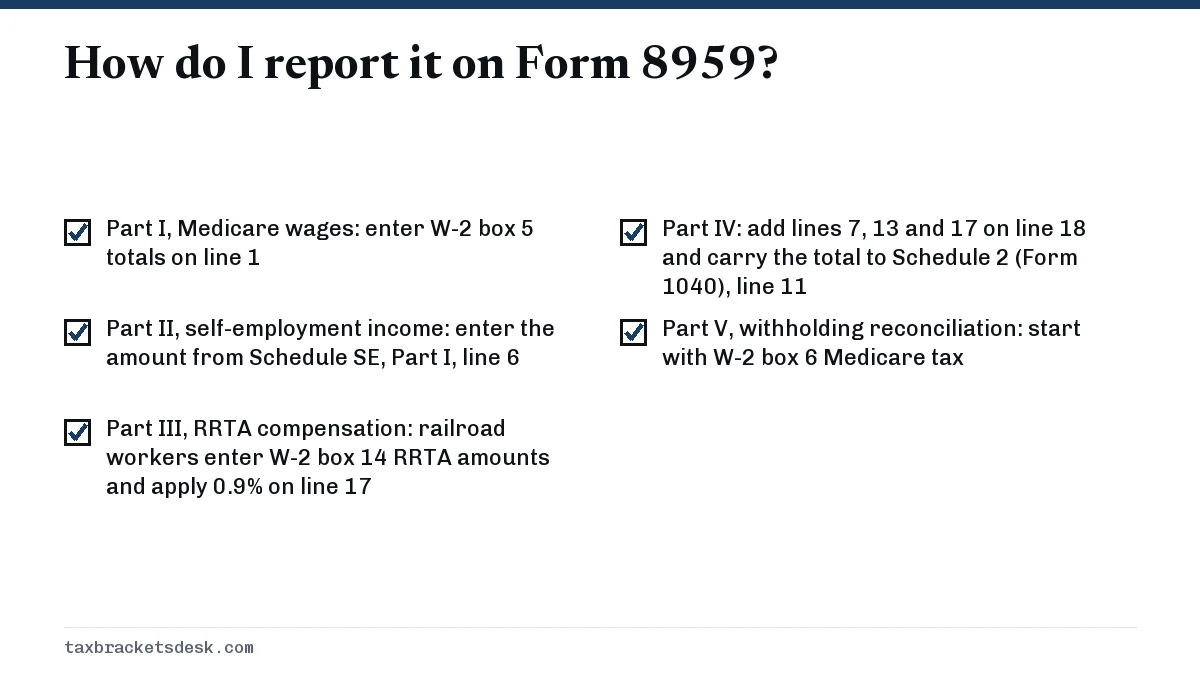
- Part I, Medicare wages: enter W-2 box 5 totals on line 1, plus unreported tips from Form 4137 and wages from Form 8919. Subtract the threshold and multiply the excess by 0.9% on line 7.
- Part II, self-employment income: enter the amount from Schedule SE, Part I, line 6, reduce the threshold by your Medicare wages, and apply 0.9% on line 13.
- Part III, RRTA compensation: railroad workers enter W-2 box 14 RRTA amounts and apply 0.9% on line 17.
- Part IV: add lines 7, 13 and 17 on line 18 and carry the total to Schedule 2 (Form 1040), line 11.
- Part V, withholding reconciliation: start with W-2 box 6 Medicare tax, subtract regular 1.45% Medicare tax, and carry the excess withheld (line 24) to Form 1040 line 25c.
Line references above are from the 2025 Form 8959 instructions, the latest revision available in September 2026; check the 2026 form when it is released before relying on exact line numbers.
Common questions
Is the 0.9 Medicare tax on income over $200,000 or $250,000?
It depends on filing status. Single, head of household and qualifying surviving spouse filers use $200,000, married couples filing jointly use $250,000 of combined earnings, and married filing separately uses $125,000. Employers always start withholding at $200,000 of their own wages.
Does Additional Medicare Tax apply to investment income?
No. It applies only to wages, RRTA compensation and self-employment income. Interest, dividends and capital gains of high earners can instead face the separate 3.8% net investment income tax.
Does my employer pay the Additional Medicare Tax too?
No. The IRS states there is no employer match for Additional Medicare Tax. Your employer keeps paying 1.45% on all your wages, but the extra 0.9% comes only from you.
Can I ask my employer to withhold Additional Medicare Tax before I reach $200,000?
Not as Additional Medicare Tax. Instead, enter a per-paycheck dollar amount in Step 4(c) of a new Form W-4. That extra income tax withholding counts toward your total tax bill, including this tax.
Are the Additional Medicare Tax thresholds adjusted for inflation?
No. The $200,000, $250,000 and $125,000 thresholds are fixed in the statute, so more workers reach them each year as wages rise.
Sources
- Instructions for Form 8959 irs.gov
- Questions and answers for the Additional Medicare Tax irs.gov
- Topic 751, Social Security and Medicare withholding rates irs.gov
- Publication 505 (2026), Tax Withholding and Estimated Tax irs.gov
We check figures against these official pages. Rules change; confirm anything that affects a deadline or payment with the agency before you act.
Tell us what happened
Describe your situation and our editors will use it to improve this guide. If you leave your email, we may reply with a pointer to the right page or official contact. We never share your details.
Related guides
 FICA Tax: Social Security and Medicare Rates for 2026
FICA tax is the 7.65% payroll tax taken from an employee's wages in 2026: 6.2% for Social Security on the first $184,500 of pay a…
Self-Employment Tax: 15.3% Rate and How to Figure It
Self-employment tax is 15.3% (12.4% Social Security plus 2.9% Medicare) charged on 92.35% of your net earnings from self-employme…
Net Investment Income Tax 2026: 3.8% Rate and Thresholds
For 2026, the net investment income tax (NIIT) is 3.8% of the smaller of your net investment income or the amount your modified a…
W-4 Withholding: How to Fill Out the Form W-4 for 2026
W-4 withholding is the federal income tax your employer takes from each paycheck based on the Form W-4 you give it. The 2026 Form…