
Payroll and Self-Employment Tax
Social Security tax in 2026: the 6.2% rate, the $184,500 wage base and the maximum you can pay
Short answer
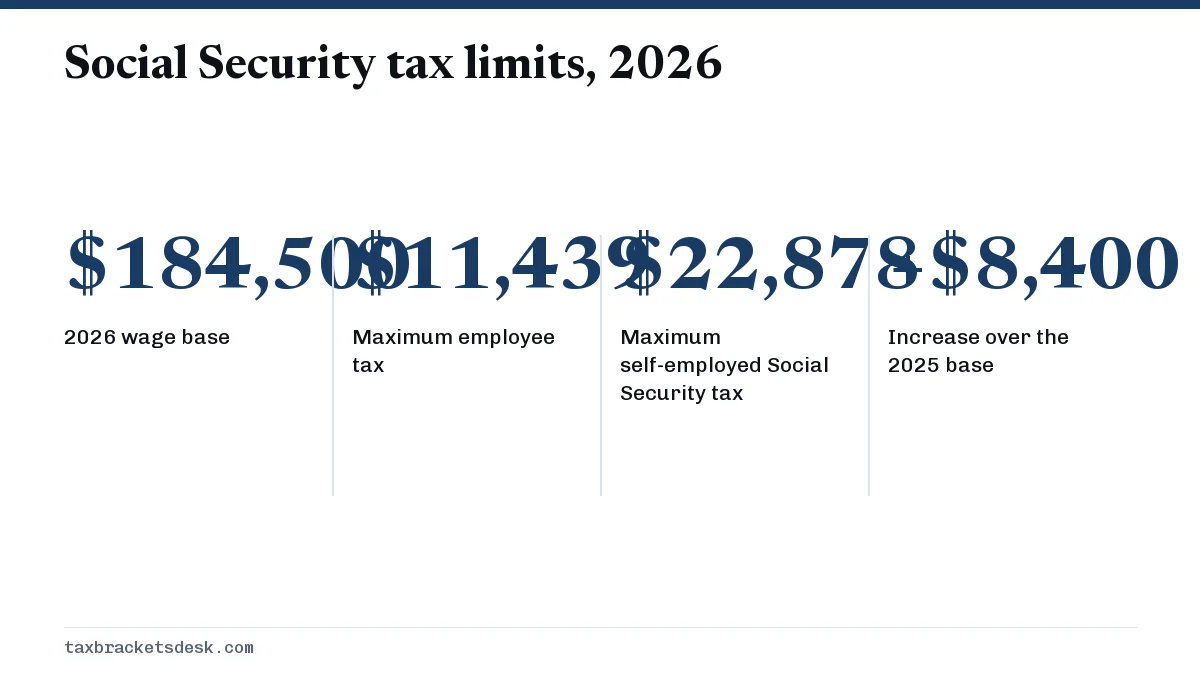
Social Security tax is 6.2% of an employee's wages up to the 2026 wage base of $184,500, which makes the maximum employee tax $11,439 for the year. Employers pay a matching 6.2%, and self-employed people pay 12.4% on the same capped amount. Wages above the cap owe no Social Security tax, though Medicare tax continues.
- 01Employee rate
- 6.2% of wages
- 022026 wage base
- $184,500
- 032025 wage base
- $176,100
- 04Max employee tax, 2026
- $11,439
- 05Max self-employed Social Security tax, 2026
- $22,878
- 062027 wage base
- $192,300 (announced October 14, 2026)
What is the Social Security wage base for 2026?
The Social Security wage base for 2026 is $184,500 (IRS Topic 751). The wage base is the most earnings per year that can be taxed for Social Security, and it is also the ceiling on earnings the Social Security Administration credits toward future benefits, which is why SSA calls it the contribution and benefit base.
| Year | Wage base | Maximum employee tax (6.2%) | Status |
|---|---|---|---|
| 2025 | $176,100 | $10,918.20 | Final (IRS Publication 15, 2025) |
| 2026 | $184,500 | $11,439.00 | Final (IRS Topic 751) |
| 2027 | $192,300 | $11,922.60 | Announced by SSA on October 14, 2026; applies to wages paid in 2027 |
The base rises most years because it is tied to growth in the national average wage. From 2025 to 2026 it went up $8,400, and for 2027 SSA has set it at $192,300, another $7,800. The 2027 Social Security wage base page shows how that figure was calculated.
When in the year do high earners hit the cap?
You hit the cap on the paycheck that brings your year-to-date Social Security wages from one employer past $184,500. After that, the 6.2% deduction drops off and take-home pay rises until January.
Take an employee paid $240,000 a year in 24 semimonthly checks of $10,000. The first 18 checks each have $620 of Social Security tax withheld, for $180,000 of wages. The 19th check is taxed on only the remaining $4,500, or $279. Checks 20 through 24 have no Social Security tax, so each is $620 larger. Bonuses paid earlier in the year move that date forward.
What if I have two jobs and pay too much Social Security tax?
If two or more employers together withheld more than $11,439 of Social Security tax for 2026, you get the excess back as a credit on your federal return. Each employer must withhold on its own wages up to $184,500 because it cannot see your other job, so overpayment is common for people with two well-paid jobs.
Example: Job A pays $130,000 and withholds $8,060. Job B pays $90,000 and withholds $5,580. Total withheld is $13,640, or $2,201 more than the $11,439 maximum. You claim that $2,201 on the excess Social Security line of Schedule 3 (Form 1040), and it reduces your tax or increases your refund.
Rules for claiming the excess
- The credit is only for excess caused by more than one employer during the year (IRS Topic 608).
- If a single employer withheld too much, the employer should refund it; if it does not, file Form 843 with copies of your W-2 forms.
- On a joint return, each spouse figures excess Social Security tax separately; one spouse's overpayment cannot be combined with the other's wages.
- Check box 4 of every Form W-2 before filing. That box is the Social Security tax each employer withheld.
Your employers do not get their 6.2% share back in this situation. Only the employee's overpayment is refundable. If you want the extra income tax withholding from a second job to line up with your real bill, the W-4 withholding guide covers the Step 2 checkbox for multiple jobs.
Common questions
At what income do you stop paying Social Security tax in 2026?
Employees stop paying Social Security tax after $184,500 of wages from an employer in 2026. Medicare tax continues on all wages above that amount.
How much was the max Social Security tax in 2025?
For 2025 the wage base was $176,100, so the maximum employee Social Security tax was $10,918.20. For 2026 the maximum rose to $11,439.
Can I get back Social Security tax over the limit from one employer?
Yes, but not as a credit on your return. Ask the employer to refund it. If the employer does not correct it, file Form 843 with copies of your Forms W-2.
Is Social Security tax taken out of a 401(k) contribution?
Yes. Traditional 401(k) deferrals reduce income tax wages but still count as Social Security wages, so the 6.2% applies to them until you reach the wage base.
Has the 2027 Social Security wage base been announced?
Yes. The Social Security Administration announced on October 14, 2026 that the wage base for 2027 is $192,300, so the maximum employee tax on wages paid in 2027 is $11,922.60.
Sources
- Topic 751, Social Security and Medicare withholding rates irs.gov
- Topic 608, Excess Social Security and RRTA tax withheld irs.gov
- Publication 15 (2025), Employer's Tax Guide irs.gov
- Publication 505, Tax Withholding and Estimated Tax irs.gov
- Topic 554, Self-employment tax irs.gov
We check figures against these official pages. Rules change; confirm anything that affects a deadline or payment with the agency before you act.
Tell us what happened
Describe your situation and our editors will use it to improve this guide. If you leave your email, we may reply with a pointer to the right page or official contact. We never share your details.
Related guides
 FICA Tax: Social Security and Medicare Rates for 2026
FICA tax is the 7.65% payroll tax taken from an employee's wages in 2026: 6.2% for Social Security on the first $184,500 of pay a…
Social Security Wage Base 2027: $192,300 Official Limit
The Social Security wage base for 2027 is $192,300, up from $184,500 in 2026. The Social Security Administration announced it on…
Medicare Tax Rate 2026: 1.45% Rate With No Wage Base Cap
The Medicare tax rate for 2026 is 1.45% of all wages for the employee, matched by another 1.45% from the employer, for 2.9% in to…
Self-Employment Tax: 15.3% Rate and How to Figure It
Self-employment tax is 15.3% (12.4% Social Security plus 2.9% Medicare) charged on 92.35% of your net earnings from self-employme…
W-4 Withholding: How to Fill Out the Form W-4 for 2026
W-4 withholding is the federal income tax your employer takes from each paycheck based on the Form W-4 you give it. The 2026 Form…